
Views: 222 Author: Wenva Machine Publish Time: 2026-06-06 Origin: Site
Content Menu
● Understanding Oven Spring in Hard Biscuits
● What Is Direct Gas Firing in Biscuit Ovens?
● What Is Indirect Heat Exchange (Indirect Gas Fired / Indirect Radiant)?
● Direct vs. Indirect – Impact on Oven Spring and Texture
>> Effect on Crust, Color, and Internal Texture
● Engineering Comparison – Direct Gas vs. Indirect Heat Exchange
>> Key Parameters for Hard Biscuit Lines
● Hybrid Solutions – Combining Direct and Indirect Strengths
● Market and Technology Trends in Biscuit Ovens
● Practical Selection Framework for Hard Biscuit Producers
● Expert Insights from Project Experience
● How Wenva Machine Designs for Optimal Oven Spring and Texture
● When to Choose Direct Gas, Indirect, or Hybrid – A Quick Guide
● Call to Action – Plan Your Next Biscuit Line with Wenva Machine
● FAQ
Direct gas firing and indirect heat exchange can both bake high-quality hard biscuits, but they influence oven spring, crust development, and texture in very different ways across the tunnel length. For manufacturers, choosing the right oven design is no longer just a thermal engineering question—it is a strategic decision that affects product consistency, energy efficiency, and long‑term competitiveness. [bakerpedia]
Over the past 15+ years working with automated biscuit lines and process engineers, I have seen how a "perfect" formulation can still fail on the line if the oven profile and firing technology are not correctly matched to the product. Hard biscuits are especially sensitive because their structure is defined in a narrow time‑temperature‑humidity window during the early bake phase, when oven spring and gas expansion occur. [asbe]
Today, many plants face a similar question: should we invest in direct gas fired ovens (DGF), indirect heat exchange ovens (IGF/indirect radiant), or a hybrid solution to balance texture, color, and energy use? For a manufacturer like Wenva Machine, with 40 years focusing on automated biscuit production, this choice is central to line design, layout, and lifetime performance. [wenvamachine]
Oven spring in hard biscuits is the controlled, limited expansion that happens in the first part of baking, before the structure sets. Unlike bread, where large volume is desired, hard biscuits need precise, modest lift to avoid excessive blistering, warping, or internal voids. [iba-tradefair]
Key drivers of oven spring in hard biscuits include:
- Initial heat transfer mode (radiation, convection, conduction) in the first zones. [bakerpedia]
- Moisture evaporation rate at the surface vs. interior. [bakerpedia]
- Gas release from leavening agents and fat behavior as temperature rises. [bakerpedia]
- Baking chamber humidity and its control across zones. [iba-tradefair]
From a process perspective, the first 20–30% of the tunnel length determines whether you get a tight, uniform cell structure or over‑expanded, fragile biscuits that break easily during cooling and packaging. [iba-tradefair]
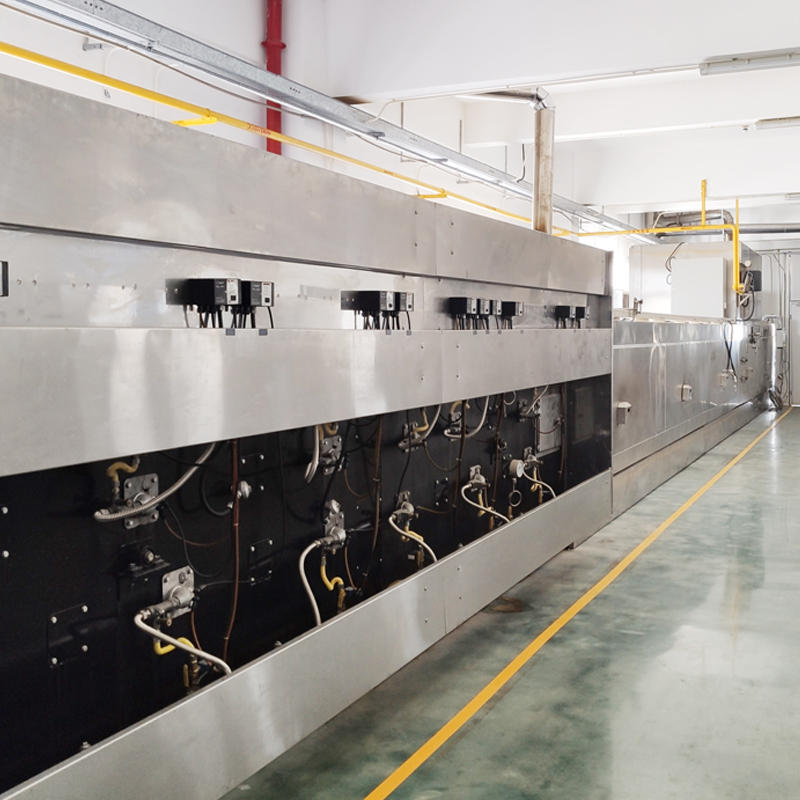
Direct gas fired ovens place burners directly in the baking chamber, so combustion products and radiant energy act directly on the dough pieces. This design is widely used for biscuits, crackers, and pizza, especially where high temperatures above 300 °C and strong radiant heat are needed. [asbe]
Typical characteristics of direct gas firing:
- Heat source: Gas flames and hot surfaces inside the tunnel. [asbe]
- Heat transfer: Dominated by radiation from the flames and refractory surfaces, with some convective component. [asbe]
- Control: Ribbon burners arranged above and below the band, each with controllable gas/air mix and pressure. [asbe]
- Response: Fast thermal response and strong heating power in the initial zones. [eastmanmanufacturing]
For extra‑wide biscuit lines, DGF is attractive because it can deliver high heat flux quickly to the full width of the band, reducing start‑up time and helping stabilize production at high throughput. [wenvamachine]
In an indirect heat exchange oven, the burners are outside the baking chamber, and heat is transferred via heat exchangers—typically tubular or duct systems that radiate and convect heat into the baking zone. The dough does not contact combustion products, which can be beneficial for flavor and emissions control. [bakerpacific]
Key characteristics of indirect systems:
- Heat source: Burners heat air and combustion gases in a closed circuit, which then flow through tubes or ducts. [bakerpacific]
- Heat transfer: Combination of indirect radiation from hot tubes and forced convection from fans. [mbico]
- Control: Central burners with zone‑wise air flow and exhaust control; often easier to integrate with modern automation. [mbico]
- Cleanliness: No direct flame in the chamber, which can help with flavor consistency and emissions compliance. [bakerpacific]
For modern automated lines, indirect radiant systems are often selected when plants prioritize high thermal efficiency, precise temperature control, and tighter standards for emissions or product flavor. [aocno]
From a baking science standpoint, the choice between direct gas firing and indirect heat exchange changes how the dough experiences heat in the first zones, which directly shapes oven spring and final texture. [bakerpedia]
- Direct gas fired:
- Very strong radiant heat in the top zones can cause rapid surface heating and gas expansion, creating more pronounced oven spring. [bakerpedia]
- If not carefully balanced with bottom heat and band conduction, this can lead to surface blistering or uneven lift across the width. [wenvamachine]
- Fast response allows fine tuning of the first zone to control rise, but it also amplifies operator error. [eastmanmanufacturing]
- Indirect heat exchange:
- More uniform radiant and convective heat provides a smoother temperature gradient in the dough piece. [mbico]
- Oven spring tends to be more controlled and gradual, which is ideal for thin hard biscuits where dimensional stability is critical. [iba-tradefair]
- Less risk of localized overheating from flames, reducing defects like excessive bubbling. [bakerpacific]
In practice, many high‑volume plants target a slightly lower, more controlled oven spring for hard biscuits, then rely on formulation and lamination to create eating quality rather than extreme expansion. Indirect systems typically make that easier to standardize. [mbico]
- Direct gas fired:
- Gives a stronger Maillard reaction and color development due to higher radiant heat and local gas composition. [eastmanmanufacturing]
- Produces a crisp, sometimes more brittle texture if the profile is skewed too hot in the early or middle zones. [iba-tradefair]
- Particularly suitable for products requiring a distinct roasted or toasted note, such as some crackers. [asbe]
- Indirect heat exchange:
- Promotes even color and more uniform crust hardness across the band, especially beneficial for wide ovens. [mbico]
- Can deliver a fine, consistent internal crumb structure, reducing breakage during conveying and packaging. [mbico]
- Often preferred when the brand promise is about color uniformity and subtle flavor rather than aggressive roast notes. [wenvamachine]
From an operator's perspective, indirect systems offer a wider "safe window" where small deviations in settings don't immediately show as product defects, which is important in plants facing staff turnover or multi‑SKU changeovers. [aocno]
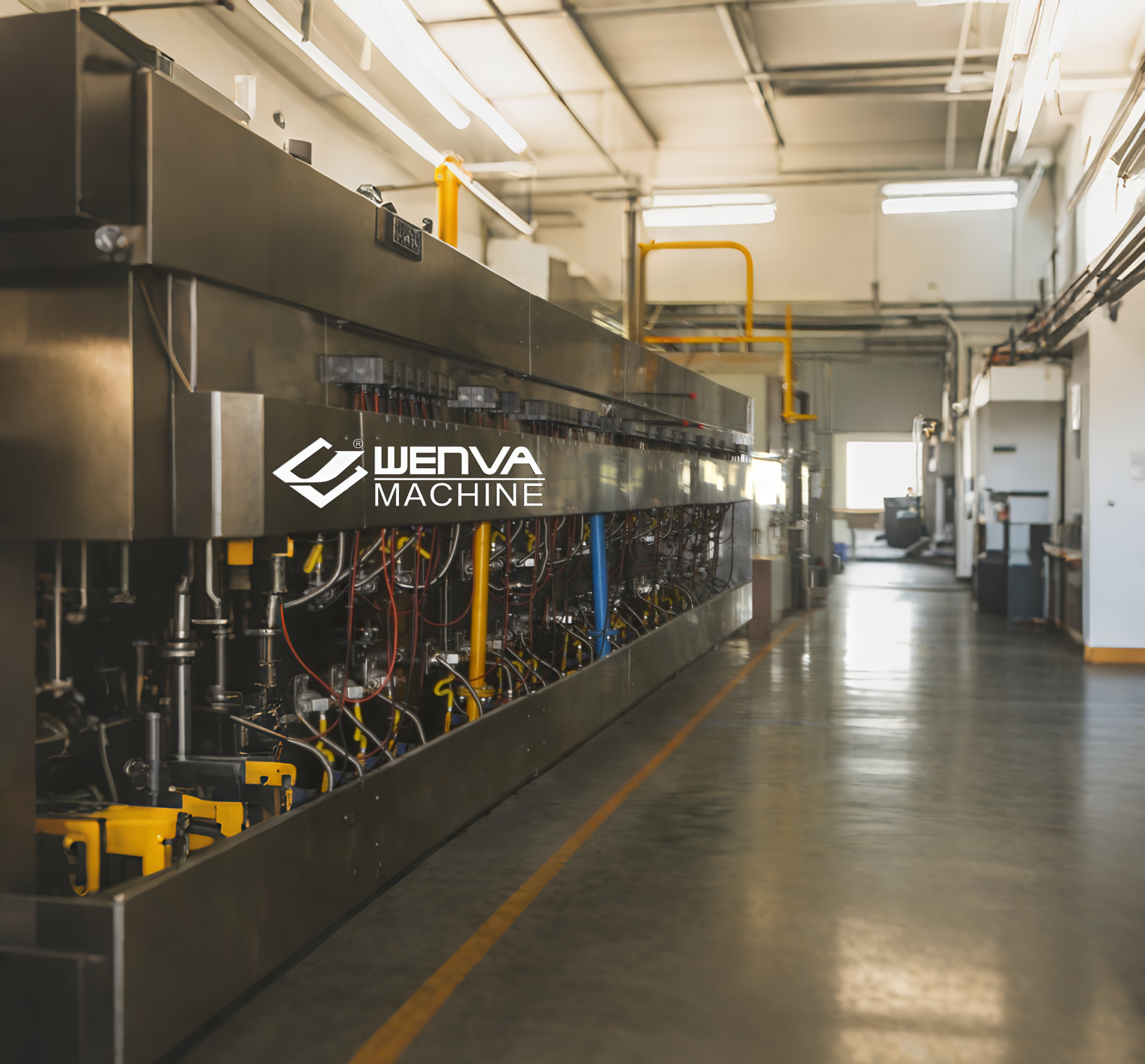
The table below summarizes key differences that process engineers and plant managers typically evaluate when specifying ovens for automated biscuit lines. [eastmanmanufacturing]
| Factor / Parameter | Direct Gas Fired Ovens | Indirect Heat Exchange Ovens |
|---|---|---|
| Primary heat transfer | Strong radiation from flames and hot surfaces (asbe) | Indirect radiation plus forced convection via exchangers (mbico) |
| Oven spring behavior | Higher, faster oven spring; risk of blistering if poorly tuned (bakerpedia) | More controlled, gradual oven spring; good dimensional stability (bakerpedia) |
| Texture profile | Very crisp, can be brittle if over‑baked (asbe) | Fine, uniform crumb; lower breakage risk (mbico) |
| Color and flavor | Strong color, roasted notes; sensitive to settings (asbe) | Uniform color, clean flavor; easier repeatability (mbico) |
| Start‑up behavior | Rapid heating and response (asbe) | Medium start‑up; more thermal inertia (eastmanmanufacturing) |
| Energy efficiency | High heat flux; efficiency depends on insulation and exhaust (asbe) | Generally high thermal efficiency and shorter baking times with good design (mbico) |
| Emissions in chamber | Combustion products in baking chamber (asbe) | No direct combustion products in chamber (asbe) |
| Best suited products | Crackers, hard biscuits with strong color, some pizzas (asbe) | Premium biscuits needing tight color/texture control (mbico) |
| Control complexity | Requires careful burner balancing zone by zone (asbe) | Centralized burner control; strong integration with automation (mbico) |
In recent years, more manufacturers have moved to hybrid tunnel ovens, combining direct gas fired zones with convection or indirect zones to fine‑tune texture and moisture removal. For hard biscuits, a common approach is to use direct gas firing in the first zone(s) to drive oven spring, then switch to convection or indirect radiant zones to complete drying and color development in a controlled way. [youtube]
This architecture offers several benefits:
- High energy input at start for gas expansion and early structure setting. [youtube]
- Gentle, even drying in later zones, reducing checking and internal stress. [youtube]
- Fine control of moisture profile along the tunnel, supporting longer shelf life and packaging integrity. [youtube]
For a supplier like Wenva Machine, hybrid ovens integrated in automated biscuit lines make it possible to support customers with multi‑product flexibility—from hard biscuits to crackers and even semi‑sweet biscuits—without compromising throughput. [wenvamachine]
The industrial biscuit equipment market has continued to grow, driven by automation, energy efficiency, and product innovation. Estimates suggest that industrial biscuit making machinery is experiencing around 5% CAGR through 2033, supported by investments in advanced baking and handling systems. At the same time, the wider bakery processing equipment market exceeded 13.1 billion USD in 2025, with strong demand expected through 2035. [gminsights]
On the technology side:
- Full‑line automation and vertical integration from mixing to packaging are becoming standard in 2026. [aocno]
- Remote monitoring and predictive maintenance are increasingly built into oven controls, enabling early detection of burner, fan, or exhaust issues. [aocno]
- Customers are asking for ovens that can balance energy efficiency, emissions, and product quality, which pushes manufacturers to refine indirect and hybrid solutions. [wenvamachine]
For Wenva Machine, positioning as a partner that can advise on firing technology selection—not just supply hardware—is becoming a key competitive advantage in this evolving landscape. [wenva]
As a content strategist and UX‑oriented advisor, I often recommend a structured decision framework so plant teams can evaluate oven options more confidently. Below is a practical step‑by‑step outline tailored to hard biscuit lines. [aocno]
1. Clarify your product portfolio.
- Are you focused on thin, hard biscuits with tight color tolerances, or do you also run crackers and pizza bases that need aggressive color and flavor? [iba-tradefair]
2. Define volume and width requirements.
- Extra‑wide lines (>1.5 m belt width) benefit from solutions that maintain uniform heat distribution across the full band. [wenvamachine]
3. Decide your quality priorities.
- If your priority is uniform color and low breakage, indirect or hybrid ovens have clear advantages. [bakerpedia]
- If you need a strong roast profile and high output, direct gas firing in early zones is often a better starting point. [asbe]
4. Assess energy and sustainability goals.
- Many plants now prioritize thermal efficiency and reduced fuel use, making modern indirect heat exchange solutions more attractive. [gminsights]
5. Consider automation and maintenance.
- Integrated controls, remote monitoring, and easier burner access reduce downtime and support predictive maintenance strategies. [smartcaresolutions]
6. Engage with an experienced line supplier.
- Working with a specialist that has decades of oven and line integration experience helps translate these requirements into concrete zone designs, burner layouts, and band types. [wenva]
Drawing on field implementations with global biscuit plants, several practical patterns emerge:
- Plants that switched from older direct‑fired ovens to modern indirect or hybrid ovens often report fewer complaints about color variation between center and edge biscuits, especially on wide bands. [wenvamachine]
- Energy audits frequently show that upgraded indirect systems, combined with better insulation and exhaust control, reduce overall energy consumption while maintaining or improving throughput. [gminsights]
- When launching new hard biscuit SKUs, R&D teams find it easier to scale up from pilot to production if the main line has precise zone‑by‑zone control, which is easier in well‑designed indirect or hybrid ovens than in older direct‑fired-only systems. [aocno]
From a UX perspective, operators consistently favor oven HMIs that visualize zone temperature, burner status, and exhaust conditions in a clear, color‑coded way, since this reduces training time and operators' cognitive load. That usability dimension is often overlooked, yet it directly affects the plant's ability to hold a tight texture and oven‑spring specification day after day. [smartcaresolutions]
As an automation‑focused biscuit line supplier, Wenva Machine can design complete solutions that optimize oven spring and texture, not just isolated oven hardware. The company's experience in mixing, forming, baking, cooling, and packaging allows them to tune each stage around the chosen firing technology. [wenva]
Key design principles include:
- Profile‑driven engineering: Baking curves are defined from the product backwards, then matched to direct, indirect, or hybrid zone designs. [iba-tradefair]
- Full‑width uniformity: Special attention to burner or exchanger placement and air flow in extra‑wide ovens to prevent uneven bake across the band. [wenvamachine]
- Integrated controls and data: Modern lines support recipe management, data logging, and alarms that help maintain the ideal oven‑spring window. [smartcaresolutions]
- Lifecycle support: Installation, commissioning, and training services ensure that plant teams can actually use the oven's capabilities to their full potential. [wenvamachine]
For customers, this means that the decision between direct gas and indirect heat exchange is made within a complete system context, so the final biscuits meet both quality and cost targets. [wenvamachine]
To make this actionable, here is a simplified guide you can use when discussing new projects or upgrades with stakeholders. [mbico]
- Choose direct gas fired if:
- You produce crackers or robust hard biscuits with strong color and flavor. [asbe]
- You need very high heat input and fast response, for example in plants running many short campaigns. [eastmanmanufacturing]
- Choose indirect heat exchange if:
- Your brand relies on tight color and texture uniformity, especially on wide lines. [bakerpedia]
- You prioritize cleaner baking atmosphere, emissions management, and high thermal efficiency. [gminsights]
- Choose hybrid ovens if:
- You need the flexibility to run hard biscuits, crackers, and other baked products on the same line. [youtube]
- You want strong initial oven spring plus gentle drying and moisture control later in the bake. [youtube]
If you are planning a new hard biscuit line or considering an oven retrofit, the most effective next step is a technical consultation that maps your products, layout constraints, and energy goals to a concrete oven concept. Wenva Machine's engineering team can model direct, indirect, and hybrid scenarios for your specific products, using actual throughput and cost targets, then propose an optimized solution that supports stable oven spring, uniform texture, and long‑term reliability. [wenva]
You can bring your current quality challenges—uneven bake, checking, breakage, or color variation—and use them as live case studies in a design workshop. From there, the right combination of firing technology, zone configuration, and controls can turn your oven from a constraint into a competitive advantage. [wenvamachine]
Q1: Why are hard biscuits more sensitive to oven type than other baked products?
Hard biscuits rely on a narrow balance between limited oven spring, controlled moisture removal, and a crisp yet not overly brittle texture, which makes them especially sensitive to the initial heat transfer mode. [bakerpedia]
Q2: Can I upgrade from a direct‑fired oven to an indirect system without changing the entire line?
In many cases, plants can retrofit specific zones or add new hybrid sections while keeping existing handling equipment, but feasibility depends on layout, ventilation, and controls. [wenvamachine]
Q3: Does indirect heat exchange always use less energy than direct firing?
Not always, but well‑designed indirect ovens with strong insulation and optimized air flows often achieve high thermal efficiency and shorter baking times, which can reduce energy per kilogram of product. [gminsights]
Q4: How does oven choice affect shelf life?
Ovens that enable consistent moisture profiles and avoid internal stress help reduce checking and breakage, which indirectly supports better shelf life and packaging performance. [mbico]
Q5: What data should I collect before talking to an oven supplier?
You should gather current product specs, throughput targets, fuel type, layout drawings, quality issues, and energy costs so the supplier can simulate realistic direct, indirect, and hybrid scenarios. [smartcaresolutions]
1. Bakerpedia – *Direct vs. Indirect Gas-fired Ovens for Baking*. – <https://bakerpedia.com/direct-vs-indirect-gas-fired-ovens-for-baking/> [bakerpedia]
2. ASB – *Direct Gas Fired Oven* (technical overview of DGF and IGF ovens). – <https://asbe.org/article/direct-gas-fired-oven/> [asbe]
3. MBICO – *The Definitive Engineer's Guide to Indirect Heat Oven Technology*. – <https://mbico.com/blog/guide-to-indirect-heat-oven-technology/> [mbico]
4. Baker Pacific – *Indirect Radiant Ovens & Direct Gas Fired Ovens – Technology Transfer*. – <https://bakerpacific.net/technology-transfer/> [bakerpacific]
5. Eastman Manufacturing – *4 Differences Between Direct and Indirect Gas-Fired Ovens*. – <https://eastmanmanufacturing.com/4-differences-between-direct-and-indirect-gas-fired-ovens/blog.html> [eastmanmanufacturing]
6. IBA Trade Fair – *Choosing the Perfect Baking Oven: Types, Features and Selection*. – <https://www.iba-tradefair.com/en/c/choosing-the-perfect-baking-oven-types-features-and-selection.62763> [iba-tradefair]
7. Wenva Machine – *Direct-Fired vs. Convection Tunnel Ovens: Solving the "Uneven Bake" Problem in Extra-Wide Biscuit Production Lines*. – <https://www.wenvamachine.com/direct-fired-vs-convection-tunnel-ovens-solving-the-uneven-bake-problem-in-extra-wide-biscuit-production-lines.html> [wenvamachine]
8. Wenva Machine – *The Future of Biscuit Production Lines: Trends To Watch*. – <https://www.wenvamachine.com/the-future-of-biscuit-production-lines-trends-to-watch.html> [wenvamachine]
9. AOCNO – *Industrial Bakery Automation: Top 5 Trends Scaling Production in 2026*. – <https://www.aocno.com/Industrial-Bakery-Automation-Top-5-Trends-Scaling-Production-in-2026-id47561365.html> [aocno]
10. Global Market Insights – *Bakery Processing Equipment Market Size & Growth Analysis 2026–2035*. – <https://www.gminsights.com/zh/industry-analysis/bakery-processing-equipment-market> [gminsights]
11. Data Insights Market – *Industrial Biscuit Making Machine Market Predictions and Forecast*. – <https://www.datainsightsmarket.com/reports/industrial-biscuit-making-machine-1578334> [datainsightsmarket]
12. Wenva Machine – Corporate website and company profile. – <http://www.wenva.net> [wenva]
13. SENIUS (YouTube) – *Direct Gas Fired and Hybrid Ovens* (application to hard biscuits). – <https://www.youtube.com/watch?v=pgMrA6zp2sg> [youtube]
14. Smart Care Solutions – *Types of Ovens Compared – What's the Difference?* – <https://smartcaresolutions.com/resources/blog/whats-the-difference-comparing-types-of-ovens/> [smartcaresolutions]


