
Views: 222 Author: Wenva Machine Publish Time: 2026-05-19 Origin: Site


After four decades engineering automated biscuit production lines, I've witnessed countless production managers struggle with the same frustrating challenge: uneven baking across extra-wide production bands. The culprit often isn't the recipe or the dough formulation—it's the fundamental heat transfer mechanism of your tunnel oven. This comprehensive comparison explores how direct-fired tunnel ovens and convection tunnel ovens tackle the notorious "uneven bake" problem differently, helping you select the optimal baking technology for wide-format biscuit manufacturing. [foodsmachine]

Uneven baking manifests as inconsistent coloration, texture variations, and disappointing taste profiles across your biscuit batches. In extra-wide production lines (exceeding 1200mm band width), this problem intensifies exponentially. Temperature gradients develop across the oven chamber, creating hot zones near burner locations and cooler zones toward the band edges. [foodsmachine]
The root causes include inadequate airflow management, inconsistent heat distribution mechanisms, and improper product loading patterns. When your oven cannot maintain uniform temperature across a wide baking chamber, edge biscuits emerge pale and underbaked while center products darken prematurely. This quality inconsistency translates directly to increased waste rates, customer complaints, and damaged brand reputation. [foodsmachine]
Direct gas-fired (DGF) ovens position ribbon burners directly inside the baking chamber, creating flames that radiate energy immediately to the product surface. This configuration eliminates heat exchangers entirely, delivering near 100% thermal efficiency by converting fuel to heat without intermediary components. [ch-polka]
The combustion occurs within the baking environment itself, with burners typically arranged above and below the conveyor band. Each burner receives a precisely controlled gas-air mixture, where pressure and flow rate determine combustion intensity and temperature output. Negative pressure combustion principles ensure operational safety while suction channels on both sides extract humid air continuously. [biscuitmakingline]
Direct-fired systems excel at delivering rapid heat-up and recovery times, reaching target temperatures significantly faster than indirect alternatives. This capability proves invaluable for high-volume lines with frequent product changeovers. The combination of radiant heat from flames and conductive heat from the belt creates "flash heat" that generates superior dough spring—critical for products requiring dramatic expansion. [ch-polka]
For extra-wide production, DGF ovens offer multi-zone independent control, allowing operators to adjust individual burner banks across the band width. This zonal flexibility helps compensate for natural heat distribution challenges in wide chambers. When calibrated correctly, you can create customized temperature profiles that address edge-to-center variations effectively. [ch-polka]
Despite their thermal efficiency, direct-fired ovens present temperature uniformity challenges in extra-wide configurations. The point-source nature of burner flames creates localized hot spots, particularly directly beneath or above burner positions. Without sophisticated airflow management, these thermal variations propagate across the baking chamber. [eastmanmanufacturing]
Additionally, DGF systems expose products directly to combustion gases, which some operations find undesirable for certain product categories. The aggressive radiant heat transfer, while excellent for products requiring high temperatures above 300°C, may prove excessive for delicate biscuit formulations requiring gentler, more balanced heating. [asbe]
Convection tunnel ovens fundamentally differ by utilizing forced air circulation as the primary heat transfer method. In these systems, combustion occurs in separate heat exchangers positioned away from the baking chamber. Clean, heated air is then circulated through strategically designed plenums above and below the conveyor band. [making]
The Meincke Turbu 4.0 from Bühler Group exemplifies advanced convection technology, featuring a double damper mechanism that optimizes burner heat for energy efficiency. Air preheats in external heat exchangers, ensuring zero combustion gas contact with products—a critical advantage for food safety and product purity. [making]
Convection systems achieve exceptional temperature uniformity through comprehensive airflow design. Fans circulate hot air continuously, with velocity and direction control ensuring even heat distribution across the entire band width. This eliminates the hot-spot problem inherent to direct-fired configurations. [readingbakery]
For extra-wide production lines, convection ovens incorporate independent top and bottom heat control with precise temperature management in every zone. This dual-plane temperature regulation prevents the uneven baking that occurs when top and bottom heat drift out of synchronization. The circulating air also efficiently removes moisture released during baking, supporting consistent texture development. [bakingbiscuit]
Convection ovens require longer heat-up times compared to direct-fired units, as the system must heat both the air and the heat exchanger materials before reaching operational temperatures. This translates to increased energy consumption during startup and potentially longer baking times. [asbe]
Thermal efficiency is inherently lower in indirect systems, as energy dissipates through exchanger materials rather than transferring directly to products. Production capacity may also be constrained, as the additional space required for heat exchangers and blower systems increases oven footprint. [eastmanmanufacturing]
| Factor | Direct-Fired Tunnel Oven | Convection Tunnel Oven |
|---|---|---|
| Thermal Efficiency | Near 100% fuel-to-heat conversion | Lower due to heat exchanger losses asbe |
| Heat-Up Time | Rapid startup, fast temperature recovery | Slower startup, medium recovery eastmanmanufacturing |
| Temperature Uniformity | Challenging across wide bands, requires zonal calibration eastmanmanufacturing | Excellent uniformity through forced air circulation |
| Product Contact | Direct combustion gas exposure bakerpedia | Zero combustion gas contact |
| Multi-Zone Control | Independent burner bank adjustment | Precise damper and airflow control |
| Energy Consumption | Lower operational costs | Higher due to extended baking times asbe |
| Ideal Product Types | High-temperature products (>300°C), crackers, flatbreads asbe | Delicate biscuits, cookies, cakes requiring balanced heat |
| Maintenance Requirements | Moderate burner servicing biscuitmakingline | Heat exchanger cleaning, blower maintenance eastmanmanufacturing |
To maximize uniformity in wide direct-fired ovens, implement aggressive oven calibration protocols. Monitor temperature distribution across all oven chambers using multiple measurement points spanning the band width. Adjust individual burner zones to compensate for edge-to-center variations, creating customized thermal profiles. [foodsmachine]
Install automatic tray rotation systems if using discrete trays, ensuring products receive equal heat exposure throughout the baking cycle. For continuous band operations, optimize product loading patterns to maintain consistent spacing and density across the width. [foodsmachine]
Enhance airflow management by adjusting blower speeds and suction channel configurations. The speed of air circulation directly impacts temperature distribution—increasing velocity can help homogenize heat across wide chambers, though excessive airflow may cause undesirable surface drying. [biscuitmakingline]
Convection ovens demand precise airflow velocity calibration to achieve optimal results. The operator controls moisture removal rates by managing exhaust settings, air temperature, and circulation velocity simultaneously. This three-variable adjustment allows for exceptional control over both color development and texture. [readingbakery]
Leverage programmable baking profiles to store optimal settings for different product categories. Modern convection systems like the PRISM OVEN feature customizable temperature, humidity, and timing parameters that ensure consistent repeatability. [readingbakery]
For products requiring both development and drying phases, utilize hybrid zone configurations that blend radiant and convection heat transfer. SMART Zone technology allows flexible switching between pure radiation, pure convection, or combination modes, optimizing heat delivery for each baking stage. [readingbakery]
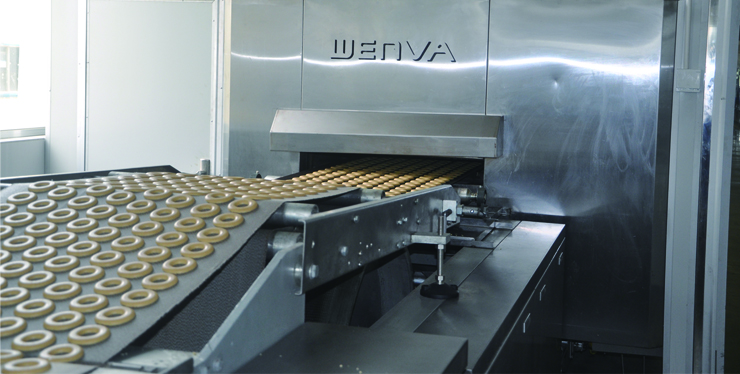
Progressive manufacturers increasingly adopt hybrid oven designs that combine direct gas-fired zones with convection zones in a single tunnel. This approach deploys DGF zones for initial product development and rapid cooking, while convection zones handle efficient moisture removal and balanced coloring. [readingbakery]
The Thomas L. Green PRISM OVEN exemplifies this philosophy, offering flexible single-pass baking with combinations of direct gas-fired, convection, and radiant/convection zones. By strategically positioning each heating method along the baking tunnel, you achieve cost-effective production with superior quality control. [readingbakery]
For extra-wide production specifically, hybrid configurations allow you to address the strengths and limitations of each technology. Use direct-fired zones where rapid heat transfer is critical, then transition to convection zones where uniformity becomes paramount as products set and color develops.
Based on our 40 years manufacturing automated biscuit production lines, we recommend convection tunnel ovens for extra-wide production lines where uniformity is the top priority. The superior air circulation inherently solves edge-to-center temperature variations that plague wide chambers.
However, for operations producing high-temperature specialty products (crackers, flatbreads, fermented biscuits requiring aggressive oven spring), direct-fired systems deliver unmatched performance despite requiring more intensive calibration. [bakerpedia]
Consider these decision criteria:
1. Product portfolio diversity: Hybrid systems offer maximum flexibility when producing multiple product types on the same line
2. Energy cost structure: Direct-fired systems minimize operational utility expenses [ch-polka]
3. Quality specifications: Products with stringent color uniformity requirements benefit from convection technology
4. Production volume: High-throughput operations maximize the ROI of efficient direct-fired systems [ch-polka]
5. Regulatory environment: Convection ovens eliminate combustion gas contact concerns [making]
Regardless of oven type, implementing real-time temperature monitoring systems dramatically improves uniformity. Advanced sensors enable continuous product surface temperature measurement, contributing to precise control and uniform results across the band width. [readingbakery]
Smart controls facilitate remote monitoring and adjustments, allowing operators to respond immediately to temperature deviations before they impact product quality. Data analytics platforms can identify subtle drift patterns, enabling predictive maintenance before uniformity degrades. [readingbakery]
Computational fluid dynamics (CFD) software helps engineers design ovens with optimized airflow patterns and temperature control. This advanced modeling technology predicts heat distribution in wide chambers, guiding burner placement, plenum design, and exhaust configurations for maximum uniformity. [scribd]
While direct-fired ovens deliver superior fuel efficiency, total cost of ownership calculations must consider multiple factors. Convection systems typically require higher initial capital investment due to complex heat exchanger and blower systems. [eastmanmanufacturing]
Operational energy costs favor direct-fired technology, as the elimination of heat exchangers reduces thermal losses and enables shorter baking times. However, convection ovens may reduce waste rates through superior uniformity, potentially offsetting higher energy consumption through improved yield. [asbe]
Maintenance expenses differ significantly: direct-fired systems require regular burner servicing and flame safety system inspection, while convection units demand heat exchanger cleaning and blower component replacement. Factor these ongoing costs into your equipment selection process alongside energy and capital considerations. [biscuitmakingline]

Q1: Can I retrofit my existing direct-fired oven to improve uniformity across wide bands?
Yes, several retrofit strategies can enhance uniformity. Install additional burner zones across the band width for finer temperature control, upgrade to programmable multi-zone controllers, implement advanced airflow management systems with adjustable blowers, and add comprehensive temperature monitoring with multiple sensors spanning the chamber width. [foodsmachine]
Q2: What band width is considered "extra-wide" for biscuit production?
Industry standards generally classify production lines exceeding 1200mm (47 inches) band width as extra-wide configurations. At these dimensions, heat distribution challenges intensify, requiring advanced oven technologies and careful calibration to maintain uniformity. Custom solutions exist for band widths up to 2000mm for specialized applications.
Q3: How do baking times compare between direct-fired and convection ovens?
Direct-fired ovens typically achieve shorter baking times due to aggressive radiant heat transfer and rapid temperature response. Convection ovens require medium to longer baking times as heat transfers more gradually through circulating air. However, total production time differences may be minimal when factoring in startup procedures and product changeover requirements. [asbe]
Q4: Which oven type is better for soda crackers and fermented biscuits?
Soda crackers are a notable exception to convection oven advantages, as they specifically require direct heating in early baking stages to achieve proper expansion and texture development. Direct-fired or hybrid systems with initial DGF zones perform optimally for these products. Most other fermented biscuits benefit from the balanced heat treatment convection systems provide. [bakerpedia]
Q5: How does oven selection impact product shelf life and quality retention?
Consistent baking temperature and uniform moisture removal directly influence shelf life stability. Convection ovens' superior uniformity typically produces more consistent moisture content across batches, supporting predictable shelf life performance. Direct-fired ovens can achieve comparable results with intensive calibration, but require more frequent monitoring to maintain consistency over time. [foodsmachine]
1. Making.com - Industrial tunnel oven for biscuits and cakes: https://making.com/equipment/industrial-tunnel-oven-for-biscuits-and-cakes
2. Golden Bake - Biscuit Production Line Comprehensive Troubleshooting Guide: https://www.foodsmachine.net/a-news-biscuit-production-line-a-comprehensive-troubleshooting-guide.html
3. Polka - Direct Fire Tunnel Oven Industrial Bakery Ovens: https://www.ch-polka.com/direct-fire-tunnel-oven
4. Baking+Biscuit - Efficient baking assignment thermal oil tunnel ovens: https://bakingbiscuit.com/efficient-baking-assignment-thermal-oil-tunnel-ovens/
5. ASBE - Direct Gas Fired Oven: https://asbe.org/article/direct-gas-fired-oven/
6. BAKERpedia - Direct vs Indirect Gas-fired Ovens for Baking: https://bakerpedia.com/direct-vs-indirect-gas-fired-ovens-for-baking/
7. Eastman Manufacturing - Gas Fired-Ovens Or Indirect Gas-Fired Ovens: https://eastmanmanufacturing.com/gas-fired-ovens-or-indirect-gas-fired-ovens/blog.html
8. Golden Bake - Factors Affecting Baking Oven Efficiency in Biscuit Production: https://www.foodsmachine.net/fr/factors-affecting-baking-oven-efficiency-in-biscuit-production.html
9. Reading Bakery Systems - How to Optimize Baking Quality with Industrial Ovens: https://www.readingbakery.com/resources/how-to-optimize-baking-quality-with-industrial-ovens.html
10. Reading Bakery Systems - Tunnel Oven Technologies: https://www.readingbakery.com/resources/tunnel-oven.html
11. Biscuit Making Line - Gas Fired Tunnel Oven for biscuits: http://biscuitmakingline.com/4-2-gas-fired-tunnel-oven.html
12. Scribd - Optimizing Biscuit Baking Ovens: https://www.scribd.com/document/479837880/Banishing-the-Black-Arts


