
Views: 222 Author: Wenva Machine Publish Time: 2026-05-17 Origin: Site
As a manufacturer evaluating new equipment, you are probably asking a very practical question: is a hybrid biscuit production line that handles both hard and soft biscuits really efficient, or is a dedicated line still the smarter long‑term investment? From my experience working with industrial bakeries and drawing on Wenva Machine's nearly 40 years in automated biscuit production, the answer is: it depends on your product mix, capacity roadmap, and engineering discipline in line design. [hg-machine]
A hybrid biscuit production line is designed to run both hard biscuits (e.g. soda, Marie, crackers) and soft biscuits (e.g. shortbread, butter cookies) on the same core infrastructure, usually by switching forming modules, baking profiles, and sometimes cooling and packaging recipes. A dedicated biscuit line is optimized around one main product family—either hard or soft—so everything from dough make‑up to tunnel oven and cooling is tuned to that specific texture and throughput. [bakingeurope]
In modern plants, both models are used side by side: hybrid lines for flexibility and product development, dedicated lines for high‑volume "workhorse" SKUs. Wenva Machine has supplied more than 300 biscuit production lines globally, which gives a clear view of how each approach performs in real factories over many years. [wenva]
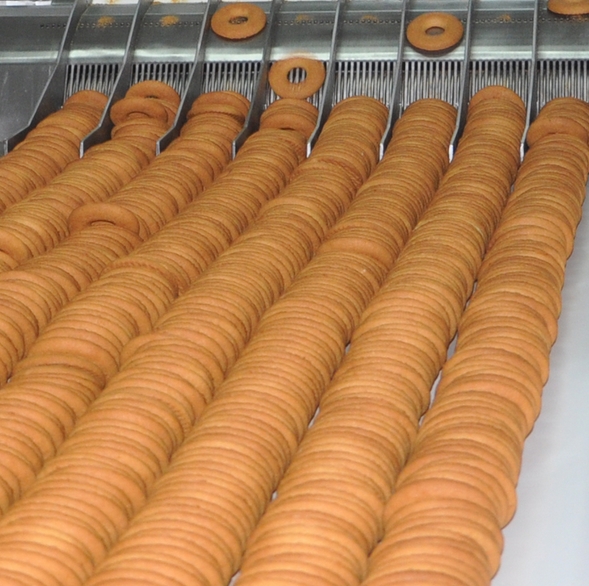
Hard biscuits require lower fat, lower sugar, and tighter doughs with controlled gluten development, often using lamination and sheeting with rotary cutters or embossing molds. Soft biscuits use higher fat and sugar, with more aeration and shorter gluten development, and are typically formed by wire‑cutting, depositing, or rotary molder systems. [hg-machine]
Because of this, a hybrid line must integrate compatible dough handling technologies (e.g. sheeter + rotary molder + wire‑cut/ depositor options), while a dedicated line can be engineered around one forming principle with narrower parameter windows. Poorly integrated forming on a hybrid line often shows up as inconsistent weight control, spread, or surface definition when switching recipes. [bakingeurope]
Hard biscuits generally need longer bake times, higher final moisture removal, and precise color control across multiple oven zones. Soft biscuits need gentler, shorter bakes to protect crumb structure, fat phase, and eating quality. [hg-machine]
A hybrid oven therefore relies on multi‑zone tunnel designs with independently controlled temperature, airflow, and exhaust, so you can store and recall distinct baking profiles for each product. Dedicated lines can simplify and optimize the oven layout (e.g. zone lengths, burner distribution) around one family, often gaining 3–5% efficiency and more stable color uniformity at very high speeds. [senymachinery]
From an engineering standpoint, yes, one well‑designed hybrid line can run both hard and soft biscuits with high efficiency, but only if you manage four levers carefully: forming flexibility, oven control, changeover discipline, and maintenance. Modern modular equipment, such as interchangeable formers and flexible extruder designs, has been explicitly developed to support multi‑style production in a single installation. [foodsmachine]
However, there is always a trade‑off: hybrid lines typically sacrifice a portion of maximum throughput and some simplicity in exchange for SKU flexibility. In practice, most plants see hybrid lines as a strategic tool for varied portfolios, not as a universal replacement for high‑output dedicated lines. [biscuitpeople]
Below is a practitioner‑level view of how the two models compare across the dimensions that matter most to plant managers and owners.
Table – Hybrid vs. Dedicated Biscuit Production Lines
| Dimension | Hybrid biscuit line | Dedicated biscuit line |
|---|---|---|
| Product flexibility | High – supports hard and soft biscuits with changeovers. hg-machine | Low–medium – optimized for one product family. hg-machine |
| Capex (initial) | Often lower than buying two separate lines. bakingeurope | Higher if you need two lines for two product types. biscuitpeople |
| Opex per kg | Slightly higher due to more complex setups and cleaning. bakingeurope | Lower at scale; better energy and labor efficiency. hg-machine |
| Throughput | Medium–high; limited by compromise design and changeover time. hg-machine | Very high for the target SKU; can run near nameplate speed. hg-machine |
| Changeover time | Higher due to mold, tooling, and recipe change. bakingeurope | Minimal if staying within one product family. hg-machine |
| Quality consistency | High, but requires strict SOPs for multi‑recipe control. hg-machine | Very high; narrow process window is easier to stabilize. hg-machine |
| Future SKU expansion | Strong; easy to test new shapes and recipes. bakingeurope | Limited; expansions may need new modules or a new line. foodsmachine |
| Operator skill demand | Higher; operators must manage more setups and recipes. hg-machine | Moderate; operations more routine and standardized. hg-machine |
For a manufacturer with 3–6 main SKUs spanning both hard and soft categories, a hybrid line often yields the best ROI; for companies with 1–2 extremely high‑volume SKUs, dedicated lines usually win on cost per kilogram and uptime. [biscuitpeople]
A hybrid configuration is usually a better fit when:
- You are building or upgrading your first automated line, and demand for each biscuit type is still developing. [bakingeurope]
- You serve multiple export markets that require different shapes, textures, and packing formats in smaller to medium batch sizes. [foodsmachine]
- You need a "pilot plus production" platform: a line that supports R&D trials while still delivering commercial volumes. [bakingeurope]
- You want to reduce investment risk, validating which SKUs scale before committing to a second dedicated line. [biscuitpeople]
In these conditions, the additional complexity of a hybrid solution is offset by higher asset utilization and faster response to customer requests.
From an expert perspective, the following design elements make or break a hybrid biscuit line:
- Modular forming station – quick‑change rotary molder/wire‑cut/depositor tooling for hard and soft doughs. [hg-machine]
- Wide‑range tunnel oven – multi‑zone control with recipe storage for different baking curves. [hg-machine]
- Hygienic, accessible layout – tools and belts easy to clean between high‑sugar soft doughs and low‑moisture hard biscuits. [foodsmachine]
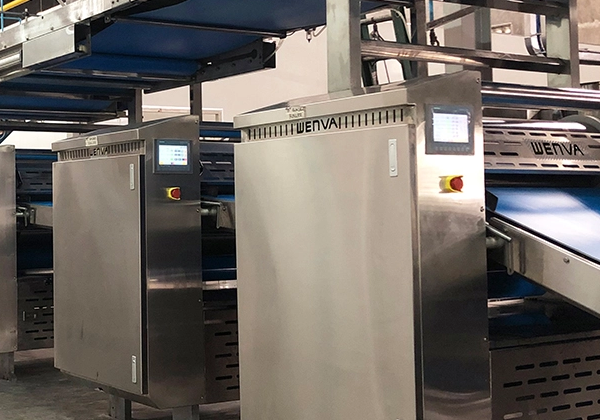
- Integrated control system – centralized HMI with pre‑set programs for each SKU to reduce human error. [bakingeurope]
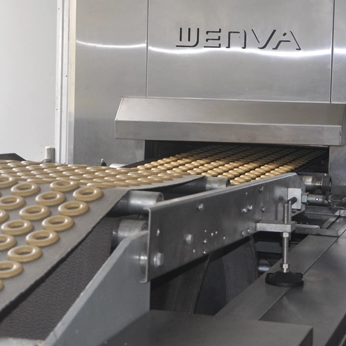
Wenva's fully automatic lines, for example, combine dough mixers, forming machines, tunnel ovens, cooling conveyors, and packaging systems in a single architecture, which simplifies hybrid design and commissioning from layout to after‑sales support. [wenvamachine]
Dedicated lines continue to be the benchmark for:
- Single product families with very high annual volumes (e.g. national soda biscuit brands or core sandwich biscuits). [biscuitpeople]
- Highly standardized supply contracts where unplanned downtime or variability is unacceptable. [hg-machine]
- Plants with limited changeover tolerance, for example due to strict allergen segregation or very lean staffing. [foodsmachine]
Because every component is tailored for one target product, dedicated lines often deliver higher line speeds, reduced scrap, and lower energy per kilogram, especially when paired with heat recovery systems and optimized drive technology. [senymachinery]
Over a 10‑ to 15‑year equipment lifecycle, dedicated lines typically produce more tons per line and require less complex cleaning and maintenance strategies. Spare parts inventories can also be simpler, and operator training more focused. [foodsmachine]
Many global biscuit manufacturers therefore adopt a hybrid + dedicated strategy: start with a hybrid line to grow the portfolio, then add one or more dedicated lines once certain SKUs pass the volume threshold.
Drawing on Wenva Machine's decades of projects across Asia, Africa, South America, and the Middle East, the most successful investments always begin with a rigorous feasibility study rather than a generic "hybrid or dedicated" decision. [youtube]
1. Map your current and forecast product mix
- Hard vs. soft biscuits, shapes, SKUs, and their projected 3‑ to 5‑year volumes. [biscuitpeople]
2. Define performance targets
- Required hourly throughput, OEE, planned changeovers per week, and acceptable scrap rate.
3. Audit factory layout and utilities
- Available footprint, ceiling height, electrical supply, gas, and ventilation capacity. [hg-machine]
4. Quantify changeover and cleaning constraints
- How many changeovers per day are realistic with your workforce and hygiene rules? [bakingeurope]
5. Simulate production scenarios
- Use digital tools or spreadsheet models to compare hybrid vs. dedicated line utilization at different volume assumptions. [bakingeurope]
6. Calculate lifecycle cost, not just capex
- Include energy consumption, labor, maintenance, and planned upgrades over at least 10 years. [senymachinery]
Wenva's engineering team often conducts this analysis jointly with customers at their production line experience center, using real equipment configurations and test runs to validate assumptions. [wenvamachine]
Industry data and trade‑fair launches show a clear push towards automation and modular equipment in biscuit production. New extruder and depositor technologies feature interchangeable dies and cutting systems, allowing one platform to handle wire‑cut, co‑extruded, filled, and continuous products at up to hundreds of strokes per minute. [foodsmachine]
At the same time, manufacturers are investing in connected, data‑driven lines: integrating ovens, proofers, and packaging with MES/ERP for real‑time monitoring, traceability, and predictive maintenance. This trend favors hybrid lines, because their flexibility is fully utilized when combined with robust digital recipe and performance management. [foodsmachine]
Rising energy costs and sustainability commitments make oven design and heat recovery critical to total cost of ownership. Modern lines use features such as exhaust heat recovery, variable frequency drives, and fine‑tuned insulation to cut kWh per kilogram while stabilizing product quality. [senymachinery]
Whether you choose hybrid or dedicated, selecting a vendor with proven energy‑efficient baking technology and experience in your product segment is now as important as mechanical reliability.
Consider a mid‑sized biscuit manufacturer in Southeast Asia expanding from a domestic hard biscuit range into export‑oriented soft butter cookies. Initial demand for the new soft biscuits is promising but still volatile across markets. [wenva]
Working with Wenva Machine, the company invests in a hybrid line capable of:
- Running traditional hard crackers at competitive throughputs
- Switching to premium soft butter cookies and co‑extruded products in shorter campaigns
- Integrating with existing packaging formats while leaving space for future upgrades [youtube]
Over several years, once export orders for specific soft biscuit SKUs stabilize, the plant then justifies a second dedicated soft‑biscuit line, while the original hybrid line shifts towards innovation and seasonal products.
If you produce a diversified but still evolving biscuit portfolio, a well‑engineered hybrid line can absolutely handle both hard and soft biscuit molds efficiently, provided you commit to robust design, recipe management, and operator training. If one or two SKUs dominate your volume and margins, at least one dedicated line will usually deliver better long‑term cost per kilogram and uptime. [biscuitpeople]
To avoid over‑ or under‑investing, your next step should be to engage an experienced biscuit line specialist to model your demand scenarios, line configurations, and lifecycle costs. Wenva Machine's engineering and application teams are equipped to support everything from layout design and test baking to installation, commissioning, and after‑sales optimization. [youtube]
Call to action:
If you are considering whether a hybrid or dedicated biscuit production line is right for your plant, contact Wenva Machine's engineering team to schedule a technical consultation and feasibility assessment based on your actual SKUs, capacity targets, and factory layout. [wenvamachine]
Q1. Can I upgrade an existing hard biscuit line to a hybrid configuration?
In many cases, yes, by retrofitting additional forming modules, expanding control recipes, and optimizing oven zones, but a detailed mechanical and thermal assessment is essential before committing to upgrades. [hg-machine]
Q2. How often can I realistically switch between hard and soft biscuits on a hybrid line?
Well‑designed hybrid lines can support multiple changeovers per week, but most plants limit major product family changes to a few times per week to control cleaning time and minimize scrap. [bakingeurope]
Q3. Will a hybrid line compromise biscuit quality compared with dedicated lines?
With precise process control, appropriate tooling, and well‑validated recipes, hybrid lines can match dedicated lines in quality for most products, though extreme high‑speed SKUs may still favor dedicated systems. [biscuitpeople]
Q4. What is the typical payback period for a new hybrid biscuit line?
Depending on capacity, energy costs, and labor savings, payback is commonly targeted in the 3–5 year range, similar to dedicated lines, but actual ROI depends strongly on how well you utilize the line's flexibility. [senymachinery]
Q5. Why work with Wenva Machine for hybrid or dedicated lines?
Wenva Machine brings almost 40 years of biscuit line design, more than 300 installed lines, a global service network, and a physical production line experience center where you can test products and validate configurations before investing. [wenva]
1. Inside a Modern Biscuit Production Line – Equipment, Process Control and Efficiency. *HG‑Machine* (2026). [Link] [hg-machine]
2. Customized Biscuit Production Line, Dough Mixer, Tunnel Oven – Company Profile. *Wenva Machine* (2025). [Link] [wenvamachine]
3. Industrial Biscuit Production Faces Automation Push. *Baking Europe* (2025). [Link] [bakingeurope]
4. Production Line Series – Wenva Machine. *Wenva* (2024). [Link] [wenva]
5. About Us – Yangjiang Ronghua Yuandong Industrial Co., Ltd. *Wenva Machine* (n.d.). [Link] [wenva]
6. Efficient Biscuit Production Line: The Best Choice. *Seny Machine* (2025). [Link] [senymachinery]
7. What Are the Latest Technologies in Biscuit Production Line Manufacturers. *Foodsmachine* (2025). [Link] [foodsmachine]
8. Wenva Fully Automatic Biscuit Production Line – Corporate Video. *YouTube* (2014). [Link] [youtube]
9. The Advantages of Cookie Production Lines for Large Companies. *Biscuit People* (2023). [Link] [biscuitpeople]
10. Wenva Machinery – Professional Manufacturer of Biscuit Production Lines. *YouTube* (2026). [Link] [youtube]
x


