
Views: 222 Author: Wenva Machine Publish Time: 2026-05-09 Origin: Site
A rotary biscuit moulder and a dough sheeter serve different but highly complementary roles in an automated biscuit production line, and choosing between them depends on your product portfolio, dough types, and automation strategy. From an equipment integrator's perspective, most modern plants actually need both machines, configured and tuned to work together in a stable, high‑yield process. [wenvamachine]
In industrial biscuit manufacturing, rotary biscuit moulders and dough sheeters are two of the most critical forming solutions on the line. Although they may look similar to non‑specialists, they are engineered for very different tasks and dough behaviors. As a biscuit production line manufacturer with nearly 40 years of experience, Wenva Machine has seen many factories over‑ or under‑invest in one of these machines simply because the real differences were not clearly explained in practical, engineering language. [studocu]
From my experience working with biscuit plants upgrading to fully automatic lines, I always start by asking three questions:
1) What biscuit types are you producing now?
2) What products do you plan to launch in the next 3–5 years?
3) What level of automation and changeover flexibility do you expect?
Your answers to these questions will usually determine whether the rotary moulder or the dough sheeter plays the leading role in your line design.

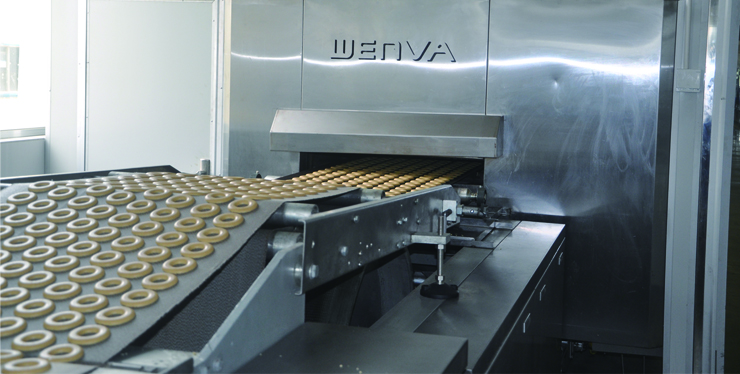
A rotary biscuit moulder is a specialized forming machine designed to turn short, relatively low‑hydration biscuit dough into precise, repeatable shapes at industrial speeds. In a typical line, it sits after the mixer and feed system, directly shaping dough pieces that will go to the baking oven. [wenvamachine]
Rotary moulders are especially suited to:
- Short dough biscuits (plain, sweet, or semi‑sweet)
- Cookies and simple sandwich biscuit shells
- Decorative or branded biscuits that require logo or pattern embossing [foodsmachine]
Because short dough behaves more like damp sand than elastic bread dough, it does not sheet well over multiple passes; the rotary moulding process handles this texture reliably.
In a standard configuration, the rotary biscuit moulder uses a feed roller, a moulding (die) roller, and a pressure roller to form pieces. [studocu]
Typical sequence:
1. Dough feed – A hopper feeds short dough onto the feed roller.
2. Compression and moulding – The dough is pressed into mould cavities on the rotary drum (die roller) under controlled pressure.
3. Extraction – A web or knife system releases formed dough pieces onto the conveyor, ready for baking. [foodsmachine]
The key to stable operation is matching dough consistency, roller speed, and extraction settings. Experienced operators quickly learn that small adjustments in dough moisture or fat content can significantly affect extraction and weight control. [studocu]
From a plant manager's standpoint, the rotary biscuit moulder offers several high‑value advantages: [foodsmachine]
- High throughput for short dough biscuits at consistent piece weight
- Excellent detail and branding thanks to custom engraved dies
- Stable automation with minimal manual handling between mixing and baking
- Fast, repeatable production once parameters are set
For factories focused on one or several core biscuit SKUs, this machine often becomes the "workhorse" of the line.
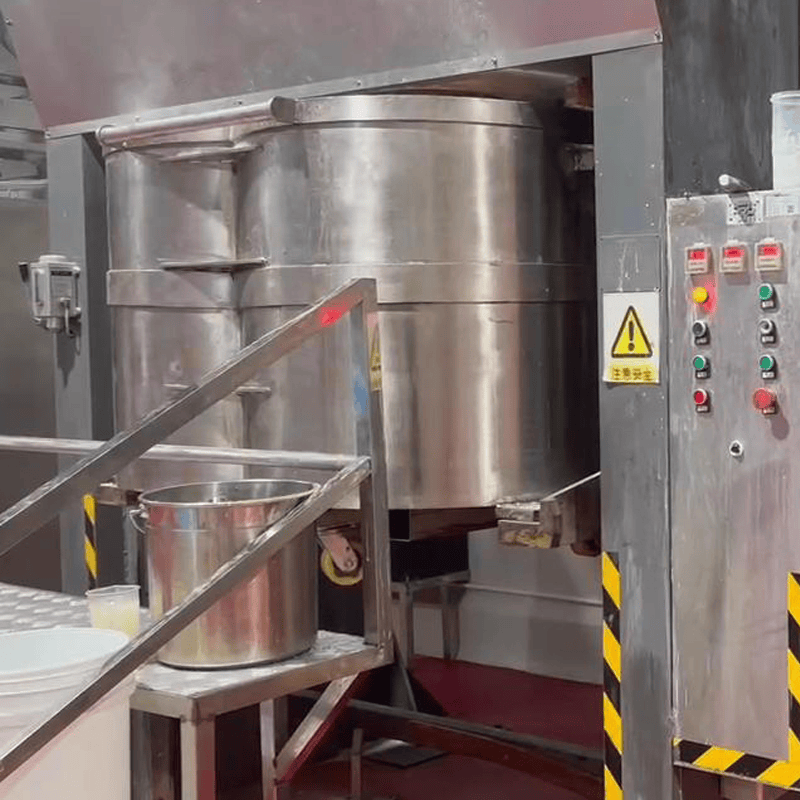
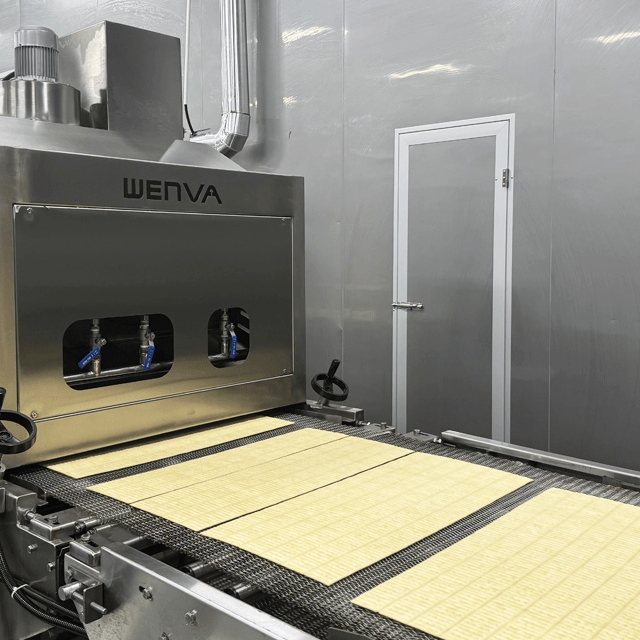
A dough sheeter's main job is to transform dough into a continuous sheet of controlled thickness, width, and length. Unlike the rotary moulder, it is not a final shaping machine; it prepares the sheet that will be further cut, laminated, or formed. [vrsupply]
Dough sheeters handle a wider variety of dough types, including:
- Laminated dough for crackers and puff biscuits
- Pastry and croissant dough
- Pizza and flatbread dough
- Cookie or biscuit dough when downstream cutting is required [empirebake]
In a fully automatic biscuit line, the dough sheeter is often combined with gauge rolls and cutting or laminating stations to build complex product structures. [foodsmachine]
A typical industrial sheeter uses a conveyor feeding dough through a series of rollers. [empirebake]
Standard sheeting sequence:
1. Feed – Dough chunk or bulk dough is placed onto the infeed conveyor.
2. Primary reduction – The first roller pair flattens the dough into a rough sheet.
3. Progressive reduction – Additional gauge rolls fine‑tune thickness to the target setting. [foodsmachine]
4. Downstream forming – The sheet is passed to rotary cutters, laminators, or punching tools to create final shapes. [wenvamachine]
By adjusting roller gaps and speeds, operators can achieve precise sheet thickness, which is critical for even baking and weight control.
For engineering and production teams, a high‑quality dough sheeter offers: [vrsupply]
- Excellent control of sheet thickness and uniformity across the belt
- Versatility for multiple product categories beyond biscuits
- Significant labor savings versus manual rolling
- Seamless integration with automated lines and Industry 4.0 monitoring systems [linkedin]
For plants aiming at a diversified product portfolio—crackers, cream sandwiches, thin biscuits—a robust sheeting system is often non‑negotiable.
Although both machines interact with dough early in the process, their functions are fundamentally different. [vrsupply]
| spect | Rotary Biscuit Moulder | Dough Sheeter |
|---|---|---|
| Main function | Shapes short dough directly into final biscuit pieces foodsmachine | Creates a continuous dough sheet for later cutting or forming vrsupply |
| Typical dough | Short, low‑hydration biscuit doughs studocu | Wider range: pastry, laminated, pizza, crackers, some biscuit doughs vrsupply |
| Output | Finished pieces with patterns/embossing foodsmachine | Flat sheet; shape defined downstream vrsupply |
| Customization | Change mould drum/dies for different shapes and logos foodsmachine | Adjust roller gaps and downstream cutters to change thickness and size vrsupply |
| Ideal users | High‑volume biscuit factories with stable SKUs foodsmachine | Plants needing product flexibility and laminated or cracker products foodsmachine |
From a line design perspective, you usually choose a rotary moulder when detail and branding on short dough are critical, and a dough sheeter when you need thin, controlled sheets for cutting or lamination.
In modern automated biscuit production lines, sheeters and rotary moulders are often part of a modular layout designed around product families. A simplified configuration for a mixed biscuit plant might look like this: [foodsmachine]
1. Dough mixing – Batch or continuous mixers create the base dough. [wenvamachine]
2. For short dough biscuits – Dough is fed to the rotary biscuit moulder, then to the baking oven.
3. For crackers or laminated biscuits – Dough goes first to the dough sheeter and laminator, then to cutting rollers and finally into the oven. [foodsmachine]
4. Cooling, stacking, and packaging – Automated coolers, stackers, and packaging lines complete the process. [wenvamachine]
In many projects, owners choose a flexible layout so they can run either a sheeting‑cutting route or a direct rotary moulding route on the same baking oven, depending on the product schedule. This is one of the main ways to future‑proof a biscuit plant without over‑investing in duplicate ovens.
The latest generation of fully automated biscuit equipment increasingly integrates sensors and smart controls. For sheeters and moulders, this means: [linkedin]
- Automatic monitoring of dough thickness, sheet width, and piece weight
- Real‑time alarms when parameters drift outside acceptable ranges
- Integration with MES/ERP systems for production reports and maintenance planning [linkedin]
Plants adopting these technologies have reported up to 20% higher throughput and around 15% lower operational costs thanks to reduced downtime and more consistent quality. [linkedin]
When advising biscuit manufacturers, I usually recommend a simple 5‑step decision framework:
1. Define your core products
- Mainly plain, filled, or branded short biscuits → prioritize rotary biscuit moulder.
- Mix of crackers, puff biscuits, and thin products → prioritize dough sheeter and laminator. [foodsmachine]
2. Assess required flexibility
- Stable product range with few new SKUs → rotary moulder‑centric line.
- Frequent new launches and custom shapes → sheeter plus rotary cutters for agile changeovers. [bakingeurope]
3. Evaluate dough characteristics
- Fragile short dough that doesn't tolerate multiple passes → rotary moulding works better.
- Stronger, laminated, or yeast dough → sheeter‑based process is more appropriate. [vrsupply]
4. Consider branding and appearance
- Deep patterns or logos on the biscuit surface → rotary mould drum is ideal. [foodsmachine]
- Simple shapes without heavy embossing → sheeting and cutting is usually sufficient. [vrsupply]
5. Plan for long‑term automation and growth
- If you plan to expand into new categories later, reserve space and line connection points for the machine you are not yet installing.
- Modular layouts allow you to add sheeters or moulders later without replacing the entire line. [bakingeurope]
A mid‑size manufacturer producing classic tea biscuits today but planning to launch savory crackers in 2–3 years might:
- Start with a rotary biscuit moulder for the existing core short biscuits.
- Pre‑configure the line layout and oven width for a future sheeter plus laminator module.
When the cracker project becomes concrete, they add the sheeter section ahead of the same oven, using smart changeover procedures to switch between product families without long downtime. [wenvamachine]
Based on industry experience and technical studies on rotary moulding, several practices consistently improve performance: [studocu]
- Control dough moisture and fat content to maintain clean extraction and stable piece weight.
- Regularly inspect and clean mould cavities to prevent buildup that affects shape and weight.
- Align feed and pressure rollers carefully to avoid uneven filling of cavities.
- Schedule preventive maintenance on bearings and drive components to minimize unplanned stops.
Investing in operator training is also essential. When operators understand how dough rheology and roller settings interact, they can respond faster to raw material variations and environmental changes. [studocu]
Consider upgrading or replacing your rotary biscuit moulder when you see:
- Persistent problems with weight variation despite dough control
- Frequent unplanned downtime due to mechanical issues
- Inability to reach the speed needed to match modern oven capacities
- Demand for more complex patterns or multi‑shape drums
Newer rotary moulders can be specified with improved extraction systems, energy‑efficient drives, and better hygiene design to support modern food safety standards. [linkedin]
For dough sheeters, thickness accuracy and sheet stability are the top priorities. To achieve this: [empirebake]
- Use staged reduction rather than aggressive single‑pass thinning to protect dough structure.
- Monitor and record thickness settings for each product as part of your SOPs.
- Check roller condition regularly; worn or scratched rollers can create thickness stripes.
- Ensure synchronized speeds between sheeter, gauge rolls, and cutter to avoid tension and shrinkage. [foodsmachine]
When combined with advanced cooling and stacking systems downstream, a stable sheet helps maintain dimensional accuracy after baking and during packaging. [foodsmachine]
When selecting an industrial dough sheeter for a biscuit line, look beyond basic specifications: [equip-chef]
- Maximum sheet width relative to your oven band
- Range of thickness adjustment and repeatability
- Cleanability and hygiene design for allergen control
- Integration with laminators, cutters, and smart controls
Choosing a sheeter that fits your long‑term automation and product roadmap can prevent costly retrofits later.
Many bakeries start by buying isolated equipment, then discover that integration issues limit capacity and quality. A specialist biscuit production line manufacturer provides a complete, engineered solution—from dough mixing to packaging—where sheeters, rotary moulders, ovens, and coolers are designed to work together. [wenvamachine]
Wenva Machine has been focused on automated biscuit production lines for nearly four decades, drawing on advanced European and Japanese baking technologies while adapting them for global markets. This long‑term specialization means you are not just buying a machine; you are partnering with a team that understands layout constraints, utility requirements, recipe impacts, and the realities of day‑to‑day production. [wenvamachine]
Because every factory is different, the optimal combination of rotary biscuit moulders, dough sheeters, and auxiliary equipment must be customized. [wenvamachine]
Wenva typically supports you by:
- Evaluating available floor space and existing utilities
- Mapping current and planned product portfolios
- Recommending a line configuration—including moulders, sheeters, ovens, and automation after baking—that balances today's needs with future growth [wenvamachine]
- Providing installation, commissioning, and operator training so your team can run the line confidently
For many customers, this holistic approach is what transforms equipment investment into real, sustainable business value.
If you are evaluating whether a rotary biscuit moulder, a dough sheeter, or a combination of both is right for your next project, it helps to discuss your specific products, capacities, and layout with an experienced engineering team. [wenvamachine]
Wenva Machine can work with you to:
- Analyze your current production performance and bottlenecks
- Propose a tailored line concept with the right forming technology
- Provide full‑line design, installation, and training for your operators [wenvamachine]
Contact Wenva today to discuss your biscuit production goals and explore how an optimized forming solution can improve your efficiency, product quality, and long‑term competitiveness.
Q1: Can I use a rotary biscuit moulder for laminated cracker dough?
A rotary biscuit moulder is primarily designed for short biscuit dough and is not ideal for laminated crackers, which require controlled sheeting and lamination. [studocu]
Q2: Do I need both a dough sheeter and a rotary biscuit moulder in one plant?
Many mid‑ to large‑scale factories use both, running short biscuits through the rotary moulder and crackers or laminated biscuits through the sheeter‑laminator line, often sharing the same oven. [wenvamachine]
Q3: How does automation improve the performance of sheeters and moulders?
Smart sensors and Industry 4.0 controls help maintain thickness, piece weight, and speed within tight limits, reducing waste and downtime while improving consistency. [linkedin]
Q4: How do I know when to replace an older dough sheeter?
Signs include frequent breakdowns, difficulty holding thickness tolerances, hygiene or cleaning limitations, and inability to integrate with modern automation systems. [equip-chef]
Q5: What support can I expect from Wenva during installation and startup?
As a dedicated biscuit line manufacturer, Wenva typically offers line design, on‑site installation, commissioning, and detailed training so your operators can manage daily production and basic maintenance. [wenvamachine]
1. Golden Bake. "Rotary Biscuit Moulder vs. Dough Sheeter: What's the Difference?" [Link]
2. Wenva Machine. "Customized Biscuit Production Line, Dough Mixer, Tunnel Oven." [Link] [wenvamachine]
3. Wenva Machine. "Automatic Biscuit Production Line Components – What You Need to Know." [Link] [wenvamachine]
4. Wenva Machine. "Your Trusted Partner in Biscuit Machinery – Wenva Machine Invites You to Gulfood Manufacturing 2025." [Link] [wenvamachine]
5. VR Supply. "Important Factors to Consider Before Buying a Dough Sheeter." [Link] [vrsupply]
6. Empire Bake. "Dough Press vs Dough Sheeter." [Link] [empirebake]
7. Studocu. "Rotary Molding Techniques for Short Dough Biscuits." [Link] [studocu]
8. Industry Report. "Fully Automatic Biscuit Production Equipment Market." [Link] [linkedin]
9. Baking Europe. "Industrial Biscuit Production Faces Automation Push." [Link] [bakingeurope]
10. FSM Info Center. "The Latest Innovations in Biscuit Production Line Technology." [Link] [foodsmachine]


