



loading
| Availability: | |
|---|---|
| Quantity: | |
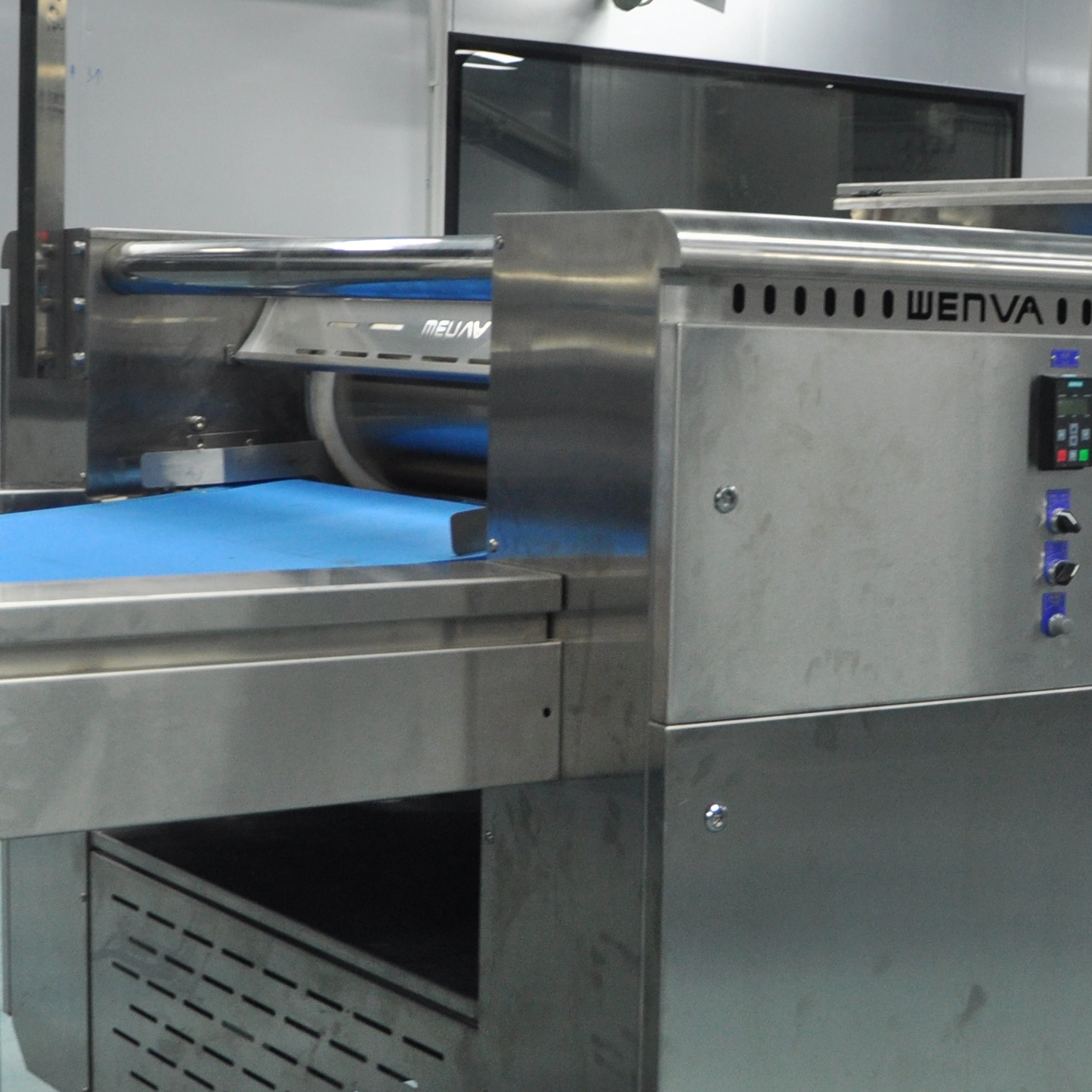
The Dough Sheeter for Biscuit Production Lineis a vital piece of equipment specifically designed for the production of hard biscuits such as soda crackers and Marie biscuits. This machine is equipped with B, C, and D roller sheeters, which continuously press and laminate the dough sheet until the desired thickness is achieved. With its integrated relaxation system, the sheeter eliminates surface stress in the dough sheet, ensuring product stability and meeting the strict requirements of biscuit production technology.
| Model | Thickness of Dough Sheet | Dimension (mm) | Power | Weight |
|---|---|---|---|---|
| 620 | 0.5–0.7 mm | L600 × W1200 × H1100 | 1.5 kW | 0.85 T |
| 800 | 0.5–0.7 mm | L750 × W1500 × H1100 | 3 kW | 1.05 T |
| 1000 | 0.52–0.7 mm | L750 × W1600 × H1100 | 4 kW | 1.37 T |
Gradually presses and stretches the dough sheet to the required thickness.
Produces smooth, uniform sheets that are ideal for rotary cutting and subsequent forming.
Releases the internal stress of dough during sheeting.
Prevents shrinkage, warping, or distortion of biscuit shapes during baking.
Adjustable roller gaps allow accurate control of sheet thickness.
Guarantees even baking, resulting in uniform color and crisp texture.
Continuous sheeting ensures high output and consistent quality.
Seamlessly integrates with rotary cutters, tunnel ovens, and other downstream equipment.
The Dough Sheeter for Biscuit Production Line is widely used for:
Hard Biscuits
Soda Crackers
Other thin, crisp biscuits requiring accurate thickness and consistent forming
The Dough Sheeter for Biscuit Production Line (B, C, D Rollers) is one of the essential machines in modern hard biscuit manufacturing. It guarantees dough sheet uniformity, releases stress to maintain product stability, and ensures smooth integration with the entire production process. For biscuit factories seeking reliable performance and consistent biscuit quality, this sheeter is an indispensable investment.
Hot tags: Dough Sheeter for Biscuit Production Line,Hard Biscuit Sheeter Machine,Biscuit Making Machine Supplier,Automatic Biscuit Production Line Equipment,Soda Cracker Production Line,Marie Biscuit Production Line,Biscuit Laminating and Sheeting Machine,Dough Roller for Biscuit Factory,Industrial Biscuit Production Machinery,Hard Biscuit Manufacturing Equipment
A Thai biscuit and OEM bakery manufacturer upgraded its ageing 500 kg/h production line with Wenva Machine’s 1000 Series automated biscuit production line. Featuring PLC centralised control and a hybrid tunnel oven, the 800–1,000 kg/h solution improved baking uniformity, colour consistency, operational simplicity, and capacity. The project’s success led to a repeat equipment order.
Wenva Machine helped a leading Jakarta snack manufacturer overcome a year of unstable potato-cracker trials. Its customised 1,200 mm automated line, featuring precision forming and a 160 m tunnel oven, reached stable 24/7 output of 800 kg/h within two weeks of commissioning.
The biggest mistake in biscuit line selection is confusing theoretical capacity with effective output. A nameplate rating of 1,000 kg/h typically shrinks to less than 800 kg/h of actually saleable finished goods after deducting downtime, sheeting trim, baking rejects, weight‑deviation overfills, and packaging breakage.A real‑world case: forcing line speed up by 30% caused uneven baking, boosting the reject rate from 2% to 9% – and the total cost per tonne of qualified product actually rose by 15%.Two often‑overlooked profit killers are uneven dough‑sheet thickness (responsible for 80% of baking inconsistencies) and weight inaccuracy – a mere 0.3 g overfill per biscuit wastes tens of tonnes of raw materials annually.For smart selection, follow the “Three Don’ts” – don’t fixate on top speed, oven length, or total power. Instead, ask the “Three Dos”: ① stable speed at under 3% reject rate, ② changeover time, and ③ oven‑zone temperature uniformity.A professional equipment supplier’
This article reviews a real project by Wenva Machine in Malaysia, documenting the complete journey of a biscuit manufacturer building a new production line from scratch. The client, facing capacity constraints, insufficient oven length, and lack of potato cracker production process, connected with Wenva in 2019 through an existing customer referral. Wenva provided a customized 160-meter 1000-type complete line with an extended tunnel oven and dispatched a process specialist from China to Malaysia to address the process gap, helping the client double production capacity and successfully launch a new product line. The project encompassed needs assessment, solution design, cross-border manufacturing and shipping, installation and commissioning, training and acceptance. The client subsequently placed a repeat order for a steel-belt gas-fired oven, with cumulative cooperation exceeding one million yuan. The article summarizes lessons in needs assessment, process capability, cross-border ada
This article provides a comprehensive technical analysis for selecting the optimal dough mixer for commercial cookie production, specifically contrasting the opposing needs of shortbread and hardtack dough. It details five essential equipment standards: dual-speed variable drives, horizontal twin-paddle geometry, water-cooled jacketing for precise temperature control, robust 304 stainless steel construction, and integrated timing with overload protection. The piece highlights critical operational mistakes to avoid, such as using bread mixers or neglecting temperature management. It serves as a definitive purchasing and operational guide for manufacturers aiming to improve product consistency, texture, and production efficiency.
This article delivers a comprehensive technical guide to tuning the air-fuel ratio for direct-fired burners in cookie tunnel ovens. It covers the theoretical stoichiometric basis, the practical excess air requirements, and critical visual flame diagnostics. It details standard step-by-step procedures and offers specific caveats for cookie production, including flame length needs, separating combustion from circulation air, and maintaining stable gas pressure. The guide also includes a quick operator memory aid and answers to five frequent on-site questions, providing a complete field manual for achieving high combustion efficiency, consistent cookie quality, and reduced energy costs.
This article provides a complete technical analysis of why shortbread cookie dough sticks to molds, covering five main areas: ingredient formulation, dough mixing, mold condition, baking parameters, and environmental factors. It details the critical roles of flour moisture, fat quantity and melting point, sugar syrup ratios, gluten strength, mixing time and temperature, mold surface finish and coatings, molding pressure, oven front-zone heat, and cooling rates. Practical solutions are offered for each cause, including specific temperature targets, percentage adjustments, and maintenance schedules. Common mistakes—like over-oiling or over-reliance on fat—are debunked. The guide concludes with an actionable checklist and answers five frequently asked questions. This resource is valuable for both industrial bakers and artisanal producers seeking consistent, high-quality shortbread production with minimal waste.
This article provides a comprehensive, real‑world guide to building a biscuit factory from scratch, using a successful project in Indonesia as the central case study. It breaks the entire journey into four essential steps – budget planning, equipment specification, factory layout design, and installation/commissioning – and highlights the critical mistakes to avoid at each stage. The case demonstrates how proper planning and turnkey technical support can reduce project risk, cut commissioning time from over a year to just two weeks, and deliver stable production of high‑quality potato crackers for global export markets. The article also includes practical FAQs addressing floor space, product flexibility, timeline, training, and common pitfalls, making it a valuable resource for any investor or production manager planning a new biscuit manufacturing facility.
A professional dough sheeting system is fundamental to achieving consistent biscuit quality in industrial manufacturing. This article explains how **Progressive Reduction**, **Gauge Rolls**, precise dough thickness control, and synchronized conveying minimize internal dough stress, improve structural stability, and enhance baking performance. It also explores why dough sheeting influences forming accuracy, product dimensions, texture, and long-term production consistency, making it one of the most critical stages in a modern **biscuit production line** and an essential factor in improving manufacturing efficiency and product quality.
This article explains why industrial biscuit baking is fundamentally a process of moisture management rather than simple heating. It explores how temperature, humidity, and baking time work together to control moisture migration, product texture, color, and shelf life. It also discusses the importance of scientifically designed baking profiles and modern tunnel oven technologies that enable manufacturers to achieve consistent, high-quality biscuit production through precise process control.
Explore the differences between hard biscuits, soda crackers, soft biscuits, cookies, sandwich biscuits, and double-layer biscuits. Learn about their production processes, equipment configurations, and how to choose the right biscuit production line for your factory to improve efficiency and product quality.
Selecting the best flour for different biscuit types is critical for texture, consistency and industrial efficiency. This expert guide explains how all‑purpose, cake, whole wheat and gluten‑free flours interact with automated biscuit production lines to help bakeries scale with confidence.
Discover the main biscuit dough types used in automated biscuit production lines—short, sweet, rich, choux, and whole‑grain—and learn how they interact with industrial mixing, forming, and baking equipment, based on Wenva Machine's 40 years of biscuit line experience.
Dual-filling vs. single-filling sandwich machines: discover how each technology shapes premium multilayer snacks, capacity, flexibility, and ROI. Learn how Wenva Machine designs automated biscuit lines that balance innovation with efficiency for global manufacturers.
This 2026 expert guide profiles the top 10 commercial biscuit equipment manufacturers in China for global buyers. It explains evaluation criteria (certifications, R&D, QC, capacity), highlights Wenva Machine as a high‑value OEM/ODM partner, addresses common sourcing pitfalls, and provides a practical buyer checklist plus advanced FAQs.
Optimize your automated biscuit production line with expert, factory-level insights into common biscuit-making mistakes, quality control, equipment design, and troubleshooting strategies to boost efficiency, consistency, and food safety in industrial biscuit manufacturing.
Explore the differences between Inline Jam Injection and Top-Dosing technologies for high-speed jam-filled cookie production. Learn which system delivers better efficiency, quality, and ROI for automated biscuit production lines. Ideal for manufacturers seeking scalable solutions.
This Saudi Arabia biscuit production case highlights how Wenva Machine delivered a fully automated, halal-compliant biscuit production line capable of 20–25 tons daily output. Designed for extreme heat and premium product manufacturing, the solution integrates precision baking, hygienic design, and nitrogen packaging for high-end market competitiveness.
Wenva Machine delivered a customized automated biscuit production line in Ethiopia, addressing high-altitude baking challenges, unstable power supply, and limited technical resources. The solution enables efficient local production of affordable biscuits, reducing import dependency while ensuring stable output and easy operation.
This case study explores how a leading Indonesian snack brand partnered with Wenva Machine to deploy a fully automated biscuit production line, overcoming capacity limits, reducing energy costs, and enabling premium product diversification with an annual output of up to 7,000 tons.


