
Views: 225 Author: WENVA MACHINE Publish Time: 2026-07-27 Origin: Site
Content Menu
● The Essence of Baking Is Moisture Management, Not Simply Heating
● Three Key Factors That Determine Moisture Control During Biscuit Baking
>> Temperature: Controlling the Rhythm of Moisture Release
>> Initial Heating Zone: Gentle Preheating and Product Setting
>> Middle Heating Zone: Internal Structure Development
>> Final Heating Zone: Achieving the Target Moisture Content
● Humidity: A Critical Factor Affecting Moisture Migration
● Time: Establishing the Final Moisture Balance
● Professional Baking Relies on a Stable Baking Profile
● How Professional Equipment Delivers Consistent Product Quality
>> Independent Temperature Zone Control
>> Uniform Hot Air Circulation
>> Accurate Conveyor Speed Control
>> Long-Term Operational Stability
>> Q1: Why is moisture control more important than maximum oven temperature?
>> Q2: What happens if biscuits lose moisture too quickly during baking?
>> Q3: Why do tunnel ovens use multiple temperature zones instead of one constant temperature?
>> Q4: How does oven humidity influence biscuit quality?
>> Q5: Why is conveyor speed so important in a tunnel oven?
>> Q6: How can a professional biscuit production line improve consistency?
For many companies entering the biscuit manufacturing industry, baking appears to be a straightforward process. Once the dough has been formed, it is sent through a tunnel oven, heated for a predetermined period, and emerges as a finished biscuit.
However, industrial biscuit baking is far more sophisticated than simply applying heat. The quality of the final product is determined not by the oven's maximum temperature, but by the precise coordination of heat transfer, moisture migration, and baking time throughout the entire baking process.
As a professional biscuit production line manufacturer, our focus extends beyond designing ovens that generate high temperatures. We are committed to helping manufacturers ensure that every biscuit experiences the same controlled baking conditions, resulting in consistent color, texture, moisture content, and product quality. Producing one successful batch is relatively easy; consistently reproducing that quality day after day is what truly creates value for modern food manufacturers.

Many people believe baking simply means "cooking" the biscuit. In reality, the most significant transformation occurring during baking is the gradual migration of moisture from the interior of the dough toward its surface, where it evaporates into the circulating hot air.
This moisture movement does not happen instantly. Instead, it continuously evolves as the product travels through different temperature zones inside the tunnel oven.
If moisture escapes too rapidly, the biscuit surface hardens prematurely and forms a crust. This crust prevents internal moisture from escaping efficiently, increasing the likelihood of blistering, cracking, warping, and even moisture reabsorption after packaging.
Conversely, if moisture is released too slowly, the finished biscuits may retain excessive moisture, develop insufficient color, lose their desired crispness, and experience a shorter shelf life.
For professional equipment manufacturers, the primary objective is therefore not simply achieving the target oven temperature. Instead, it is maintaining a dynamic balance between internal moisture migration and surface evaporation, allowing moisture to leave the product gradually and evenly throughout the baking process.
Only under these controlled conditions can manufacturers consistently achieve uniform product quality.
In industrial biscuit production, three fundamental variables govern baking performance:
Temperature
Humidity
Time
These parameters are closely interconnected rather than independent. Together, they determine the final moisture content, internal structure, surface appearance, texture, and storage stability of the finished biscuit.
When selecting a tunnel oven, many customers first compare maximum heating temperatures or heating methods such as gas-fired ovens, electric tunnel ovens, or diesel-heated systems.
In practice, however, the most important factor is not the highest achievable temperature but the temperature profile throughout the oven.
Modern tunnel ovens are divided into multiple heating zones, each designed to perform a specific function during baking rather than maintaining a single uniform temperature across the entire oven.
The first stage of baking should not expose the dough to excessive heat too quickly.
If the surface temperature rises too rapidly, a rigid outer crust forms before the internal moisture has sufficient time to migrate outward. Steam pressure then builds inside the biscuit, potentially causing blistering, cracking, warping, or uneven expansion.
Instead, the initial heating zone gradually warms the dough, allowing temperature to penetrate uniformly while preparing the product for controlled moisture removal during later stages.
This gentle transition establishes a stable foundation for the entire baking process.
As the biscuit enters the middle section of the tunnel oven, heat penetrates deeper into the product.
During this stage, moisture continues migrating toward the surface while several important structural changes occur simultaneously.
The gluten network becomes stabilized, starch gelatinization progresses, proteins continue to denature, and the internal pore structure gradually develops. These changes collectively determine the biscuit's mechanical strength, texture, and eating quality.
A properly designed middle heating zone promotes balanced moisture movement while allowing the internal structure to mature evenly, ensuring the finished biscuit develops a consistent bite and uniform appearance.
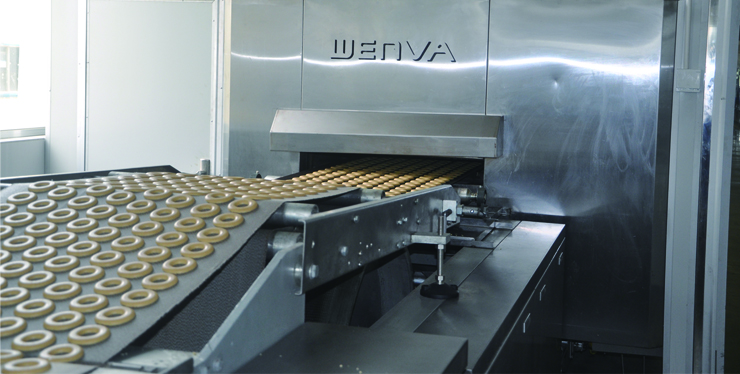
The purpose of the final baking zone is not simply to apply higher temperatures.
Instead, it performs controlled dehydration while completing color development.
Carefully regulated heat input reduces the biscuit's moisture content to its target value without overheating the surface.
If the final zone is excessively hot, the exterior may become over-browned or scorched while excessive moisture remains trapped inside. This imbalance negatively affects both product quality and storage stability.
An excellent tunnel oven therefore relies on a scientifically designed temperature profile rather than extreme temperatures. Every heating zone contributes to a specific stage of moisture management, enabling optimal product quality.
Although temperature often receives the greatest attention, humidity inside the baking chamber plays an equally important role.
The concentration of water vapor surrounding the biscuit directly influences how efficiently moisture can evaporate from its surface.
If oven humidity is excessively low, moisture evaporates very rapidly from the biscuit surface.
The resulting dry outer layer hardens prematurely, creating resistance to further moisture movement from the interior.
Thin biscuits may develop surface cracking, while thicker products often exhibit a "dry outside, moist inside" condition that leads to inconsistent moisture distribution throughout the product.
These variations can reduce product uniformity and create quality problems during packaging and storage.
Conversely, excessive humidity slows surface evaporation.
Products may expand more than intended, spread excessively, develop insufficient browning, and retain higher moisture levels after baking.
Higher residual moisture also increases the risk of softening during storage, reducing shelf life and consumer satisfaction.
For continuous industrial production, carefully balancing oven humidity is therefore essential for maintaining consistent product quality across every production batch.
Temperature and humidity alone cannot guarantee successful baking.
Time is equally important.
In continuous tunnel ovens, baking time is primarily determined by conveyor speed.
If the conveyor moves too quickly, biscuits spend insufficient time inside the oven. Internal moisture cannot escape completely, leaving products softer than desired with reduced crispness and shorter shelf life.
On the other hand, excessively slow conveyor speeds expose biscuits to heat for too long.
Over-drying causes excessive weight loss, harder textures, increased brittleness, and unnecessary production costs due to product shrinkage.
For this reason, production speed should never be adjusted solely to maximize output.
Instead, conveyor speed must be optimized according to dough formulation, biscuit thickness, product dimensions, desired moisture content, and overall process requirements.
Only when these factors are balanced can manufacturers consistently produce high-quality biscuits.
In industrial biscuit manufacturing, product quality is not determined by the temperature of a single heating zone.
Instead, success depends on the complete baking profile developed throughout the entire oven.
A baking profile represents the coordinated relationship among heat input, moisture migration, airflow, humidity, and conveyor speed from the moment the biscuit enters the oven until it exits.
An optimized baking profile allows moisture to migrate gradually from the biscuit interior while maintaining a balanced evaporation rate at the surface.
This controlled process produces uniform internal structure, stable color development, consistent crispness, predictable weight, and reliable moisture content.
Consequently, professional equipment manufacturers design not only tunnel ovens but complete baking solutions tailored to the requirements of different biscuit varieties, production capacities, and factory environments.
For modern biscuit manufacturers, equipment value extends beyond production capacity.
High-quality machinery provides repeatable process control that enables every production batch to meet the same quality standards.
Professional tunnel oven design typically emphasizes the following aspects.
Each baking zone is independently controlled to perform its intended function, whether gentle preheating, moisture removal, structural development, or final color formation.
This staged approach is far more effective than relying on uniformly high temperatures throughout the oven.
Efficient airflow distribution ensures that heat reaches every biscuit evenly.
Uniform circulation minimizes color variation, prevents localized under-baking or over-baking, and improves consistency across the entire conveyor width.
Stable airflow also supports predictable moisture evaporation, improving overall product uniformity.
Consistent conveyor movement ensures every biscuit spends exactly the required amount of time in each heating zone.
Stable residence time leads to repeatable heat transfer, predictable moisture loss, and reliable baking performance over extended production runs.
Industrial food production requires more than occasional success.
Manufacturers expect identical product quality throughout every shift, every day, and every production cycle.
Reliable mechanical design, precise temperature regulation, durable components, and stable continuous operation all contribute to maintaining this consistency.
When equipment performs reliably over the long term, manufacturers experience fewer production interruptions, lower operating costs, and improved product quality.
Many people assume the purpose of a tunnel oven is simply to bake biscuits until they are fully cooked.
In reality, modern biscuit baking is a sophisticated process of managing heat, moisture, airflow, and time with exceptional precision.
Temperature determines how heat enters the product.
Humidity controls how efficiently moisture evaporates.
Time establishes the final moisture balance.
Together, these factors create the complete baking process that defines biscuit quality.
For professional biscuit production line manufacturers, success is not measured by how hot an oven becomes. Instead, it is determined by the ability to create carefully designed temperature zones, stable hot-air circulation, accurate conveyor control, and scientifically optimized baking profiles that ensure every biscuit experiences the same controlled baking conditions.
The best production lines do far more than manufacture biscuits. They enable food manufacturers to reproduce consistent quality batch after batch, improve production efficiency, reduce waste, and deliver products that meet consumer expectations every day. This capability represents the true value of modern industrial biscuit baking technology.
Answer: Moisture control determines the biscuit's texture, internal structure, color, shelf life, and overall product consistency. High temperatures alone cannot guarantee quality if moisture migrates unevenly throughout the baking process.
Answer: Rapid surface drying can create a hard outer crust that traps internal moisture. This often leads to blistering, cracking, warping, uneven moisture distribution, and reduced product stability after packaging.
Answer: Different baking stages require different thermal conditions. Multiple heating zones allow gradual preheating, structural development, controlled dehydration, and color formation, resulting in higher product consistency and better baking performance.
Answer: Oven humidity affects the rate of moisture evaporation. Low humidity may cause excessive surface drying, while high humidity can slow dehydration, reduce browning, increase residual moisture, and shorten shelf life.
Answer: Conveyor speed determines the baking time. Proper residence time ensures sufficient moisture removal, uniform heat transfer, stable product quality, and optimal production efficiency.
Answer: Professional production lines combine independent temperature control, uniform hot-air circulation, accurate conveyor speed regulation, and stable continuous operation to maintain consistent moisture content, color, texture, and product quality throughout every production batch.


