
Views: 225 Author: WENVA MACHINE Publish Time: 2026-08-14 Origin: Site
Content Menu
● Lessons from Failure Cases and Common Misconceptions in Equipment Selection and Process Matching
>> Introduction: A Question Worth Asking
>> 1. A Game‑Changing Perspective: Theoretical Capacity ≠ Effective Output
>> 2. Redefining "Capacity" – Five Distinct Meanings You Must Distinguish
>> 3. The Real Performance of a "1,000 kg/h" Production Line
>> 4. A Cautionary Case Study: The Trap of "Speeding Up to Increase Output"
>> 5. Overlooked Profit Killers
>>> Uneven dough‑sheet thickness – even a good oven cannot fix it
>>> Weight deviation – losing tonnes of flour every year
>>> Do ask:
>> 7. Elevating the Value Proposition: Selling "Cost per Tonne of Qualified Product"
>> Conclusion
When many biscuit factory owners look for a production line, their first question is often: "I need a 1,000 kg/h line."
That number sounds clear enough. But as professional equipment manufacturers, we have to ask one more question: Which 1,000 kg are you talking about?
Most customers have never really thought about this. And it is precisely this kind of assumption that leads many factories to discover, after commissioning, that the capacity printed on the nameplate and the actual finished-goods stock at the end of the month are separated by a huge gap.
This article will systematically explain equipment selection and process matching for biscuit lines, drawing on real failure cases and common pitfalls. Our core message is this: do not look only at theoretical capacity – look at the final effective output.
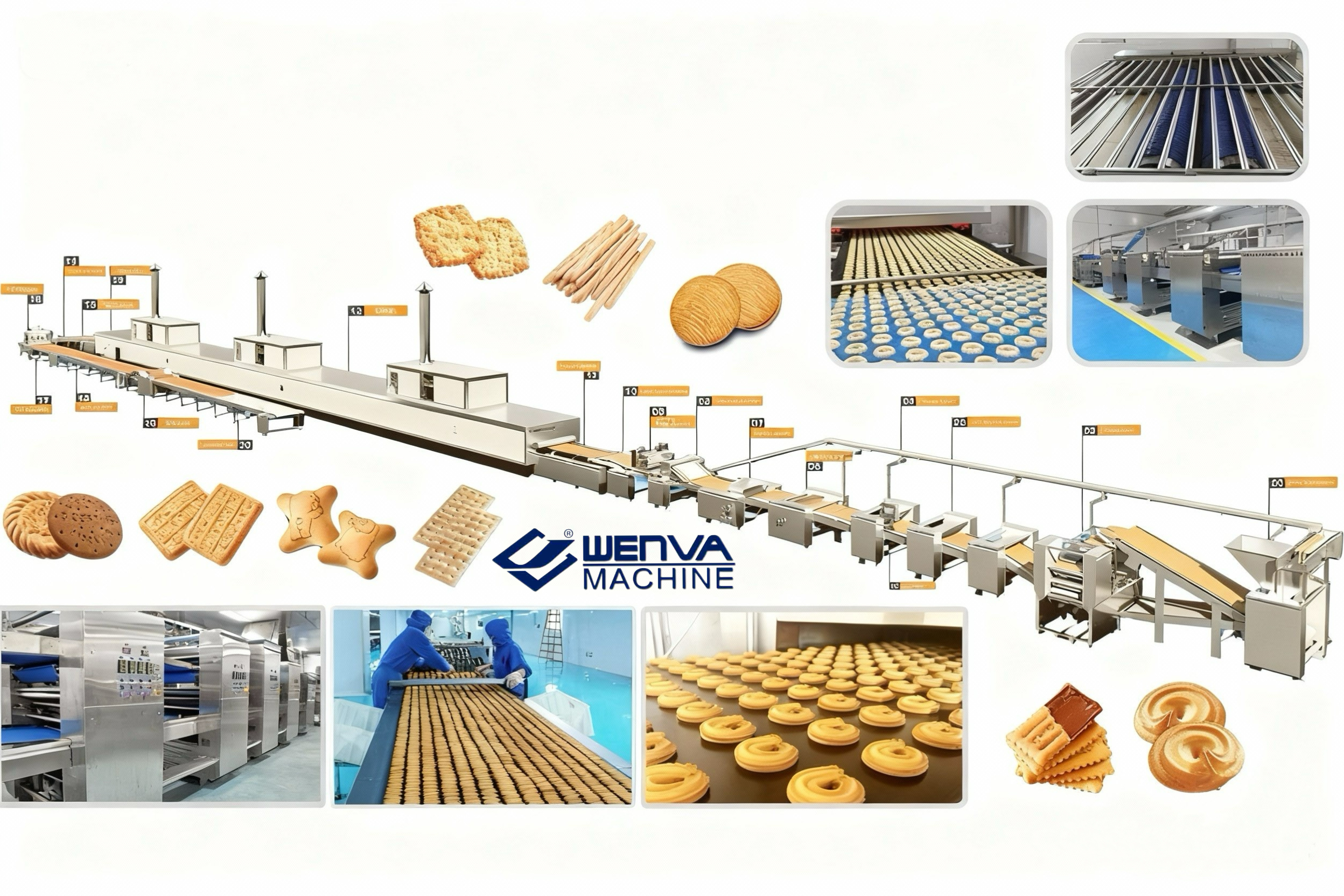
The single most important shift in thinking when choosing a biscuit line is to move your attention from "how many kilograms per hour can the machine produce" to "how many kilograms of qualified, saleable biscuits it can actually deliver per hour."
The "theoretical capacity" on the nameplate is only a physical limit – an empty‑line speed calculated under ideal conditions. The real production result is the quantity of finished goods that enters your warehouse at the end of the month, as shown on your financial statements. Between these two numbers lie multiple barriers: machine downtime, process waste, rejects, weight deviations, and packaging losses.
If we view the entire production line as a system, then the final effective output is the system's true output. No matter how fast the front end runs, if the back end cannot hold onto the product, everything is for nothing.
In the biscuit industry, the same phrase "1,000 kg/h" can refer to at least five completely different physical states. If you do not clearly understand these five meanings, you are likely to make a costly mistake when purchasing equipment.
First, theoretical mechanical capacity.
This is the peak value calculated from the empty‑line speed at the design stage. When the machine runs without flour, without oil, and without any load, this is how fast it can theoretically go. But in actual production, with ingredients and pressure applied, this number is almost never achieved. It is more of a reference benchmark than a production target.
Second, dough throughput.
Some suppliers may quote the feeding capacity of the mixer and the forming machine. But remember: dough contains up to 15‑20% water. A significant portion of that number is water, not biscuits. Using dough throughput as a capacity claim is a common numbers game.
Third, weight of the unbaked biscuit blank.
This is the weight after forming and cutting, just before entering the oven. At this stage, the dough still has a moisture content of about 18‑20%. The number looks impressive, but as soon as it enters the oven and loses water, the weight drops sharply.
Fourth, weight of the baked product.
After passing through the tunnel oven, the biscuit moisture drops to 3‑4%. After cooling, this is the biscuit you actually see. But note: it has not yet been packaged or inspected, so strictly speaking, it is not yet a "finished product."
Fifth, final effective output.
This is the portion that has been cooled, sorted, packed, inspected, palletised, and is ready for delivery to distributors. This is the only number that counts when your finance department closes the books at month‑end.
So, when you say "1,000 kg/h," which one do you mean? If you don't clarify this before signing a contract, you may find that the line you get does not deliver what you expected – and by then, the losses are not just time.
To make this more concrete, let's simulate a line rated at 1,000 kg/h and walk through the step‑by‑step deductions from theory to reality.
Start: 1,000 kg/h. That is what the nameplate says.
First loss: Overall Equipment Effectiveness (OEE).
Production is dynamic. The line cannot run non‑stop. Daily cleaning, changeover adjustments, minor breakdowns, and shift handovers all consume time. Assuming an OEE of 85% – which is quite good – 1,000 kg becomes 850 kg.
Second loss: Sheeting edge trim.
During sheeting and gauging, there will always be head and tail pieces and edge trimmings. These can be recycled, but typical inline waste is about 2%. 850 kg minus 2% leaves 833 kg.
Third loss: Baking rejects.
Inside the oven, problems arise. Uneven heating, warping, cracking, and breakage all produce rejects. A conservative estimate is 3% rejection at this stage. 833 kg minus 3% leaves 808 kg.
Fourth loss: Weight‑deviation overfill.
Many machines sacrifice metering accuracy for speed, causing individual biscuit weights to fluctuate. To ensure that every pack meets the minimum net weight, the factory must increase the average deposit weight. This creates a hidden raw‑material waste of about 1.5%. 808 kg minus 1.5% leaves 796 kg.
Fifth loss: Packaging breakage.
The final hurdle is the high‑speed sorter and packaging machine. Mechanical impact during conveying and collation causes about 1% breakage. 796 kg minus 1% leaves … approximately 788 kg/h.
So, from a 1,000 kg start, after passing through the entire line, the final stable warehouse entry is less than 800 kg.
The nameplate says 1,000; the monthly financial report says 788. The 200‑plus kg difference was not stolen – it was lost bit by bit at every stage.
Therefore, a truly excellent biscuit line is not judged by how fast it can start, but by how many pallets of qualified product it can stack in the finished‑goods area after an eight‑hour or sixteen‑hour shift.
A certain cracker factory wanted to rush a peak‑season order, so they forced the former line speed from 10 m/min to 13 m/min. The production manager's logic was simple: a 30% speed increase should yield a 30% output increase.
But it backfired.
As the speed increased, the biscuits spent less time in the oven. To get them baked through, the operators raised the oven temperature. However, the high‑temperature short‑time baking brought new problems: the surface underwent excessive Maillard reaction, making the colour too dark; meanwhile, the centre did not receive enough heat, leaving residual moisture and a sticky, underdone texture. Worse, the internal stress after baking caused severe warping and distortion.
The reject rate soared from 2% (before the speed increase) to 9%. When they tallied the total cost, the gross output was higher, but the final qualified output had barely changed. Worse, because of increased rework and higher energy bills, the comprehensive cost per tonne of qualified product actually rose by 15%.
This teaches us a profound lesson: capacity cannot be forced by pushing speed alone. If a customer genuinely needs higher output, the process parameters must be systematically re‑matched – by adjusting the starch ratio and water content to suit faster baking, or by choosing a longer oven with more temperature zones at the equipment selection stage. Capacity is "baked" into the product, not "pushed" through the line.
Besides the case above, there are two subtle issues that seem minor but eat away at profits every single day.
Many owners, when they see uneven colour (dark in some spots, pale in others) or underbaked centres, immediately blame the oven. But the truth is that 80% of uneven baking problems originate in the sheeting machine.
If the dough sheet comes out of the gauging rollers with a left edge of 2.3 mm, a centre of 2.5 mm, and a right edge of 2.8 mm, then all these pieces go into the same oven with the same temperature and time. The result is predictable: the thin parts bake too quickly and burn (dark colour), while the thick parts conduct heat poorly and remain underbaked in the centre (pale colour). One tray of biscuits will have inconsistent colour and varying texture.
The oven's job is to brown and set the product – not to compensate for thickness variations. If the dough sheet is not uniform, no oven can fix it. That is why a high‑precision sheeting station is the first line of defence for product quality.
Suppose the target weight is 10 g per biscuit. If the metering accuracy is poor and the average weight drifts to 10.3 g – just a 0.3 g deviation – the numbers add up quickly.
Extra per piece: 0.3 g
800 pieces per minute → extra 240 g/min
16 hours per day → extra 230 kg/day
25 days per month → extra 5.7 tonnes/month
Over a year: tens of tonnes of flour and fat are literally burnt away.
Now, a cheap machine with poor accuracy may save you 200,000–300,000 RMB upfront, but it can cost you hundreds of thousands in raw materials every year. Once you do the maths, the right choice becomes obvious.
1. Don't just look at the top line speed.
That is an unloaded figure; it does not represent stable production of acceptable biscuits. Extreme example: a machine may run at 15 m/min empty, but drop to 8 m/min under load – what good is that peak speed?
2. Don't just look at oven length.
Longer is not always better; the key is the zoning layout. A 20‑metre oven with only three zones may have large temperature gradients and poor transition, while a 15‑metre oven with five independently controlled zones can bake much more evenly.
3. Don't just look at total installed power.
High power does not equal high performance – a high‑power oven with low thermal efficiency is just an electricity guzzler. What really matters is the energy consumption per kilogram of product.
1. "What stable running speed can you guarantee while maintaining a reject rate below 3%?"
This forces the supplier to give you real production data, not theoretical empty‑line numbers.
2. "How long does it take to change over from one biscuit thickness to another, including sheeting and forming adjustments?"
This tests the level of automation and quick‑change capability. Shorter changeover time means higher OEE.
3. "How do you ensure temperature uniformity across the oven width and between top and bottom heat zones?"
This examines the engineering quality of the air circulation and burner layout. Uniformity directly affects product consistency.
At the end of this article, I want to share our view on the true nature of equipment sales.
Many machinery suppliers, when talking to customers, habitually compare "my line produces X kg/h more than theirs." This approach is essentially just a parameter‑ and price‑driven competition.
But we believe that a truly professional food machinery manufacturer should complete a value upgrade:
Don't sell equipment – sell the "comprehensive production cost per tonne of qualified product."
You can talk to your customer like this:
Mr. Wang, if our equipment, thanks to its higher precision, can reduce your raw‑material waste by just 1% per tonne of qualified product, at your current output that means saving tens of tonnes of flour every year."
"Because our oven has better insulation and more precise temperature control, we can cut your energy cost per tonne by 5% – that's over 100,000 RMB in annual savings."
"With higher automation and faster changeovers, you can reduce labour by two operators per line – saving nearly 200,000 RMB per year in wages."
"Our machine may cost 300,000 RMB more than a cheaper alternative, but when you add up these savings, the payback period is less than eight months. Everything after that is pure profit."
From selling machinery to selling solutions; from comparing prices to comparing efficiency – that is the true professional value of a equipment manufacturer.
Back to the opening question: Is a 1,000 kg/h biscuit line necessarily more profitable than a 900 kg/h line?
The answer is now clear – not necessarily.
Because what ultimately determines your profit is never the glamorous theoretical number on the nameplate, but the solid entry of finished goods in your monthly financial statements. And to maximise that number, you cannot rely on the "speed limit" of any single section; you need systematic process matching across the entire line – from sheeting to baking, from forming to packaging.
The best biscuit production line is not necessarily the one with the highest theoretical capacity. It is the one that, while maintaining stable product quality, achieves the highest effective output and the lowest comprehensive production cost per tonne.
This is the selection philosophy we uphold as a professional equipment manufacturer, and it is the fundamental approach we use to help every customer achieve long‑term, stable profitability.


