
Views: 226 Author: WENVA MACHINE Publish Time: 2026-07-23 Origin: Site
Content Menu
● Why Do Different Types of Biscuits Require Different Production Equipment?
● Process Requirements and Equipment for Different Types of Biscuits
>> Hard Biscuit Production Line
>> Soda Biscuit Production Line
>> Soft Biscuit Production Line
>> Sandwich Biscuit Production Line
>> Double Layer Biscuit Production Line
● What Are the Main Equipment Differences Between Various Biscuit Production Lines?
● How to Choose the Right Biscuit Production Line
>> Define Your Target Products
>> Estimate Production Capacity
>> Select a Modular Production Line
● Frequently Asked Questions (FAQ)
>> 1. Can one biscuit production line produce all types of biscuits?
>> 2. Why do soda biscuits require a laminator?
>> 3. Why aren't cookies produced using a dough sheeting process?
>> 4. Should I choose a gas tunnel oven or an electric tunnel oven?
>> 5. How can I choose the most suitable biscuit production line?
>> 6. Can sandwich or double-layer systems be added later?
As the global bakery industry continues to grow, consumers are demanding greater variety in biscuit texture, appearance, and flavor. From classic Marie biscuits and soda crackers to butter cookies, sandwich biscuits, and the increasingly popular double-layer biscuits, each product requires a unique manufacturing process and production line configuration.
The key factor in selecting a biscuit production line is not the appearance of the biscuit itself, but its recipe, dough characteristics, forming method, fermentation process, and baking requirements. Understanding the differences between various biscuit production processes helps manufacturers choose the most suitable equipment, improve production efficiency, and ensure consistent product quality.
Although all biscuits belong to baked products, their formulations and manufacturing processes vary significantly. For example, cookies contain high levels of sugar and fat, resulting in a soft dough that is unsuitable for sheeting. Hard biscuits, on the other hand, require strong gluten development and multiple sheeting stages to achieve their crispy texture. Soda biscuits additionally require fermentation and laminating processes to create a flaky structure and improve crispness.
Therefore, a biscuit production line is typically designed based on the following factors:
Whether the dough is suitable for sheeting
Whether fermentation is required
The forming method, such as rotary cutting, rotary moulding, or wire cutting
Baking time and temperature zone requirements
Whether sandwiching, secondary processing, or double-layer assembly equipment is needed
Different production processes determine the equipment configuration and directly affect production efficiency, investment cost, and final product quality.
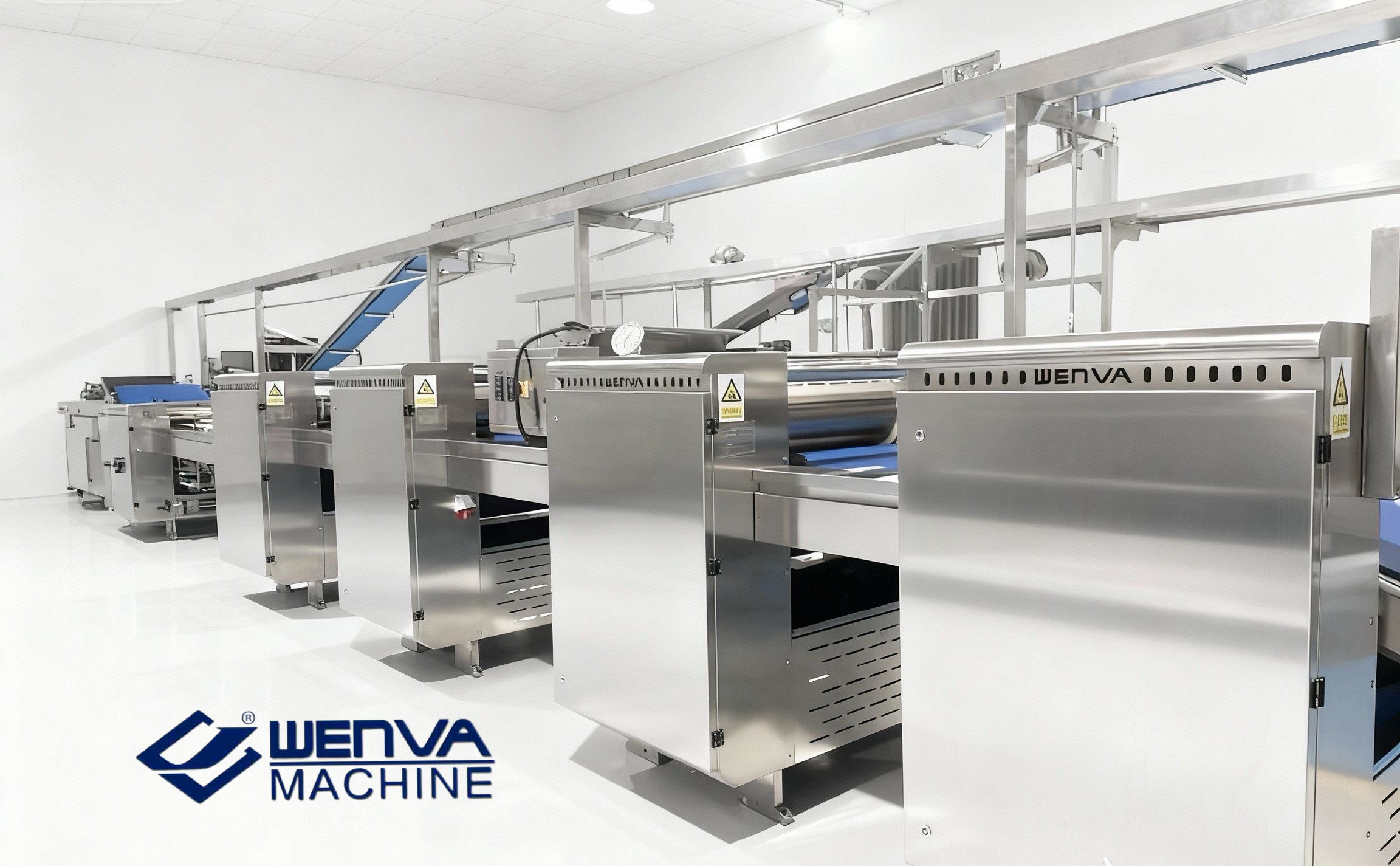
Hard biscuits include Marie biscuits, milk biscuits, and animal-shaped biscuits. They are characterized by a compact internal structure, smooth surface, and crispy texture.
Because the dough has strong gluten strength, it must pass through continuous sheeting to achieve uniform thickness before being cut and embossed using a rotary cutter.
Typical production process:
Raw Material Mixing → Laminating → Dough Sheeting → Rotary Cutting → Tunnel Oven Baking → Cooling → Packaging
Main equipment includes:
Dough Mixer
Laminator
Dough Sheeter
Gauge Rolls
Rotary Cutter
Tunnel Oven
Cooling Conveyor
Since hard biscuits require precise dough thickness and uniform baking, these production lines are usually equipped with longer tunnel ovens to ensure consistent color and crisp texture.
Soda biscuits are among the most technically demanding biscuit products and are also one of the most common types where customers select incorrect equipment.
Compared with hard biscuits, soda crackers require fermentation and laminating processes to develop their characteristic layered structure and crispy texture.
Typical production process:
Mixing → Fermentation → Laminating → Dough Sheeting → Rotary Cutting → Baking → Cooling
Main equipment includes:
Fermentation System
Laminator
Dough Sheeting System
Rotary Cutter
Long Tunnel Oven
Oil Spraying Machine
The laminator is one of the most important machines in a soda biscuit production line. It repeatedly folds multiple dough layers together, creating the internal laminated structure that gives soda crackers their distinctive crispness.
Soft biscuits generally contain a higher proportion of sugar and fat, resulting in weaker gluten development. Therefore, they do not require complex sheeting processes and are usually formed directly by rotary moulding.
Typical products include:
Digestive Biscuits
Tea Biscuits
Breakfast Biscuits
Typical production process:
Mixing → Rotary Moulding → Baking → Cooling → Packaging
Main equipment includes:
Dough Mixer
Rotary Moulder
Tunnel Oven
Cooling Conveyor
Compared with hard biscuits, soft biscuits place greater emphasis on decorative patterns and product appearance, making mould design an important consideration during equipment selection.
Cookies are characterized by their high sugar, high fat, and high butter content. Their dough is extremely soft and unsuitable for sheeting. Due to the high-fat formulation, cookie production lines generally use steel band conveying systems throughout the baking process.
Depending on the product type, cookies can be formed using:
Wire Cut Machine
Depositor
Rotary Moulder
For example, chocolate chip cookies are typically produced using wire-cut technology, while butter cookies are commonly formed using depositing equipment.
Main equipment includes:
Planetary Mixer
Cookie Forming Machine
Tunnel Oven
Cooling Conveyor
Because cookies come in various shapes and designs, manufacturers can quickly switch products by changing moulds, greatly improving equipment flexibility.
Sandwich biscuits are secondary processed products. The base biscuits are first produced using either a hard biscuit or soft biscuit production line, followed by cream filling and assembly.
Additional equipment includes:
Cream Sandwiching Machine
Automatic Aligning System
Stacking System
Conveying System
Typical production process:
Base Biscuit Production → Cooling → Cream Filling → Biscuit Assembly → Product Alignment → Packaging
The cream sandwiching system ensures accurate cream dosage and precise alignment between the upper and lower biscuits, improving product consistency.
In recent years, double-layer biscuits have become increasingly popular due to their richer texture and higher added value.
Compared with traditional sandwich biscuits, double-layer biscuits use a lamination and pressing process that combines two biscuit layers before subsequent baking or packaging.
Additional equipment generally includes:
Double-Layer Combining System
Pressing Device
Automatic Synchronizing Conveyor
The double-layer structure not only enhances product texture but also enables manufacturers to develop more innovative products and improve market competitiveness.
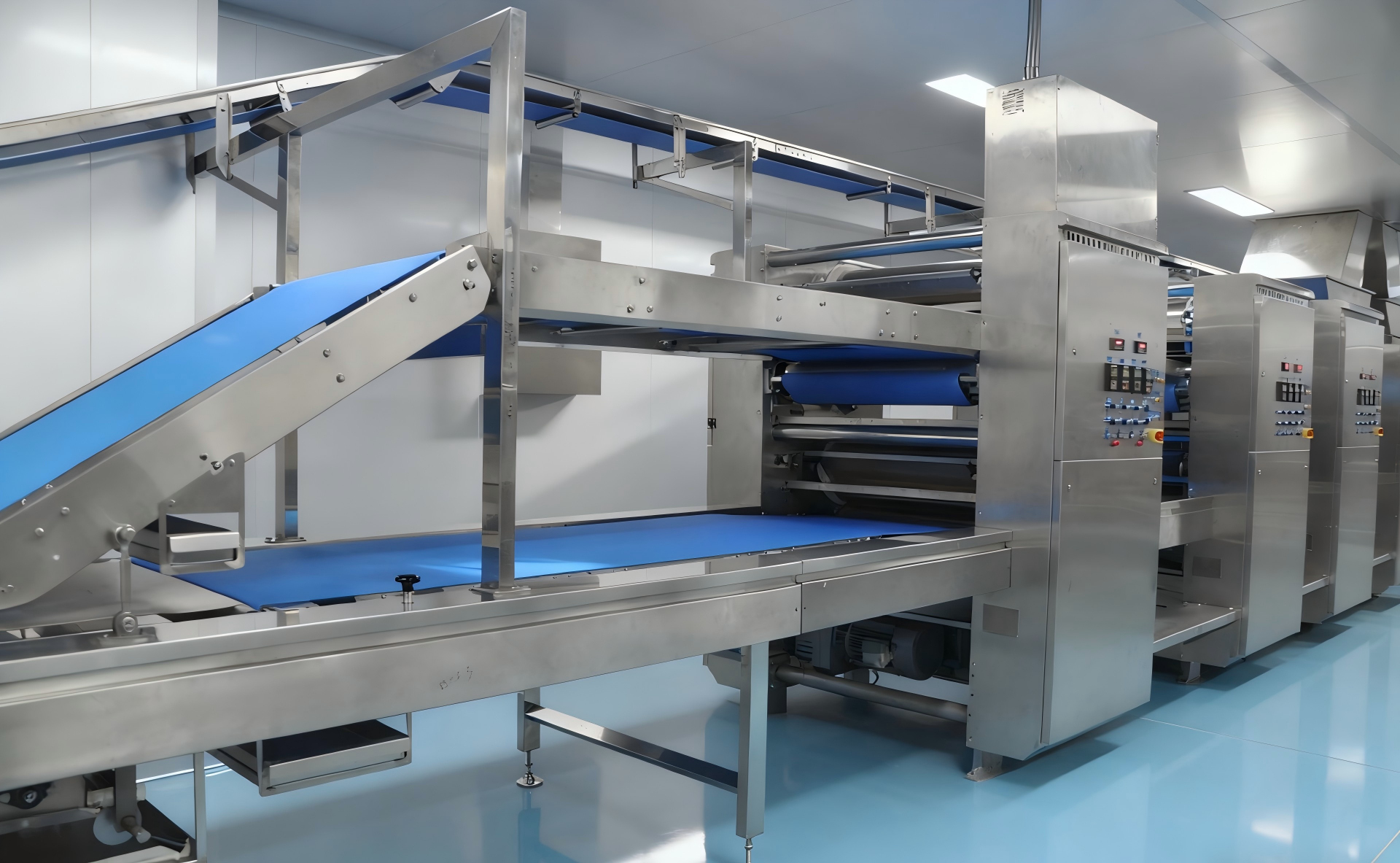
Although most biscuit production lines include mixing, baking, cooling, and packaging, the greatest differences lie in the forming section.
For example:
Hard biscuits rely on dough sheeting and rotary cutting.
Soda biscuits require fermentation and laminating.
Soft biscuits mainly use rotary moulding.
Cookies are formed by wire cutting or depositing.
Sandwich and double-layer biscuits require additional downstream assembly equipment.
Therefore, a production line designed for hard biscuits cannot directly manufacture every biscuit type without adding or replacing specific equipment modules.
For companies planning to build a new biscuit factory or expand production capacity, the following aspects should be carefully considered.
Determine whether your primary products will be hard biscuits, soda crackers, cookies, sandwich biscuits, or other varieties. Different products require different core equipment.
Choose equipment specifications based on your desired hourly output or daily production capacity while leaving room for future expansion.
A well-designed factory layout reduces material handling, improves production efficiency, and makes future maintenance and expansion easier.
If you plan to produce multiple biscuit varieties in the future, choosing a modular production line allows you to switch products by replacing forming systems, moulds, or certain equipment modules, reducing long-term investment costs.
As consumer demand continues to evolve, biscuit products are becoming increasingly diversified, premium, and innovative. Different biscuit types require different formulations, production processes, and equipment configurations, making it impossible to manufacture every product efficiently on the same production line.
For biscuit manufacturers, selecting the right production line should be based on product positioning, production process, capacity requirements, factory layout, and future expansion plans. A production line that matches your product characteristics will not only ensure consistent product quality but also maximize production efficiency and return on investment.
No. While some equipment can be shared, hard biscuits, soda crackers, cookies, and sandwich biscuits require different forming technologies and processing methods. Different core equipment or modular configurations are usually necessary.
The laminator repeatedly folds multiple dough layers together, creating the characteristic flaky structure that gives soda crackers their crispy texture.
Cookie dough contains a high proportion of sugar and fat, making it soft and less elastic. Sheeting can easily deform the dough, so wire-cutting, depositing, or rotary moulding is generally used instead.
Gas tunnel ovens heat up quickly and generally have lower operating costs for large-scale production. Electric tunnel ovens provide more stable temperature control and better baking consistency. The choice depends on local energy costs, factory conditions, and product requirements.
You should evaluate your target products, recipe characteristics, production capacity, factory layout, automation requirements, and future expansion plans before selecting a customized production solution.
Yes. Many modern biscuit production lines feature modular designs, allowing manufacturers to add cream sandwiching systems, double-layer combining equipment, and automatic packaging machines as production requirements grow.


