| Model: | |
|---|---|
| Availability: | |
| Quantity: | |
The biscuit oil spraying machine is an essential auxiliary equipment in a biscuit production line, designed to evenly spray edible oil on the surface of cookies after baking. The oil coating gives biscuits a glossy, moist appearance while enhancing their crispness and flavor. Made of food-grade stainless steel, the machine meets international hygiene standards and is widely used in cookie production lines, soda biscuit lines, and automatic biscuit making machines.
This machine adopts a stainless steel centrifugal disc oil injection system, capable of spraying oil simultaneously on both the upper and lower surfaces of biscuits. Equipped with an oil mist collection system, it ensures uniform oil distribution while maintaining a clean working environment with minimal oil mist pollution.
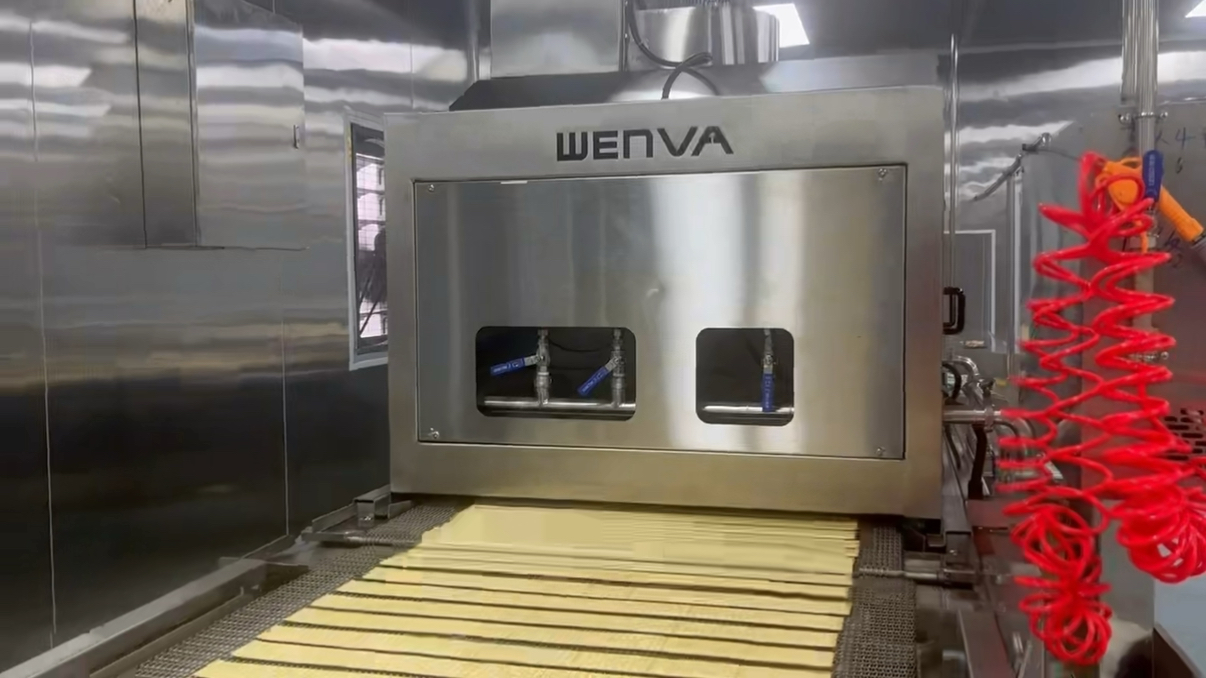
Oil Supply System: Stainless steel oil tank or external pipeline with oil pump to ensure stable and continuous supply.
Atomization Mechanism: Pressure atomization and air-assisted atomization deliver fine, uniform oil mist for better coating.
Injection Control: Adjustable nozzles for angle and direction, suitable for different biscuit shapes and sizes.
Automation Control: Integrated PLC control synchronizes with the biscuit production line, automatically adjusting spray timing and volume.
Eco-Friendly Design: Equipped with an oil mist collection system, ensuring a clean and pollution-free production environment.
| Model | Oil Type | Application | Power | Voltage | Material | Features |
|---|---|---|---|---|---|---|
| Centrifugal Oil Sprayer | Centrifugal disc, dual-side spraying | Biscuits, cookies, crackers | 3.5 – 5.5KW | 220V/380V 50Hz | Food-grade stainless steel | Double-side spraying, oil mist collection system |
Cookie production line
Soda biscuit line
Automatic biscuit making machines
Supporting equipment for sandwich biscuit production lines

Uniform Oil Spraying: Ensures each biscuit has consistent coating, improving taste and appearance.
Enhanced Product Quality: Creates glossy surface, crispy texture, and delicious flavor.
High Efficiency & Energy Saving: Automated control system reduces oil consumption and labor cost.
Easy Maintenance: Stainless steel structure, easy to clean and maintain, long service life.
Smart Integration: Can be seamlessly connected with biscuit production line, cooling conveyor, and automatic packaging machine.
Q1: Will the oil spraying machine cause oil mist pollution in the workshop?
No. The equipment is equipped with an oil mist collection system, ensuring a clean and hygienic production environment.
Q2: Can the oil spraying volume be adjusted?
Yes. The spray volume can be precisely controlled by adjusting pump pressure, nozzle size, or PLC system parameters.
Q3: Is it compatible with a fully automatic biscuit production line?
Absolutely. It can be directly connected to the tunnel oven outlet, cooling system, and packaging line for continuous production.
Q4: What kinds of biscuits can this machine be used for?
It is suitable for various types of biscuits and cookies, including crispy biscuits, soda crackers, butter cookies, and sandwich biscuits.
Hot Tags:Biscuit oil spraying machine, cookie oil injection equipment, automatic oil sprayer for biscuits, centrifugal oil spraying system, food-grade oil sprayer, biscuit production line auxiliary equipment, cookie making machine oil sprayer, oil spraying system for cookies, stainless steel oil sprayer, biscuit coating machine, industrial cookie oiling equipment, biscuit surface oil spraying, automatic biscuit production line, biscuit machine accessories, cookie finishing equipment
This step-by-step guide shows how to start a biscuit factory in Southeast Asia, Africa & South America. Covers market research, licenses, factory location, equipment selection (complete production lines), raw materials, hiring, quality control, distribution, and startup costs ($107K-$261K). Includes common mistakes to avoid.
This article explains how to select a profitable biscuit production line by focusing on real operational factors such as capacity planning, equipment configuration, and hidden costs. It also provides a practical ROI model based on a 4-ton/day line to help investors evaluate returns and make informed decisions.
In modern biscuit manufacturing, a tunnel oven is far more than a simple heating device—it is a core system that determines final product quality.Through multi-zone precise temperature control, adjustable top and bottom heat ratios, optimized hot air circulation design, and intelligent temperature management systems, modern tunnel ovens significantly improve baking consistency and production stability.For food manufacturers, selecting a tunnel oven with stable performance and precise temperature control is a crucial step toward achieving both high product quality and efficient production.As market demands for product quality and manufacturing efficiency continue to increase, tunnel oven technology will continue to evolve toward higher precision and greater automation, providing more reliable solutions for the industrial baking industry.
This article analyzes the industrial production of Toaster Pastry using a modern Double Layered Biscuit production line. It explores product structure, filling deposition technology, lamination control, tunnel oven baking strategy, and automation upgrades. The solution improves efficiency, structural stability, and product consistency, helping manufacturers enter high-value filled bakery markets.
Abstract In modern biscuit production, the double-layered sheet biscuit production line, with its innovative structure and efficient production process, has become a key piece of equipment for improving production efficiency and product quality. Compared to traditional single-layered biscuits, double-layered sheet biscuits offer a richer and more multi-layered texture, giving consumers new choices in biscuit types. Based on the ideas and concepts of double-layered sheet biscuits, Wenva Machinery, in collaboration with our clients, has incorporated new technologies and ideas into its traditional shortbread and chewy biscuit production line, developing a double-layered sheet biscuit production line. This article aims to introduce in detail the working principle, technical advantages, and significant benefits of the double-layered sheet biscuit production line in terms of product taste, appearance, and packaging efficiency. The article also discusses the equipment's automation control, en
This article discusses common tunnel oven problems encountered in biscuit production, including inconsistent baking, underbaked products, and equipment malfunctions. It provides insights into the causes of these issues and offers practical solutions to avoid them. Best practices for tunnel oven operation, such as regular training and maintenance, are also highlighted to ensure efficient and high-quality biscuit production.
In industrial baking production, the tunnel oven length and its temperature zone structure are key technical factors that determine baking quality. A properly designed oven length directly affects the product’s residence time inside the oven, while multi-zone temperature control ensures stable heat distribution and proper product structure formation. Based on tunnel oven operating principles, this article systematically analyzes the relationship between oven length and baking time, the mechanisms of multi-zone temperature control, and the suitability of different tunnel oven structures for various baked products, providing technical guidance for food factories seeking to optimize baking quality.
This article explores custom tunnel oven solutions for biscuit and snack manufacturers, highlighting their efficiency, quality consistency, and flexibility. It discusses the functionality, benefits, and key features of tunnel ovens, as well as their applications in various snack production. The article concludes with guidance on selecting the right oven and answers to common questions.
Choosing the right tunnel oven for biscuit production is a strategic decision that affects capacity utilization, factory layout efficiency, and long-term return on investment. This article explains how to select an industrial baking oven by analyzing the relationship between capacity and oven length, factory layout considerations, and the balance between initial investment and long-term ROI.
The heating system is a critical component of an industrial tunnel oven, directly affecting baking performance, energy efficiency, and operating costs. This article explains how gas and electric tunnel oven heating systems work, compares their energy consumption and maintenance requirements, and analyzes their suitability in different countries and regions, helping manufacturers choose the right tunnel oven solution.
A tunnel oven plays a critical role in modern biscuit production by enabling continuous and stable baking. This article explains how a biscuit tunnel oven works, focusing on its continuous baking principle, temperature zone design, heat transfer methods, and process advantages. It also introduces Wenva Machine’s tunnel oven solutions for industrial biscuit production lines.
This article explores global pretzel biscuit market trends, consumer demand drivers, OEM and private label opportunities, and key considerations for building pretzel biscuit production lines, helping snack manufacturers evaluate market entry and long-term growth strategies.
This article compares automatic pretzel biscuit machines and semi-automatic biscuit machines in terms of labor cost, efficiency, and ROI. It helps startup and established factories choose the right equipment based on production scale, budget, and long-term profitability.
This article explains gas, electric, and diesel tunnel ovens for pretzel biscuits, comparing energy consumption, maintenance, and suitable markets. It highlights why customizable oven length is essential for stable baking, consistent color, and efficient pretzel biscuit production.
This article explains how to choose the right pretzel biscuit production line by analyzing capacity, factory layout, equipment configuration, and ROI. It helps manufacturers select a pretzel biscuit making machine that delivers stable production and long-term profitability.
This article explains how a pretzel biscuit machine works by detailing the complete pretzel biscuit production process, including mixing, forming, alkaline dipping, baking, and cooling. It helps manufacturers understand equipment functions and achieve stable, industrial-scale pretzel biscuit production.
This article explains how to choose the right pretzel biscuit production line by analyzing equipment configuration, automation level, and ROI. It helps manufacturers match production capacity, reduce labor costs, and achieve stable, long-term profitability in pretzel biscuit manufacturing.
Uniform coloring in pretzel biscuits is not achieved by adjusting a single parameter. It is the result of a **well-coordinated system** that includes the alkaline solution tank, press rollers, idler rollers, conveyor belts, and baking oven.By investing in a properly engineered alkaline dipping system, manufacturers can eliminate color inconsistency, stabilize product quality, and enhance the market competitiveness of their pretzel biscuits.
Producing Danish butter cookies at scale is a system challenge rather than a recipe issue. This article analyzes three critical production stages—mixing stability, forming precision, and baking control—using a problem-to-solution approach. It explains why high-butter cookies demand specialized equipment and coordinated process design to achieve consistent appearance, texture, and long-term production stability.
This article provides a comprehensive analysis of industrial double-layer biscuit production lines, covering process flow, key equipment functions, and selection principles. It also compares integrated and modular solution approaches and offers guidance for manufacturers at different development stages, supporting stable and efficient production planning.