Views: 226 Author: WENVA machine Publish Time: 2025-12-15 Origin: Site
Content Menu
● 1. Why Forming Determines the Commercial Success of Soda Biscuits
>> Unlike sweet biscuits or soft cookies, soda biscuits require:
>> Any instability during forming may result in:
● 2. Material Foundations of Soda Biscuit Forming
>> Dough Structure and Physical Properties
>> 2.1 Unique Characteristics of Soda Biscuit Dough
>> 2.2 Dough Structure and Its Influence on Forming Stability
● 3. Temperature Control: An Underestimated Variable in Soda Biscuit Forming
>> 3.1 The Impact of Dough Temperature on Rolling Behavior
>> 3.2 Key Temperature Control Points in Industrial Production
● 4. Moisture Control: The Core Parameter Behind Dough Sheet Stability
>> 4.1 How Moisture Content Affects Forming Quality
>> 4.2 Moisture Management in Industrial Biscuit Production
● 5. Rolling Control: From Thickness Reduction to Structural Engineering
>> 5.1 The Role of Multi-Stage Rolling in Soda Biscuit Production
>> 5.2 Key Rolling Parameters Affecting Forming Consistency
>> 5.3 Why Soda Biscuits Require Dedicated Rolling Systems
● 6. From Rolling to Forming: Docking, Cutting, and Visual Consistency
>> 6.1 The Functional Role of Docking Systems
>> 6.2 Coordination Between Forming and Cutting Systems
● 7. The Equipment Manufacturer's Perspective:
>> Turning Scientific Parameters into Stable Production Capacity
● 8. Conclusion: Stable Forming Comes from Science and System Design
From Processing Principles to Industrial Soda Biscuit Production Line Design
In industrial biscuit manufacturing, soda biscuits are widely regarded as one of the most challenging products to produce consistently at scale.
Although their appearance seems simple, soda biscuits place extremely high demands on dough stability, forming accuracy, and process control.
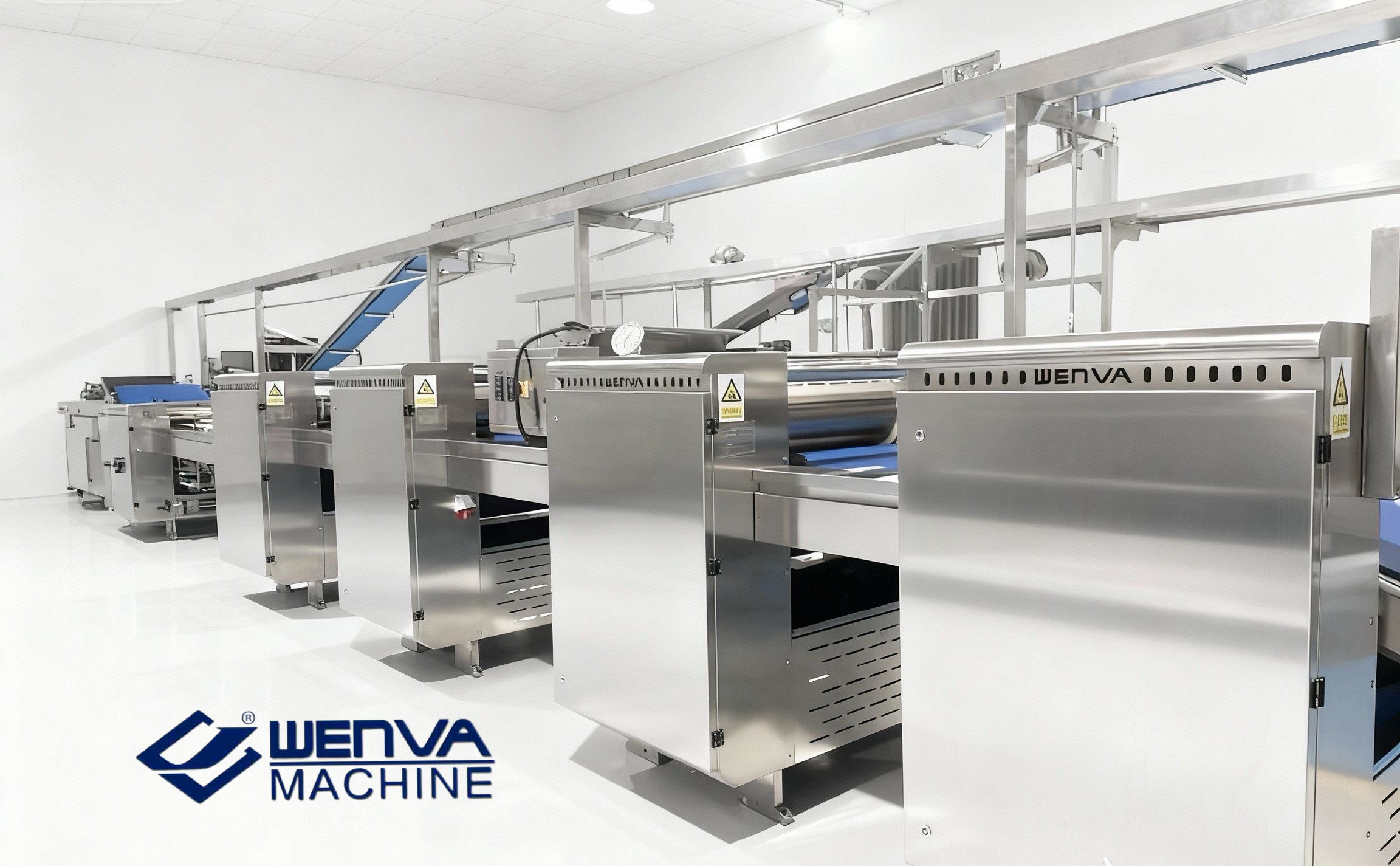
A clearly defined layered structure
Uniform internal pores
Flat surfaces without warping
Clean edges and precisely positioned docking holes
Dough sheet shrinkage or cracking
Inconsistent thickness
Blistering or warping after baking
Noticeable batch-to-batch variation in texture and appearance
For this reason, forming should not be treated as a single machine function. It is the result of food science, processing parameters, and a fully integrated soda biscuit production line working together.
Soda biscuit dough differs significantly from other biscuit doughs. It is typically:
Low in sugar and fat
Relatively high in moisture
Subjected to fermentation or chemical leavening
Designed with a deliberately controlled gluten network
The dough must remain extensible while avoiding excessive elastic recovery. This balance places high requirements on the dough handling system within an industrial biscuit production line.
During rolling and sheeting, the gluten network is not destroyed but reoriented and stabilized through controlled deformation.
When properly managed, this structure allows the dough sheet to:
Maintain continuity through multi-stage rolling
Resist tearing during cutting and docking
Release gases evenly during baking
This controlled structural development is a key difference between industrial biscuit dough processing systems and small-scale or semi-automatic production.
Many forming defects observed on production lines originate not from mechanical issues, but from insufficient temperature management.
Excessive dough temperature
Increased stickiness
Higher risk of roller adhesion
Loss of structural definition after rolling
Insufficient dough temperature
Strong elastic rebound
Dough sheet shrinkage
Cracking during forming
A stable temperature range is essential for continuous rolling and consistent forming performance.
In a modern automatic soda biscuit production line, temperature control extends beyond baking and includes:
Dough discharge temperature after mixing
Ambient conditions in the sheeting and rolling sections
Optional dough sheet stabilization or cooling zones
A properly engineered biscuit dough temperature control system significantly improves forming repeatability and operational stability.
If temperature defines dough condition, moisture defines dough structure.
Moisture directly influences:
Dough plasticity and extensibility
Thickness retention after rolling
Edge definition during cutting and docking
Excessive moisture can cause sheet collapse and deformation, while insufficient moisture often leads to cracking and breakage.
In industrial biscuit making machines, moisture control depends on:
Accurate water dosing systems
Continuous mixing for uniform hydration
Minimizing moisture loss during conveying and rolling
A well-designed biscuit mixing system ensures that dough entering the forming section remains consistent throughout long production runs.
Soda biscuits are not formed by aggressive single-pass rolling. Instead, they rely on:
Gradual thickness reduction
Progressive gluten alignment
Structural stabilization before final forming
This is why a professional soda biscuit sheeting line is built around multi-roller configurations rather than single roller sets.
Critical rolling parameters include:
Roller gap and compression ratio
Roller diameter and surface finish
Speed synchronization and tension control
Together, these elements form a complete biscuit roller system that determines dough sheet uniformity and stability.
Standard biscuit production lines often struggle with:
High-moisture dough stability
Long-term continuous rolling performance
Consistent downstream forming accuracy
For this reason, soda biscuit lines typically employ a multi-roller laminating system specifically designed for layered cracker structures.
Docking holes are not merely decorative. They play a critical role in:
Controlling gas release during baking
Preventing blistering
Ensuring flat and uniform finished products
Whether using rotary moulding or cutting systems, the biscuit forming machine must operate in precise coordination with upstream dough tension and thickness control.
Without this synchronization, even high-precision moulds cannot deliver consistent product quality.
A truly mature soda cracker manufacturing line is not defined by individual machines, but by how effectively process variables are integrated into one system.
When designing a fully automatic soda biscuit production line, our focus as a biscuit machinery manufacturer is built around three core objectives:
Full control of critical processing parameters
Long-term operational stability
High repeatability of forming quality
By integrating temperature control, moisture management, and rolling precision into a unified system, the production line actively supports the forming process rather than simply executing mechanical actions.
Soda biscuit forming is not the result of trial and error, but a repeatable and controllable scientific process.
When temperature, moisture, and rolling control operate as a closed loop, forming stability becomes a built-in capability of the production line.
Choosing an industrial biscuit production equipment manufacturer with a deep understanding of processing science ensures not only reliable machinery, but also long-term consistency, efficiency, and product quality.
Producing Danish butter cookies at scale is a system challenge rather than a recipe issue. This article analyzes three critical production stages—mixing stability, forming precision, and baking control—using a problem-to-solution approach. It explains why high-butter cookies demand specialized equipment and coordinated process design to achieve consistent appearance, texture, and long-term production stability.
This article provides a comprehensive analysis of industrial double-layer biscuit production lines, covering process flow, key equipment functions, and selection principles. It also compares integrated and modular solution approaches and offers guidance for manufacturers at different development stages, supporting stable and efficient production planning.
Building a successful biscuit factory in Africa requires more than identifying market demand or installing modern equipment. Long-term success depends on the ability of the factory to operate continuously, reliably, and efficiently under local conditions. From a biscuit production line manufacturer’s perspective, sustainable operation is the cornerstone of profitability, product consistency, and competitive strength.This article outlines key considerations for achieving sustainable biscuit production in African markets. It begins by emphasizing the importance of understanding local operating environments, including climate conditions, energy structures, and production rhythms. These factors directly influence production line design and long-term stability.The article highlights the strategic importance of the first production line, noting that a stable and well-planned starting point allows manufacturers to establish reliable operations and quality control systems.
Soda biscuit forming is not the result of trial and error, but a repeatable and controllable scientific process.When temperature, moisture, and rolling control operate as a closed loop, forming stability becomes a built-in capability of the production line.Choosing an industrial biscuit production equipment manufacturer with a deep understanding of processing science ensures not only reliable machinery, but also long-term consistency, efficiency, and product quality.
This article explains common quality defects in butter cookie production and the mechanisms behind them. It provides practical guidance on dough preparation, depositing control, and baking conditions, along with equipment and process adjustments that improve uniformity and stability.
In industrial butter cookie production, achieving the signature “buttery, crisp, melt-in-mouth” texture depends not only on the recipe but on two critical technical pillars: **precise temperature control** and **proper fat management**. High-fat dough is extremely sensitive to temperature changes; e
Double-layer biscuit production is a complex engineering system requiring synchronized control over dough rheology, lamination precision, baking dynamics, and cooling stabilization. With properly configured mixing, sheeting, coating, lamination, forming, baking, adhesion, cooling, and packaging equipment—and a reliable equipment partner such as Wenva Machine—factories can achieve high output, consistent quality, and strong market differentiation.
The butter cookie category is entering a new era. Health-conscious consumers, new retail channels, and rapid innovation are reshaping the market. Factories that modernize their equipment and processes will be positioned to lead the next wave of growth.With advanced dough handling, flexible forming technology, and energy-efficient baking systems, Wenva supports manufacturers in producing both classic buttery indulgence and the next generation of better-for-you cookies.
Southeast Asia is rapidly emerging as one of the fastest-growing regions in the global biscuit industry. Driven by a young population, expanding e-commerce channels, and a rising middle class, consumer demand for biscuits in Indonesia, Vietnam, the Philippines, and Thailand continues to accelerate. As local brands grow, many factories face challenges such as limited production capacity, rising labor costs, and a lack of product diversification—making automation and equipment upgrading essential. From the perspective of equipment manufacturers, the region is entering a critical investment cycle over the next five years. Semi-automatic factories are transitioning toward full automation, demand for healthy and innovative biscuit products is increasing, and old facilities urgently require modernization. With its modular production line design, energy-efficient gas tunnel ovens, stable forming and baking technology, and strong engineering support, Wenva is becoming a valuable partner for f
This article explores the top ten biscuit factory machine manufacturers in China, highlighting their unique offerings and contributions to the industry. It provides insights into the features of biscuit manufacturing machines and discusses the future of the biscuit manufacturing industry in China. The article concludes with frequently asked questions to assist potential buyers in making informed decisions.
This article explores the landscape of industrial cookie dough mixer suppliers in China, highlighting the importance of these machines in baking. It discusses various types of mixers, leading suppliers, and the benefits of sourcing from China, including competitive pricing and high quality. The article concludes with tips on choosing the right mixer and answers to frequently asked questions.
This article explores how optimizing roller design and dough handling can enhance forming stability in soda biscuit production. By fine-tuning roller texture, pressure, and dough hydration, manufacturers can achieve consistent product quality. Wenva’s advanced systems support high-efficiency, stable production.
Double layered biscuits represent an innovative and versatile category in the global snack industry, combining multiple layers of dough with or without fillings to create unique textures and flavors. This guide provides a comprehensive overview of these biscuits, including their definitions, key variants, and comparisons with traditional biscuit types. With the ability to customize ingredients, textures, and appearances, double layered biscuits offer exciting opportunities for product differentiation, premium positioning, and creative market segmentation.The production of double layered biscuits involves precise steps such as mixing, rolling, lamination, forming, baking, cooling, and optional filling and packaging. Each step requires specific equipment and process control to achieve consistency. Key equipment features include adjustable rolling thickness, temperature-zoned tunnel ovens, and high-accuracy filling systems.
This article explores the top gas tunnel oven manufacturers and suppliers in Nigeria, highlighting their offerings and the advantages of using gas tunnel ovens. It provides insights into choosing the right oven for your business needs, maintenance practices, and innovations in the industry. Additionally, it answers common questions related to gas tunnel ovens, making it a comprehensive resource for businesses in the baking sector.
This article provides a systematic introduction to how a traditional single-line biscuit factory can be upgraded into a double-layer laminated biscuit production line. It covers every key stage, including equipment assessment, layout redesign, lamination and sheet bonding technology, forming and cutting, tunnel oven calibration, cooling and packaging, as well as staff training and quality validation. Through these solutions, factories can achieve large-scale production of double-layer biscuit products with relatively low investment while significantly improving market competitiveness.
This article explores the top ten tunnel oven manufacturers and suppliers in Vietnam, highlighting their unique offerings and technologies. Tunnel ovens are essential for efficient baking, providing uniformity and high production rates. The featured companies represent the best in the industry, catering to various baking needs. With ongoing innovations and a focus on quality, these manufacturers are well-equipped to meet the demands of the modern baking industry.
In today’s fast-evolving food industry, speed and flexibility have become the lifelines for biscuit brands. With shifting consumer preferences, seasonal launches, and social media-driven trends, manufacturers are under constant pressure to introduce new flavors faster than ever—without compromising quality or efficiency. Wenva Machine, a global specialist in automated biscuit production lines, has responded to this challenge with a modular production system designed for agile manufacturing.
This article discusses how to enhance the production capacity and safety of biscuit production lines through scientific layout design. It emphasizes the importance of workflow optimization, equipment selection, and safety features, providing best practices and case studies to illustrate successful implementations. Continuous improvement is highlighted as key to maintaining efficiency in a competitive market.
# Top Biscuit Production Line Manufacturers and Suppliers in Ethiopia Ethiopia's biscuit industry has experienced remarkable growth in recent years, driven by increasing consumer demand and the establishment of local manufacturing capabilities. This article explores the leading manufacturers and su
Hard biscuit production depends on the formation of a strong, extensible gluten network that provides the desired crispness and layered structure.This article reviewed the entire process — from dough mixing and sheeting to forming and baking — and discussed the role of key ingredients such as flour proteins, sugars, fats, and functional additives.Modern hard biscuit production lines feature automated control systems for precise ingredient dosing, sheeting adjustment, and temperature regulation, ensuring consistent quality and high production efficiency.As the global biscuit market evolves toward healthier, functional products, manufacturers are adopting new raw materials and cleaner formulations.Through continuous optimization of process design and equipment technology, biscuit production lines help manufacturers achieve stable quality, lower costs, and meet diverse consumer demands in the competitive baked goods industry.