| Model: | |
|---|---|
| Availability: | |
| Quantity: | |
Crispy biscuits are loved for their light, crunchy, and melt-in-the-mouth texture. Unlike traditional biscuits, crispy biscuits can reach a minimum thickness of only 1mm, making them extra delicate and enjoyable. Their well-balanced sweetness and subtle buttery or vanilla notes bring a sophisticated snacking experience.
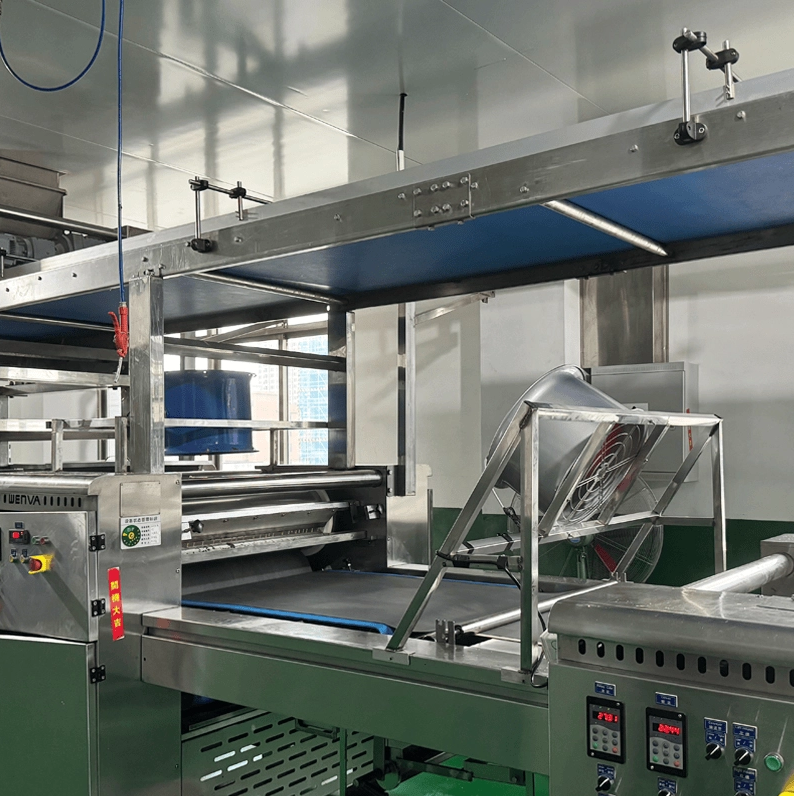
The Wenva Crispy Biscuits Production Line is specially engineered to produce high-quality, uniform, and thin biscuits with excellent texture and appearance. It is the ideal choice for food manufacturers aiming to capture the growing demand for healthy, lightweight, and premium snacks.
Ultra-Thin Production (1mm) – Advanced rolling technology ensures consistently thin biscuits.
Unique Eating Experience – Crispy yet tender, breaking easily with every bite.
Health-Oriented – Less sugar, less oil, in line with modern healthy snacking trends.
Premium Market Opportunity – Perfect for coffee shops, tea houses, and boutique snack brands.
Versatile Flavor Options – Vanilla, cheese, chocolate, spices, and more.
The crispy biscuit production line is designed with precision and stability to guarantee thin, even textures and consistent baking results.
Main processes include:
Dough Mixing System – Smooth and uniform dough preparation.
High-Precision Sheeting & Rolling – Multi-stage control achieves 1mm thin dough sheets.
Delicate Molding System – Ensures biscuit shape without cracking.
Intelligent Baking Tunnel Oven – Multi-zone temperature control for uniform crispiness.
Cooling & Packing System – Designed to handle lightweight biscuits without breakage.
Ultra-Thin Sheeting: Produces biscuits as thin as 1mm with consistent thickness.
Crispness Guaranteed: Precise temperature zoning preserves flavor and crunch.
Energy Options: Gas, electric, or thermal oil ovens to fit local energy supply.
Hygienic Design: Stainless steel structure, fully compliant with international food safety standards.
Flexible Capacity Expansion: Modular design for different production scales.
By choosing the Wenva Crispy Biscuits Production Line, you gain more than a reliable automated solution – you gain access to the fast-growing crispy snack market. With comprehensive technical support, customized production line design, and global after-sales service, Wenva helps your brand stand out in the competitive food industry.

Q1: What is the minimum thickness of biscuits that this production line can produce?
A1: Our crispy biscuit production line can achieve a minimum thickness of 1mm, ensuring an ultra-thin and crunchy texture.
Q2: Can the machine produce other types of biscuits besides crispy biscuits?
A2: Yes, by adjusting the molds or adding specific equipment, the line can also produce soft biscuits, cookies, or soda biscuits.
Q3: What energy options are available for the tunnel oven?
A3: The tunnel oven supports electric heating, gas heating, or thermal oil heating, depending on your local energy supply.
Q4: Is the production line fully automatic?
A4: Yes, the crispy biscuit production line is fully automatic, covering dough mixing, sheeting, molding, baking, cooling, and packaging.
hot tags: crispy biscuit production line, thin biscuit making machine, 1mm biscuit production equipment, automatic crispy biscuit line, crunchy biscuit baking machine, crispy cookies production equipment, industrial biscuit machinery, biscuit factory solutions, low-fat biscuit production, healthy snack manufacturing line
Choosing the right tunnel oven for biscuit production is a strategic decision that affects capacity utilization, factory layout efficiency, and long-term return on investment. This article explains how to select an industrial baking oven by analyzing the relationship between capacity and oven length, factory layout considerations, and the balance between initial investment and long-term ROI.
The heating system is a critical component of an industrial tunnel oven, directly affecting baking performance, energy efficiency, and operating costs. This article explains how gas and electric tunnel oven heating systems work, compares their energy consumption and maintenance requirements, and analyzes their suitability in different countries and regions, helping manufacturers choose the right tunnel oven solution.
A tunnel oven plays a critical role in modern biscuit production by enabling continuous and stable baking. This article explains how a biscuit tunnel oven works, focusing on its continuous baking principle, temperature zone design, heat transfer methods, and process advantages. It also introduces Wenva Machine’s tunnel oven solutions for industrial biscuit production lines.
This article explores global pretzel biscuit market trends, consumer demand drivers, OEM and private label opportunities, and key considerations for building pretzel biscuit production lines, helping snack manufacturers evaluate market entry and long-term growth strategies.
This article compares automatic pretzel biscuit machines and semi-automatic biscuit machines in terms of labor cost, efficiency, and ROI. It helps startup and established factories choose the right equipment based on production scale, budget, and long-term profitability.
This article explains gas, electric, and diesel tunnel ovens for pretzel biscuits, comparing energy consumption, maintenance, and suitable markets. It highlights why customizable oven length is essential for stable baking, consistent color, and efficient pretzel biscuit production.
This article explains how to choose the right pretzel biscuit production line by analyzing capacity, factory layout, equipment configuration, and ROI. It helps manufacturers select a pretzel biscuit making machine that delivers stable production and long-term profitability.
This article explains how a pretzel biscuit machine works by detailing the complete pretzel biscuit production process, including mixing, forming, alkaline dipping, baking, and cooling. It helps manufacturers understand equipment functions and achieve stable, industrial-scale pretzel biscuit production.
This article explains how to choose the right pretzel biscuit production line by analyzing equipment configuration, automation level, and ROI. It helps manufacturers match production capacity, reduce labor costs, and achieve stable, long-term profitability in pretzel biscuit manufacturing.
Uniform coloring in pretzel biscuits is not achieved by adjusting a single parameter. It is the result of a **well-coordinated system** that includes the alkaline solution tank, press rollers, idler rollers, conveyor belts, and baking oven.By investing in a properly engineered alkaline dipping system, manufacturers can eliminate color inconsistency, stabilize product quality, and enhance the market competitiveness of their pretzel biscuits.
Producing Danish butter cookies at scale is a system challenge rather than a recipe issue. This article analyzes three critical production stages—mixing stability, forming precision, and baking control—using a problem-to-solution approach. It explains why high-butter cookies demand specialized equipment and coordinated process design to achieve consistent appearance, texture, and long-term production stability.
This article provides a comprehensive analysis of industrial double-layer biscuit production lines, covering process flow, key equipment functions, and selection principles. It also compares integrated and modular solution approaches and offers guidance for manufacturers at different development stages, supporting stable and efficient production planning.
Building a successful biscuit factory in Africa requires more than identifying market demand or installing modern equipment. Long-term success depends on the ability of the factory to operate continuously, reliably, and efficiently under local conditions. From a biscuit production line manufacturer’s perspective, sustainable operation is the cornerstone of profitability, product consistency, and competitive strength.This article outlines key considerations for achieving sustainable biscuit production in African markets. It begins by emphasizing the importance of understanding local operating environments, including climate conditions, energy structures, and production rhythms. These factors directly influence production line design and long-term stability.The article highlights the strategic importance of the first production line, noting that a stable and well-planned starting point allows manufacturers to establish reliable operations and quality control systems.
Soda biscuit forming is not the result of trial and error, but a repeatable and controllable scientific process.When temperature, moisture, and rolling control operate as a closed loop, forming stability becomes a built-in capability of the production line.Choosing an industrial biscuit production equipment manufacturer with a deep understanding of processing science ensures not only reliable machinery, but also long-term consistency, efficiency, and product quality.
This article explains common quality defects in butter cookie production and the mechanisms behind them. It provides practical guidance on dough preparation, depositing control, and baking conditions, along with equipment and process adjustments that improve uniformity and stability.
In industrial butter cookie production, achieving the signature “buttery, crisp, melt-in-mouth” texture depends not only on the recipe but on two critical technical pillars: **precise temperature control** and **proper fat management**. High-fat dough is extremely sensitive to temperature changes; e
Double-layer biscuit production is a complex engineering system requiring synchronized control over dough rheology, lamination precision, baking dynamics, and cooling stabilization. With properly configured mixing, sheeting, coating, lamination, forming, baking, adhesion, cooling, and packaging equipment—and a reliable equipment partner such as Wenva Machine—factories can achieve high output, consistent quality, and strong market differentiation.
The butter cookie category is entering a new era. Health-conscious consumers, new retail channels, and rapid innovation are reshaping the market. Factories that modernize their equipment and processes will be positioned to lead the next wave of growth.With advanced dough handling, flexible forming technology, and energy-efficient baking systems, Wenva supports manufacturers in producing both classic buttery indulgence and the next generation of better-for-you cookies.
Southeast Asia is rapidly emerging as one of the fastest-growing regions in the global biscuit industry. Driven by a young population, expanding e-commerce channels, and a rising middle class, consumer demand for biscuits in Indonesia, Vietnam, the Philippines, and Thailand continues to accelerate. As local brands grow, many factories face challenges such as limited production capacity, rising labor costs, and a lack of product diversification—making automation and equipment upgrading essential. From the perspective of equipment manufacturers, the region is entering a critical investment cycle over the next five years. Semi-automatic factories are transitioning toward full automation, demand for healthy and innovative biscuit products is increasing, and old facilities urgently require modernization. With its modular production line design, energy-efficient gas tunnel ovens, stable forming and baking technology, and strong engineering support, Wenva is becoming a valuable partner for f
This article explores the top ten biscuit factory machine manufacturers in China, highlighting their unique offerings and contributions to the industry. It provides insights into the features of biscuit manufacturing machines and discusses the future of the biscuit manufacturing industry in China. The article concludes with frequently asked questions to assist potential buyers in making informed decisions.