
Views: 229 Author: Wenva Machinery Publish Time: 2026-01-14 Origin: Site
In modern food processing and baking industries, the industrial tunnel oven is a core piece of equipment for continuous production of biscuits, cookies, crackers, and similar products.
Among all technical configurations, the tunnel oven heating system plays a decisive role in determining product quality, production stability, and long-term operating cost.
Currently, the two most widely used heating systems for tunnel ovens are:
Gas heating systems
Electric heating systems
Although both are designed to deliver controlled thermal energy, their working principles, cost structures, and regional suitability differ significantly.
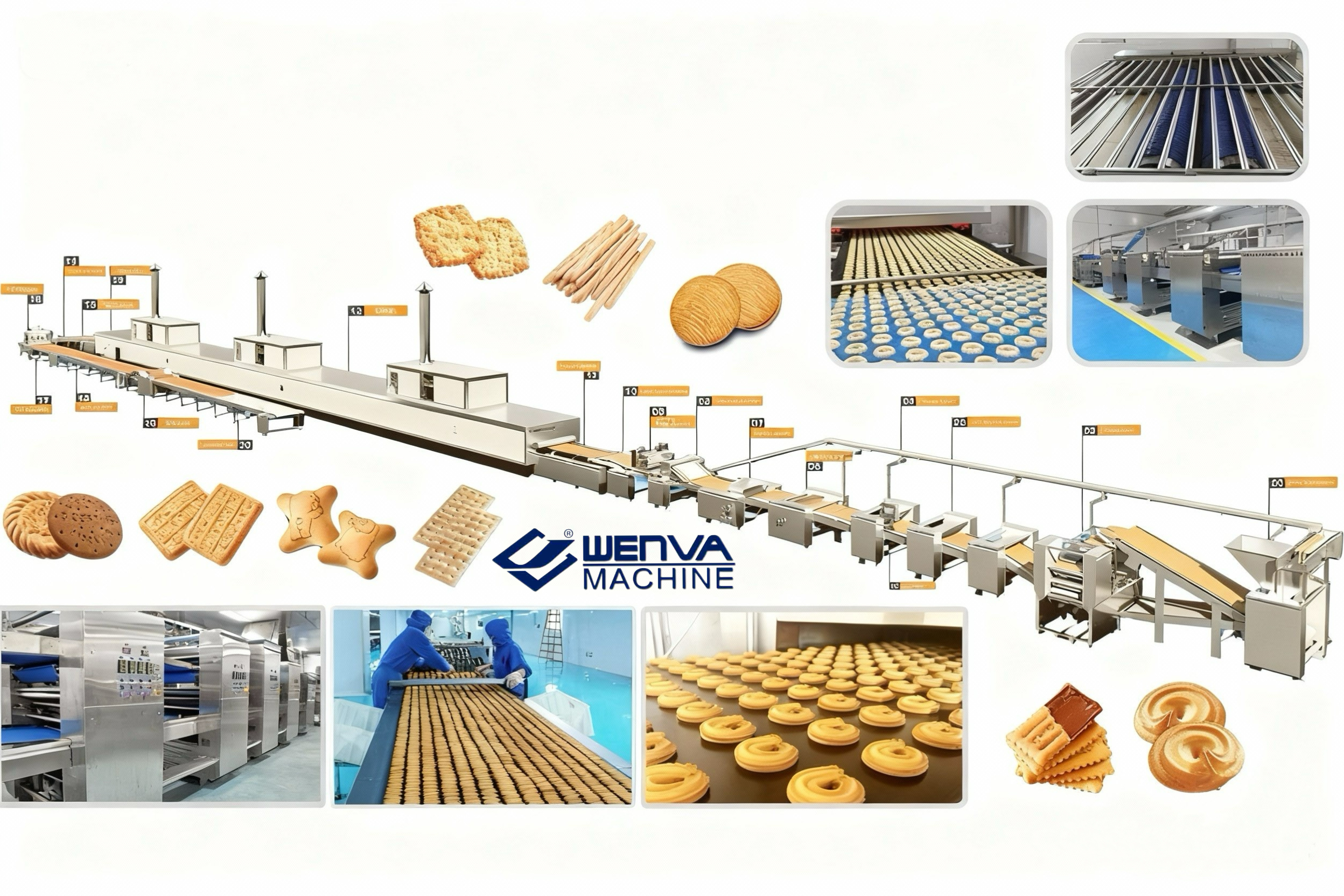
A tunnel oven is not simply a heating chamber. It is a continuous thermal processing system that must operate reliably for long periods.
An effective tunnel oven heating system must be able to:
Provide stable and continuous heat output
Support multiple temperature zones with independent control
Match conveyor speed and baking time precisely
Maintain performance during long, uninterrupted production runs
The choice between gas and electric heating directly impacts these factors.
A gas-heated tunnel oven typically uses natural gas or LPG as its energy source. The main components include:
Gas burners
Hot air circulation fans
Temperature control and safety systems
Exhaust and ventilation systems
Depending on the design, gas tunnel ovens may use direct-fired or indirect-fired heating.
Gas is ignited inside the burner, generating high thermal energy. This heat is transferred into the oven chamber by:
Directly heating the internal air
Or indirectly heating air through a heat exchanger
The heated air is circulated throughout the oven by fans, ensuring uniform heat distribution across all baking zones.
Advantages:
High thermal efficiency
Fast heating response
Lower energy cost per unit in most regions
Well suited for large-capacity, continuous production
Limitations:
Requires stable gas supply
Higher safety and emission management requirements
An electric tunnel oven generates heat through electrical heating elements. Its core components include:
Electric heating tubes or modules
Precision temperature controllers
Hot air circulation fans
Electrical protection systems
Electrical energy is converted directly into heat through heating elements. The generated heat is then distributed evenly within the oven chamber using forced air circulation.
Each temperature zone can be controlled independently, allowing highly accurate and repeatable temperature profiles.
Advantages:
High temperature control accuracy
Cleaner operation with no combustion process
Simpler mechanical structure
Easier cleaning and maintenance
Limitations:
Operating cost depends heavily on local electricity prices
Requires sufficient electrical capacity and stable power supply
From a long-term operational perspective:
Gas tunnel ovens generally offer lower overall energy costs in regions with affordable and stable gas supply.
Electric tunnel ovens can be cost-effective in countries with low electricity prices or high renewable energy usage.
| Item | Gas Heating | Electric Heating |
|---|---|---|
| System complexity | Higher | Lower |
| Routine maintenance | Medium | Low |
| Cleaning requirements | Medium | Low |
| Safety management | High | Medium |
Well-developed gas infrastructure
Strict energy efficiency and emission regulations
Both gas and electric tunnel ovens are widely used, depending on energy pricing and factory conditions.
High proportion of hydro, wind, or solar power
Electric tunnel ovens often show competitive operating costs and environmental advantages.
Unstable gas supply or high gas prices
Electric tunnel ovens are frequently chosen as a more reliable alternative.
As a professional manufacturer of food processing equipment, Wenva Machine offers both gas and electric heating solutions for industrial tunnel ovens.
Wenva Machine tunnel oven systems are designed with a focus on:
Independent temperature zone control
Stable and efficient hot air circulation
Compliance with international safety and energy standards
Reliable performance for long-term continuous operation
By customizing the heating system according to local energy conditions, Wenva Machine helps customers achieve a balance between production efficiency and operating cost.
When selecting a tunnel oven heating system, manufacturers should evaluate:
Local gas and electricity prices
Production capacity and operating hours
Environmental and emission requirements
Available factory infrastructure
The optimal solution is not the most complex one, but the system that best matches local conditions and production goals.
1: Which tunnel oven heating system is more energy-efficient?
In most regions, gas tunnel ovens offer lower overall energy costs for continuous production.
2: Can electric tunnel ovens handle large-scale production?
Yes, provided the factory has sufficient electrical capacity and stable power supply.
3: Does the heating system affect product quality?
With proper temperature zone control, both systems can achieve consistent product quality.
4: Can a tunnel oven switch between gas and electric heating later?
Heating systems are usually defined during the design stage and are not easily interchangeable.
5: Which system requires less maintenance?
Electric tunnel ovens generally require less routine maintenance and cleaning.


