
Views: 222 Author: Wenva Machine Publish Time: 2026-05-18 Origin: Site
In modern automated biscuit production lines, the choice between steel band and wire mesh conveyors directly shapes bake quality, energy efficiency, and long‑term line performance. Drawing on nearly 40 years of engineering experience at Wenva Machine and benchmark data from leading bakery equipment suppliers, this guide explains how to select the right conveyor technology for sandwich biscuit bases versus butter cookie bases. [wenvamachine]

In a tunnel oven, the conveyor is not just a transport device; it is a primary heat transfer surface for the biscuit base. Heat reaches the dough through three mechanisms: [foodsmachine]
- Conduction from the hot band into the dough base
- Convection from hot air circulating in the baking chamber
- Radiation from the oven walls and burners
For most biscuit and cookie bases, the first seconds of baking are dominated by bottom heat from the band, which sets the structure, controls spread, and defines texture. Solid steel and heavy mesh bands provide a large contact area and significant thermal mass, enabling rapid structure development in products requiring strong bottom heat. [foodsmachine]
Solid and perforated steel belts are widely recognized for excellent heat transfer and high thermal conductivity, providing very consistent bake quality. Their flat, continuous surface offers nearly full contact with the dough piece, which intensifies bottom heat in the first oven zones. [biscuitpeople]
Key thermal traits of steel bands: [biscuitpeople]
- High thermal conductivity for rapid energy transfer into the biscuit base
- Large contact area for strong, uniform bottom heat
- Stable, flat geometry that stays true at elevated temperatures
- Lower mass than comparable wire mesh, which can cut band heating energy by up to about 25–30% compared with heavier belts in some systems [biscuitpeople]
Because the belt is reheated every time it re‑enters the baking zone, reducing the mass to heat can significantly lower total oven energy consumption. [biscuitpeople]
Sandwich biscuit bases often require controlled spread, flat profiles, and defined edges to ensure reliable cream deposition and sandwiching accuracy. A smooth steel band supports these requirements:
- Flatness minimizes belt deformations that could distort biscuit geometry [biscuitpeople]
- Uniform contact reduces hot and cold spots, enhancing base color uniformity
- Strong bottom heat promotes rapid structure set, helping bases carry fillings without bending [foodsmachine]
For sandwich cream lines running at high speed, consistent base thickness and flatness translate into more stable filling weight control and fewer rejections.
Wire mesh belts are composed of interwoven metal wires, creating an open structure that allows high levels of air circulation through the belt. Compared with solid steel bands, they typically have: [wireconveyorbelt]
- Lower continuous contact area with the dough
- Higher convective contribution, as hot air rises through and around the product
- Lower effective thermal mass per contact area, depending on wire gauge and design
These traits make wire mesh conveyors ideal where gentler bottom heat, improved moisture removal, or intensive cooling airflow are desired. [multi-conveyor]
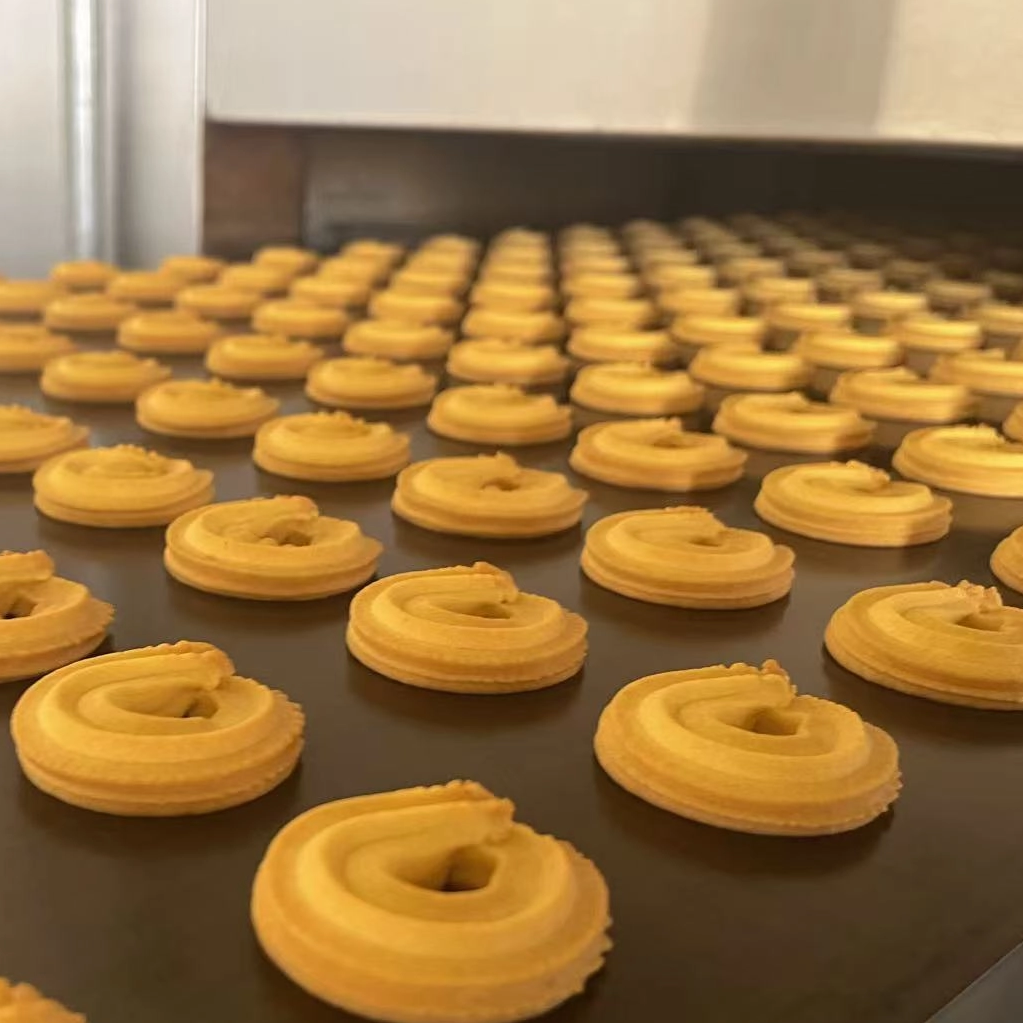
Butter cookies often emphasize rich flavor, delicate crumb, and sometimes pronounced surface patterning. A wire mesh belt supports these attributes by:
- Allowing more balanced bottom and top heat, avoiding over‑browning of the base
- Promoting efficient moisture removal, which helps develop short, crumbly textures
- Facilitating cooling in downstream spiral or multi‑tier systems, reducing footprint for post‑bake handling [wireconveyorbelt]
When combined with carefully tuned convection, wire mesh can help butter cookies retain their shape while developing the desired tender bite and even color.
| Performance angle | Steel band conveyors | Wire mesh conveyors |
|---|---|---|
| Primary heat mode | Conduction‑dominated from flat steel surface biscuitpeople | Convection‑assisted through open mesh structure wireconveyorbelt |
| Heat transfer rate | High, with strong bottom heat and rapid structure set biscuitpeople | Moderate bottom heat, more top/bottom balance wireconveyorbelt |
| Contact with dough | Nearly full‑surface contact; very uniform base color biscuitpeople | Line contact from wires; characteristic grill pattern possible wireconveyorbelt |
| Belt thermal mass | High but optimized; can be up to ~25–30% less energy to heat vs. heavier belts biscuitpeople | Varies with design; open area reduces mass but affects conduction wireconveyorbelt |
| Best for products | Sandwich biscuit bases, crackers, flat cookies needing strong bottom heat and flatness biscuitpeople | Butter cookies, soft biscuits, cooling sections needing gentle bake and airflow wireconveyorbelt |
| Surface flatness | Very high; ideal for precision depositing and sandwiching biscuitpeople | Adequate for many shapes; slight imprint or pattern possible wireconveyorbelt |
| Energy profile | Lower belt heating energy and drive power vs. heavier mesh belts biscuitpeople | Potentially higher oven energy for same bottom heat due to lower direct contact foodsmachine |
In global biscuit plants, producers increasingly adopt fully automated production and packaging lines to raise capacity and reduce manual labor, often running at hundreds of packs per minute. Case studies show that when producers upgrade entire lines, they typically reassess conveyor technology at the same time to align baking performance with new throughput targets. [jacobwhite]
Examples from recent projects: [fulaimachinery]
- A European biscuit brand boosted production to over 120 cartons per minute after integrating high‑speed cartoning and case packing with optimized conveyor systems.
- An emerging Asian biscuit brand selected an automated line after comparing European and Japanese equipment, favoring the solution that best matched product requirements and long‑term operating costs.
These cases underline a crucial point: belt choice is strategic, not just mechanical. It must align with product portfolio, energy costs, and desired automation level.
With nearly 40 years specializing in automated biscuit production lines, Wenva Machine has refined conveyor and oven configurations by benchmarking advanced European and Japanese baking technologies and adapting them to global customer needs. In practice, this means: [wenvamachine]
- Recommending steel bands for high‑speed sandwich biscuit base lines where flatness and bottom heat control are critical
- Specifying wire mesh belts in zones or lines where butter cookies and other delicate products require more flexible thermal profiles and cooling capacity
- Designing hybrid systems where different bands are used in different oven zones or lines within the same factory layout
This application‑driven approach ensures that every conveyor choice is tightly matched to both product performance and factory economics. [wenvamachine]
When we help customers design or upgrade sandwich biscuit lines, we typically follow a structured decision path:
1. Define base specifications
- Target diameter, thickness, flatness tolerance
- Required base strength to support cream and top biscuit
2. Analyze heat profile
- Bottom vs. top heat ratio in each oven zone
- Desired structure set timing and color gradient
3. Evaluate steel band suitability
- Can a steel band deliver the required strong bottom heat in the first zones?
- Will the flatness and uniform contact reduce base warping and uneven coloring?
4. Model energy and maintenance costs
- Estimate potential energy savings from reduced belt heating load [biscuitpeople]
- Evaluate belt cleaning and inspection routines
5. Run pilot tests or digital simulations
- Confirm base geometry, color, and moisture content under target throughput
For most high‑speed, standardized sandwich biscuits, steel bands emerge as the preferred solution because they enable repeatable base quality across long runs.
Butter cookie lines typically follow a slightly different logic:
1. Define texture and appearance targets
- Shortness, bite, surface pattern, color depth
2. Assess risk of over‑baking the base
- Butter cookies can darken quickly from high bottom heat
3. Evaluate wire mesh benefits
- Open structure supports gentler bottom heat and better moisture release [multi-conveyor]
4. Consider cooling strategy
- If the line uses spiral or multi‑tier cooling, wire mesh belts can serve both baking exit and early cooling sections seamlessly [wireconveyorbelt]
5. Confirm flexibility for SKU variety
- Wire mesh may better handle different shapes and deposit patterns in mixed production environments
In many butter cookie applications, wire mesh conveyors provide the thermal flexibility and airflow needed to maintain delicate texture and reduce base scorching.
From a food safety and operational standpoint, both belt types must be evaluated for cleaning regimes and expected lifespan.
- Steel bands
- Offer a smooth, non‑porous surface that is relatively easy to scrape and clean in place [biscuitpeople]
- Require alignment, tracking, and tension control to avoid long‑term stress and edge damage
- Wire mesh belts
- The open structure allows crumbs and fines to fall through but may necessitate more frequent cleaning underneath the belt path [wireconveyorbelt]
- Wire fatigue and damaged strands must be monitored to prevent contamination
Well‑designed automated lines from specialized manufacturers integrate cleaning systems and tension controls tailored to the selected belt type, extending useful life and reducing unplanned downtime. [wenvamachine]
Energy usage is increasingly central to equipment decisions. Studies of baking belts indicate that up to around 25% of an oven's energy can be consumed in heating the belt itself, making belt mass and thermal efficiency crucial. [biscuitpeople]
- Steel belts can be engineered to reduce heating energy by up to 30% compared with heavier mesh belts, while still delivering high‑quality baking. [biscuitpeople]
- Optimized oven design (e.g., band preheating and precise zone control) further enhances the sustainability profile of steel‑band lines used for sandwich biscuits. [foodsmachine]
For butter cookie lines where wire mesh is preferred for product reasons, energy efficiency can still be improved via recirculation design, zone zoning, and smart controls rather than belt substitution alone. [foodsmachine]
Many mid‑to‑large biscuit plants operate multiple product families under one roof. In these environments, Wenva Machine often recommends hybrid strategies:
- Dedicated steel band lines for high‑volume sandwich biscuits and crackers
- Dedicated mesh lines for butter cookies, filled soft biscuits, or products requiring long cooling conveyors
- Zoned ovens where early zones use a steel band (for strong bottom heat) and later zones feed onto mesh sections for cooling and finishing, where mechanically and thermally feasible
This hybrid approach balances product‑specific optimization with shared infrastructure, making best use of available floor space and utilities. [wenvamachine]
From an engineering and operations point of view, the most practical rule of thumb is:
- Choose steel band conveyors when you need:
- High, uniform bottom heat
- Flat, dimensionally precise bases (sandwich biscuits, crackers)
- Optimized belt heating energy and stable long‑run performance
- Choose wire mesh conveyors when you need:
- Gentle baking for delicate butter cookies
- Strong airflow and moisture removal
- Integrated cooling and flexible handling of shapes and SKUs
By aligning conveyor selection with both product requirements and factory strategy, manufacturers can unlock better bake quality, lower operating costs, and higher line reliability. [wenvamachine]
If you are planning a new sandwich biscuit or butter cookie line—or looking to retrofit existing ovens—Wenva Machine can help you:
- Audit current baking performance and energy usage
- Model how steel band or wire mesh upgrades would impact product quality
- Design a full automated production line that integrates dough mixing, forming, baking, cooling, and packaging around the right conveyor technology [wenvamachine]
Contact our engineering team to discuss your specific products, layouts, and throughput targets, and we will propose a conveyor and oven configuration tailored to your needs. [wenvamachine]
1. Which conveyor type is best for high‑speed sandwich biscuit bases?
For most high‑speed sandwich biscuit bases, a steel band conveyor is preferred because it delivers strong, even bottom heat and excellent flatness, which support accurate cream depositing and sandwiching. [biscuitpeople]
2. Can I use wire mesh belts for both butter cookies and sandwich biscuits?
Technically yes, but you may compromise performance for sandwich bases that expect strong bottom heat and tight flatness; a dedicated steel band line typically yields more consistent results for these products. [biscuitpeople]
3. How does belt choice affect oven energy consumption?
Because heating the belt can account for a significant portion of oven energy, optimized steel belts can cut belt heating energy by up to about 25–30% compared with heavier alternatives, improving total line efficiency. [biscuitpeople]
4. Are steel band conveyors harder to maintain than wire mesh conveyors?
Steel bands require precise tracking and tension management but offer a smooth, easy‑to‑clean surface; wire mesh belts may need more frequent inspection for wire fatigue and cleaning under the belt due to product fines. [wireconveyorbelt]
5. Can Wenva Machine support hybrid factories with both belt types?
Yes. Wenva Machine designs and supplies complete biscuit production lines, including ovens and conveyors, and can configure steel band, wire mesh, or hybrid solutions according to your product mix and factory layout. [wenvamachine]
1. Biscuit People – Solid Steel Belts: "Solid steel bake oven belts deliver exceptional performance in terms of bake quality."
[https://www.biscuitpeople.com/product/636-solid-steel-belts] [biscuitpeople]
2. Biscuit People – Steel Belt Conveyor Systems: "No other material can compete when it comes to a steel belt's baking qualities."
[https://www.biscuitpeople.com/product/Steel-belt-conveyor-systems] [biscuitpeople]
3. Golden Bake Group – Heat Transfer in Biscuit Baking Oven: "Solid steel bands and heavy mesh bands have a relatively large heat mass and a large area in contact with biscuit doughs."
[https://www.foodsmachine.net/heat-transfer-in-biscuit-baking-oven.html] [foodsmachine]
4. WENVA Machine – Company Profile and Product Information
[https://www.wenvamachine.com] [wenvamachine]
[https://www.wenvamachine.com/your-trusted-partner-in-biscuit-machinery-wenva-machine-invites-you-to-gulfood-manufacturing-2025.html] [wenvamachine]
5. Jacob White – Biscuit Brand Increases Production Case Study
[https://www.jacobwhite.com/case-studies/biscuit-brand-increases-production] [jacobwhite]
6. Foodline Food Machinery – Fully Automatic Biscuit Production Line Case
[https://www.fulaimachinery.com/cases/23.html] [fulaimachinery]
7. Multi‑Conveyor – 3‑Tiered Wire Mesh Belt Bakery Cooling Conveyor
[https://www.multi-conveyor.com/multi-media-center/press-releases-and-more/id/75/3-tiered-wire-mesh-belt-bakery-cooling-conveyor] [multi-conveyor]
8. Wire Mesh Cooling Conveyor Belt for Food Manufacturing
[https://www.wireconveyorbelt.com/conveyor-belt/belting/cooling-conveyor-belt.html] [wireconveyorbelt]
9. Sewtec – Biscuit Packaging Machine Case Study
[https://www.sewtec.co.uk/case-study/secondary-packaging-in-the-baking-industry/] [sewtec.co]
10. WENVA – Exhibition and Technology Innovation News


