| Model: | |
|---|---|
| Availability: | |
| Quantity: | |
The Steel Strip Cookie Production Line is a modern, fully automatic solution designed for large-scale cookie and biscuit manufacturing. Unlike traditional cookie production lines, this system adopts a steel belt conveyor that ensures stable, uniform, and continuous baking. It is widely applied in the production of wire-cut cookies, depositor cookies, butter cookies, shortbread biscuits, and other customized cookie products.
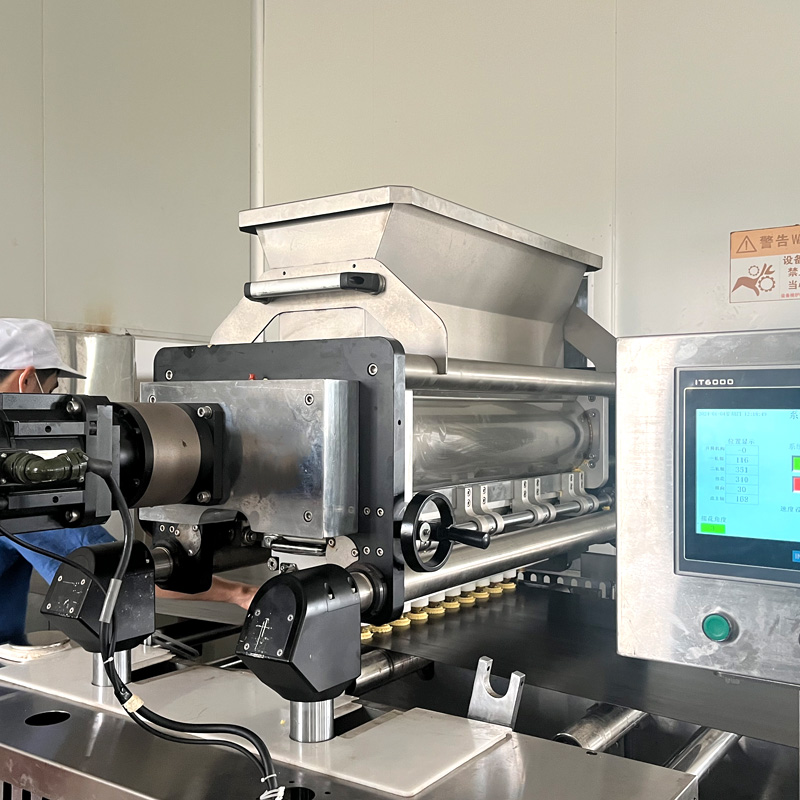
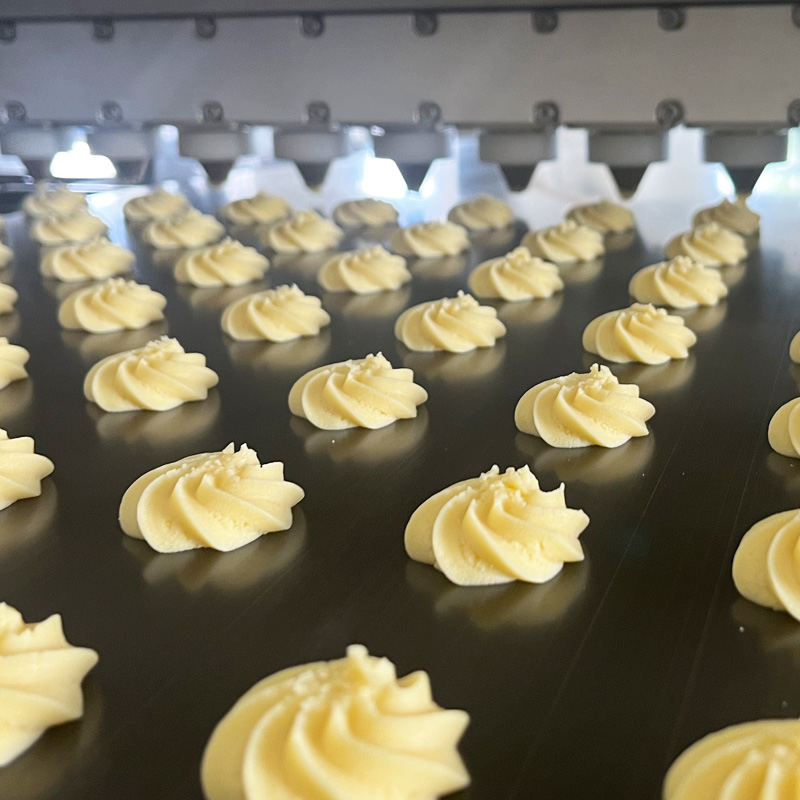
Equipped with independent servo motor drives and PLC intelligent control systems, the line guarantees precision in dough feeding, shaping, and baking. Each discharging mouth is controlled by an independent metering pump, ensuring all cookies maintain consistent size, weight, and appearance.
This production line can be flexibly configured with steel belt tunnel ovens, oil sprayers, and automatic packaging solutions, making it an ideal choice for industrial cookie factories, commercial bakeries, and snack food manufacturers looking for efficient, stable, and high-quality cookie production.
High-Efficiency Dough Mixer
Ensures even mixing of flour, butter, sugar, and other raw ingredients, creating a uniform dough foundation for superior cookie texture.
Molding & Depositing Machine
Adopts wire-cutting and depositing technology to produce cookies with diverse shapes. With the help of interchangeable molds, manufacturers can create round cookies, square cookies, flower-shaped cookies, and customized cookie designs.
Steel Belt Conveyor
The heart of the production line, providing stable conveying and supporting continuous baking. The steel strip surface ensures hygiene, durability, and easy cleaning.
Steel Belt Tunnel Oven
A multi-zone baking oven with adjustable temperature control for even heating. Ensures cookies achieve a golden color, crispy edges, and uniform baking quality. Options include electric heating, gas heating, and thermal oil heating.
Oil Spraying Machine
Sprays oil evenly on the cookie surface, enhancing flavor, shine, and color.
Cooling Conveyor
Rapidly cools baked cookies under controlled airflow, preventing moisture loss and preserving texture.
Automatic Packaging Machine
Handles flow-pack or vertical packaging, ensuring cookies are sealed, hygienic, and ready for distribution.
Precision Control – Independent servo motors and PLC systems ensure accurate dough feeding, shaping, and weight control.
Flexible Production – Capable of producing a wide variety of cookies, from wire-cut butter cookies to shortbread biscuits.
Stable Baking Performance – Steel belt tunnel oven guarantees consistent quality and industrial-scale output.
Customizable Line – Available in different widths and capacities to meet diverse factory layouts and production requirements.
Durable & Hygienic Design – Food-grade stainless steel and easy-to-clean structure ensure compliance with international food safety standards.
High Productivity – Supports continuous, large-scale cookie production, reducing labor costs and improving efficiency.
The Steel Belt Cookie Production Line is suitable for producing:
Wire-cut cookies
Depositor cookies
Butter cookies
Shortbread biscuits
Customized shape cookies
Industrial bakery snacks
It is widely used in industrial bakeries, snack food factories, contract manufacturing facilities, and large-scale cookie producers.
Over 40 years of food machinery manufacturing experience.
Tailored solutions for both startup bakeries and large-scale factories.
Compliance with CE, ISO, and international food machinery standards.
Full after-sales service with installation, training, and technical support.
Model:RQJ1000
Depositor Capacity(8h):2500-3000Kg
Power:13.4Kw
Q1: What types of cookies can this production line make?
A1: It can produce wire-cut cookies, depositor cookies, butter cookies, shortbread biscuits, and customized cookie designs.
Q2: Can I use different tunnel ovens with this line?
A2: Yes, the production line is compatible with steel belt tunnel ovens, with options for electric, gas, or thermal oil heating.
Q3: What is the advantage of the steel belt conveyor compared to mesh belt conveyors?
A3: Steel belts provide more stable conveying, better hygiene, and improved baking consistency, making them ideal for delicate cookies.
Q4: Is the system fully automatic?
A4: Yes, from dough mixing to packaging, the line is fully automated, reducing manual labor and increasing efficiency.
Q5: Can the line be customized for different production capacities?
A5: Absolutely. We offer different working widths, oven lengths, and production capacities to meet customer requirements.
Hot Tags:Steel Strip Cookie Production Line, Cookie Making Machine, Automatic Cookie Production Equipment, Industrial Cookie Machinery, Steel Belt Biscuit Baking Machine, Wire-Cut Cookie Production Line, Depositor Cookie Machine, Shortbread Cookie Manufacturing Equipment, Steel Belt Tunnel Oven for Cookies, Cookie Packaging Machine, Cookie Factory Production Line, Customized Cookie Production Solution
Abstract In modern biscuit production, the double-layered sheet biscuit production line, with its innovative structure and efficient production process, has become a key piece of equipment for improving production efficiency and product quality. Compared to traditional single-layered biscuits, double-layered sheet biscuits offer a richer and more multi-layered texture, giving consumers new choices in biscuit types. Based on the ideas and concepts of double-layered sheet biscuits, Wenva Machinery, in collaboration with our clients, has incorporated new technologies and ideas into its traditional shortbread and chewy biscuit production line, developing a double-layered sheet biscuit production line. This article aims to introduce in detail the working principle, technical advantages, and significant benefits of the double-layered sheet biscuit production line in terms of product taste, appearance, and packaging efficiency. The article also discusses the equipment's automation control, en
This article discusses common tunnel oven problems encountered in biscuit production, including inconsistent baking, underbaked products, and equipment malfunctions. It provides insights into the causes of these issues and offers practical solutions to avoid them. Best practices for tunnel oven operation, such as regular training and maintenance, are also highlighted to ensure efficient and high-quality biscuit production.
In industrial baking production, the tunnel oven length and its temperature zone structure are key technical factors that determine baking quality. A properly designed oven length directly affects the product’s residence time inside the oven, while multi-zone temperature control ensures stable heat distribution and proper product structure formation. Based on tunnel oven operating principles, this article systematically analyzes the relationship between oven length and baking time, the mechanisms of multi-zone temperature control, and the suitability of different tunnel oven structures for various baked products, providing technical guidance for food factories seeking to optimize baking quality.
This article explores custom tunnel oven solutions for biscuit and snack manufacturers, highlighting their efficiency, quality consistency, and flexibility. It discusses the functionality, benefits, and key features of tunnel ovens, as well as their applications in various snack production. The article concludes with guidance on selecting the right oven and answers to common questions.
Choosing the right tunnel oven for biscuit production is a strategic decision that affects capacity utilization, factory layout efficiency, and long-term return on investment. This article explains how to select an industrial baking oven by analyzing the relationship between capacity and oven length, factory layout considerations, and the balance between initial investment and long-term ROI.
The heating system is a critical component of an industrial tunnel oven, directly affecting baking performance, energy efficiency, and operating costs. This article explains how gas and electric tunnel oven heating systems work, compares their energy consumption and maintenance requirements, and analyzes their suitability in different countries and regions, helping manufacturers choose the right tunnel oven solution.
A tunnel oven plays a critical role in modern biscuit production by enabling continuous and stable baking. This article explains how a biscuit tunnel oven works, focusing on its continuous baking principle, temperature zone design, heat transfer methods, and process advantages. It also introduces Wenva Machine’s tunnel oven solutions for industrial biscuit production lines.
This article explores global pretzel biscuit market trends, consumer demand drivers, OEM and private label opportunities, and key considerations for building pretzel biscuit production lines, helping snack manufacturers evaluate market entry and long-term growth strategies.
This article compares automatic pretzel biscuit machines and semi-automatic biscuit machines in terms of labor cost, efficiency, and ROI. It helps startup and established factories choose the right equipment based on production scale, budget, and long-term profitability.
This article explains gas, electric, and diesel tunnel ovens for pretzel biscuits, comparing energy consumption, maintenance, and suitable markets. It highlights why customizable oven length is essential for stable baking, consistent color, and efficient pretzel biscuit production.
This article explains how to choose the right pretzel biscuit production line by analyzing capacity, factory layout, equipment configuration, and ROI. It helps manufacturers select a pretzel biscuit making machine that delivers stable production and long-term profitability.
This article explains how a pretzel biscuit machine works by detailing the complete pretzel biscuit production process, including mixing, forming, alkaline dipping, baking, and cooling. It helps manufacturers understand equipment functions and achieve stable, industrial-scale pretzel biscuit production.
This article explains how to choose the right pretzel biscuit production line by analyzing equipment configuration, automation level, and ROI. It helps manufacturers match production capacity, reduce labor costs, and achieve stable, long-term profitability in pretzel biscuit manufacturing.
Uniform coloring in pretzel biscuits is not achieved by adjusting a single parameter. It is the result of a **well-coordinated system** that includes the alkaline solution tank, press rollers, idler rollers, conveyor belts, and baking oven.By investing in a properly engineered alkaline dipping system, manufacturers can eliminate color inconsistency, stabilize product quality, and enhance the market competitiveness of their pretzel biscuits.
Producing Danish butter cookies at scale is a system challenge rather than a recipe issue. This article analyzes three critical production stages—mixing stability, forming precision, and baking control—using a problem-to-solution approach. It explains why high-butter cookies demand specialized equipment and coordinated process design to achieve consistent appearance, texture, and long-term production stability.
This article provides a comprehensive analysis of industrial double-layer biscuit production lines, covering process flow, key equipment functions, and selection principles. It also compares integrated and modular solution approaches and offers guidance for manufacturers at different development stages, supporting stable and efficient production planning.
Building a successful biscuit factory in Africa requires more than identifying market demand or installing modern equipment. Long-term success depends on the ability of the factory to operate continuously, reliably, and efficiently under local conditions. From a biscuit production line manufacturer’s perspective, sustainable operation is the cornerstone of profitability, product consistency, and competitive strength.This article outlines key considerations for achieving sustainable biscuit production in African markets. It begins by emphasizing the importance of understanding local operating environments, including climate conditions, energy structures, and production rhythms. These factors directly influence production line design and long-term stability.The article highlights the strategic importance of the first production line, noting that a stable and well-planned starting point allows manufacturers to establish reliable operations and quality control systems.
Soda biscuit forming is not the result of trial and error, but a repeatable and controllable scientific process.When temperature, moisture, and rolling control operate as a closed loop, forming stability becomes a built-in capability of the production line.Choosing an industrial biscuit production equipment manufacturer with a deep understanding of processing science ensures not only reliable machinery, but also long-term consistency, efficiency, and product quality.
This article explains common quality defects in butter cookie production and the mechanisms behind them. It provides practical guidance on dough preparation, depositing control, and baking conditions, along with equipment and process adjustments that improve uniformity and stability.
In industrial butter cookie production, achieving the signature “buttery, crisp, melt-in-mouth” texture depends not only on the recipe but on two critical technical pillars: **precise temperature control** and **proper fat management**. High-fat dough is extremely sensitive to temperature changes; e