
Views: 222 Author: Wenva Machine Publish Time: 2026-05-20 Origin: Site
After four decades engineering automated biscuit production lines at Wenva Machine, I've witnessed firsthand how choosing between rotary molding and wire-cutting technology fundamentally shapes production efficiency, product quality, and profitability. These two precision forming methods dominate modern cookie manufacturing, yet each serves distinctly different dough characteristics and production objectives. [youtube]
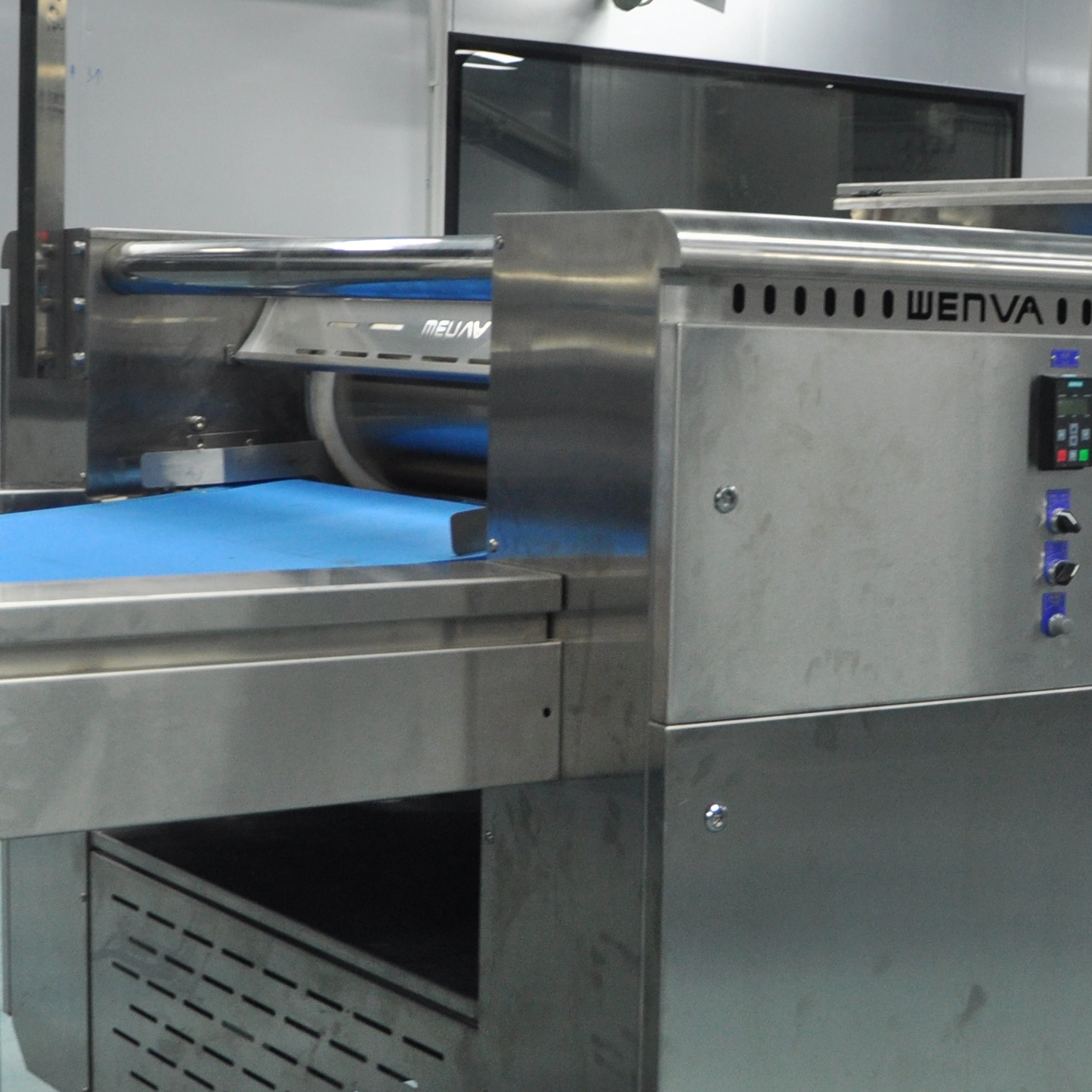
Rotary molding represents the industry standard for soft, sticky, and high-fat cookie formulations that demand gentle handling and intricate surface detailing. The technology operates through precision-engraved cylindrical molds that rotate continuously, pressing soft dough into cavities to create perfectly formed shapes with raised patterns, embossed designs, or brand logos. [eversmartbiscuitmachine]
The rotary moulder feeds soft cookie dough between two counter-rotating rollers—one featuring engraved patterns (the mold roller) and one providing backing support. As dough passes through this precision gap, it fills the engraved cavities completely, creating three-dimensional shapes with exceptional detail retention. Modern systems from manufacturers like Wenva Machine can produce up to 150 rows per minute while maintaining consistent weight tolerances within ±2%. [alibaba]
Key operational advantages include:
- Gentle dough handling that preserves texture in delicate, high-butter formulations containing 25-40% fat content [pmc.ncbi.nlm.nih]
- Quick mold changeover capabilities allowing product transitions in under 15 minutes with minimal production downtime [readingbakery]
- Superior pattern transfer that creates raised designs, logos, and intricate surface details impossible with other forming methods [foodsmachine]
- Consistent portion control ensuring uniform weight distribution critical for premium cookie brands [alibaba]
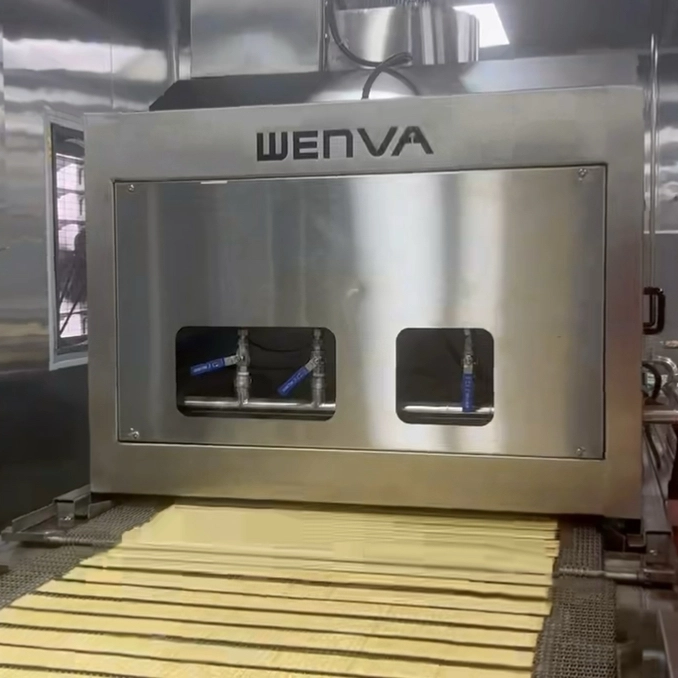
Wire-cutting systems excel at processing stiffer dough formulations and creating complex geometric shapes that require clean edges and structural integrity. This method extrudes dough through shaped dies, then uses precisely tensioned wires to slice the continuous dough rope into individual portions at programmable intervals. [foodsmachine]
The process begins with dough forced through custom-shaped extrusion dies under controlled pressure, forming continuous ribbons or ropes of specific cross-sectional profiles. High-tension stainless steel wires mounted on servo-controlled cutting frames then slice through the extruded dough at precisely timed intervals, creating individual cookie pieces with clean, sharp edges. [alibaba]
Primary advantages include:
- Versatile shape capabilities accommodating round, square, rectangular, oval, and custom geometric profiles through interchangeable dies [alibaba]
- Inclusion compatibility allowing chunks, chips, nuts, dried fruits, and other particulates without disrupting the cutting process [youtube]
- High-speed automation achieving production rates exceeding 200 cuts per minute on advanced systems [readingbakery]
- Minimal dough stress preserving crumb structure in hard biscuit and cracker formulations [py-foodmachine]
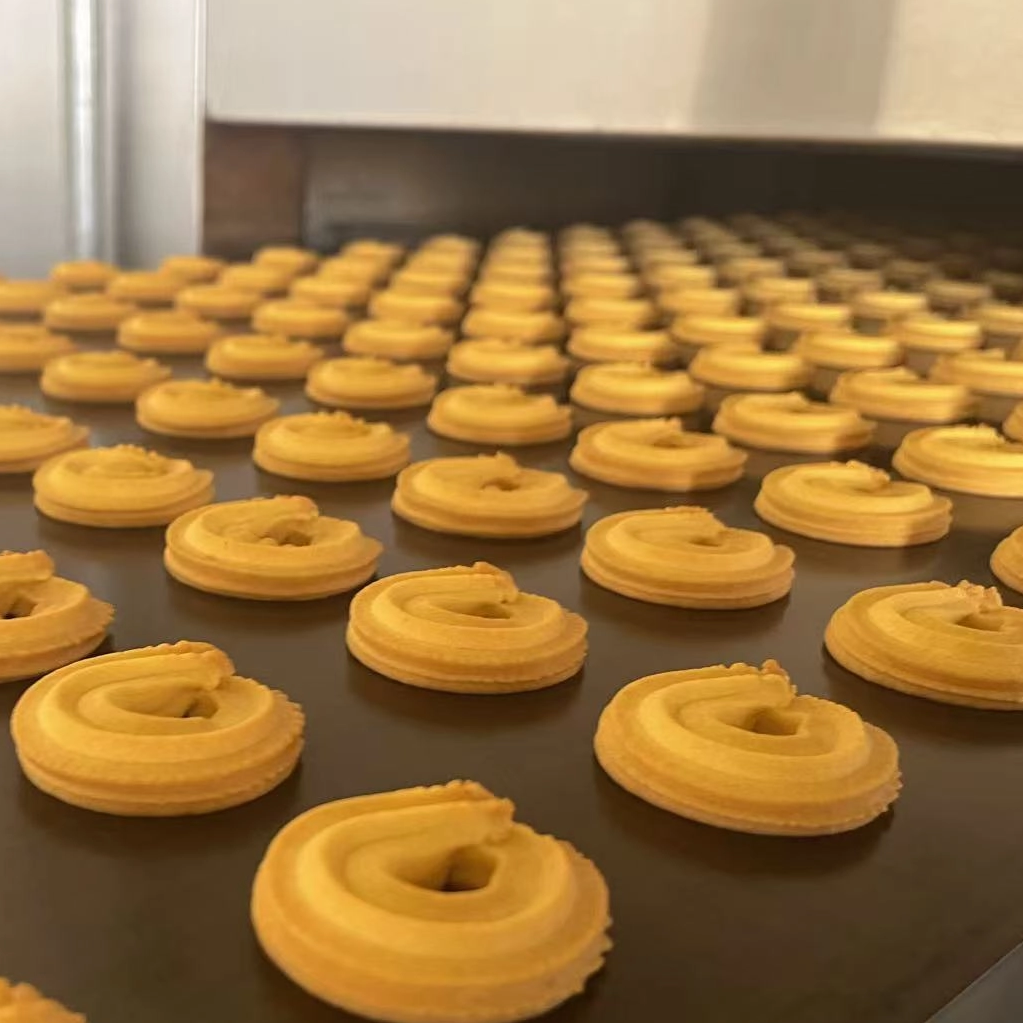
Rotary moulding systems demonstrate superior performance with soft, short dough formulations characterized by high fat content (30-45%), elevated sugar ratios, and tender, crumbly textures. These dough types typically contain minimal gluten development and exhibit sticky, cohesive properties that make wire-cutting impractical. [eversmartbiscuitmachine]
Ideal product categories:
- Butter cookies and shortbread requiring premium appearance and delicate mouthfeel [youtube]
- Danish-style butter biscuits featuring intricate surface patterns and high-definition branding [conference.biscuitpeople]
- Decorated cookies demanding precise pattern transfer for seasonal or themed designs [foodsmachine]
- Premium specialty cookies where appearance and texture justify higher production costs [readingbakery]
The global biscuits market, valued at USD 134.1 billion in 2025, continues expanding at 4.00% CAGR through 2034, with premium butter cookie segments showing particularly strong growth in Asian and European markets. [imarcgroup]
Wire-cutting technology serves stiffer, more elastic dough formulations with lower fat content (15-25%), higher protein development, and structural integrity requirements. These harder doughs maintain their extruded shape through the cutting process and develop characteristic crisp textures during baking. [py-foodmachine]
Primary product segments:
- Hard biscuits and crackers requiring structural strength and extended shelf life [youtube]
- Inclusion-containing cookies with chocolate chips, nuts, oatmeal, or dried fruit pieces [alibaba]
- Health-oriented biscuits incorporating whole grains, seeds, and functional ingredients [foodsmachine]
- Cost-sensitive product lines where production efficiency drives profitability [alibaba]
Research indicates wire-cutting systems can reduce per-unit production costs by 15-22% compared to rotary molding when producing simple geometric shapes at volumes exceeding 500kg/hour. [rotovia]
Modern rotary moulding systems incorporate servo-driven roller synchronization that maintains gap tolerances within ±0.1mm across the entire roller width, ensuring consistent pattern depth and dough thickness. Precision-machined stainless steel or aluminum rollers undergo computer-controlled engraving processes achieving surface detail resolution down to 0.5mm, enabling reproduction of intricate logos, text, and decorative patterns. [alibaba]
Quality control capabilities:
- Weight consistency: ±1.5% variance across production runs through automated gap adjustment [alibaba]
- Pattern fidelity: 99.5% detail transfer accuracy from engraved rollers to finished cookies [eversmartbiscuitmachine]
- Thickness uniformity: Automated dough feeding systems maintain ±0.3mm thickness consistency [readingbakery]
- Temperature control: Integrated cooling systems prevent dough sticking and pattern degradation [conference.biscuitpeople]
Advanced wire-cutting systems utilize servo-controlled wire tensioning maintaining 40-60N force consistency throughout production runs, delivering clean cuts without dough deformation or dragging. Programmable logic controllers (PLCs) coordinate extrusion speed, wire cutting frequency, and conveyor advancement with ±0.2% timing accuracy, ensuring dimensional consistency across thousands of pieces per hour. [alibaba]
Precision features include:
- Dimensional accuracy: ±2mm tolerance on final cookie dimensions through synchronized cutting [alibaba]
- Edge quality: Clean, sharp edges without tearing or compression from optimized wire tension [foodsmachine]
- Inclusion distribution: Maintains uniform particulate dispersion without disrupting cutting action [youtube]
- Multi-lane synchronization: Coordinates 6-12 parallel cutting lanes with ±0.5-second timing variance [readingbakery]
| Performance Factor | Rotary Molding | Wire-Cutting |
|---|---|---|
| Maximum Speed | 120-150 rows/min eversmartbiscuitmachine | 180-220 cuts/min readingbakery |
| Changeover Time | 12-18 minutes eversmartbiscuitmachine | 8-12 minutes readingbakery |
| Dough Waste | 3-5% rotovia | 2-4% rotovia |
| Energy Consumption | 8-12 kW/hour readingbakery | 6-9 kW/hour readingbakery |
| Operator Skill Level | Intermediate-Advanced | Basic-Intermediate |
| Maintenance Frequency | Weekly mold cleaning eversmartbiscuitmachine | Daily wire replacement foodsmachine |
| Floor Space Required | 4.5-6 m² | 3.5-5 m² |
Wenva Machine's automated production lines integrate both technologies, achieving outputs ranging from 200-1250 kg/hour depending on product specifications and line configuration. Our 40 years of manufacturing experience demonstrates that properly configured systems can maintain 95%+ operational efficiency with planned maintenance protocols. [wenvamachine]
Rotary molding systems require higher initial capital investment due to precision-machined engraved rollers, which typically cost USD $3,500-$15,000 per set depending on roller width, pattern complexity, and material specifications. Complete production lines incorporating rotary moulders range from USD $45,000-$180,000 for systems handling 200-800 kg/hour capacities. [rotovia]
Wire-cutting equipment presents lower entry costs, with basic systems starting at USD $2,680-$8,000 for single-lane units and complete automated lines ranging USD $35,000-$120,000 for comparable throughput capacities. However, ongoing operational costs include frequent wire replacement (every 8-16 hours of continuous operation) and die maintenance. [foodsmachine]
Beyond capital investment, total cost of ownership varies significantly between technologies based on production volume, product mix, and operational patterns: [rotovia]
- Rotary molding: Higher labor skill requirements and mold inventory costs offset by lower per-unit material waste and premium product pricing [readingbakery]
- Wire-cutting: Lower operator training costs and faster changeovers balanced against consumable wire expenses and die replacement cycles [foodsmachine]
- Energy efficiency: Modern wire-cutting systems consume 25-30% less energy per kilogram produced compared to rotary moulding for equivalent throughput [readingbakery]
Industry data suggests break-even points typically occur around 18-24 months for rotary molding investments in premium product segments, while wire-cutting systems often achieve payback within 12-18 months in high-volume applications. [rotovia]
At Wenva Machine, we design fully automated biscuit production lines incorporating optimal forming technology based on specific product portfolios, production volumes, and quality requirements. Our integrated solutions connect dough mixing, forming (rotary or wire-cut), baking, cooling, and stacking systems through synchronized PLC control platforms. [wenvamachine]
Complete line integration benefits:
- Synchronized automation coordinating all production stages from mixing through packaging with minimal manual intervention [foodmachineryint]
- Quality monitoring incorporating vision systems, weight checkers, and metal detectors at critical control points [interpack]
- Data analytics providing real-time production metrics, downtime analysis, and predictive maintenance alerts [interpack]
- Flexible configuration allowing product changeovers across different cookie types within the same production shift [interpack]
Modern biscuit production equipment now incorporates Industry 4.0 capabilities including remote monitoring, automatic lane adaptation, and real-time format adjustments that minimize product waste and optimize line efficiency. [foodmachineryint]
Selecting between rotary molding and wire-cutting requires comprehensive analysis of product specifications, production objectives, and market positioning. Based on our four decades serving global bakery manufacturers, I recommend the following decision framework: [readingbakery]
Choose rotary molding when:
- Product portfolio emphasizes premium butter cookies, shortbread, or branded biscuits commanding higher retail prices
- Brand differentiation relies on intricate surface patterns, embossed logos, or three-dimensional designs [eversmartbiscuitmachine]
- Target dough formulations contain 30%+ fat content with soft, sticky handling characteristics [pmc.ncbi.nlm.nih]
- Production volumes justify investment in multiple engraved roller sets for diverse product lines [readingbakery]
- Quality perception and premium positioning outweigh per-unit production cost considerations [alibaba]
Select wire-cutting when:
- Product focus centers on hard biscuits, crackers, or inclusion-containing cookies with structural requirements [py-foodmachine]
- Production economics demand maximum throughput efficiency and minimal operational costs [alibaba]
- Product specifications require clean geometric shapes without intricate surface detailing [foodsmachine]
- Dough formulations include chocolate chips, nuts, oats, or other particulate inclusions [youtube]
- Rapid changeover capability and production flexibility across multiple SKUs drives profitability [readingbakery]
Many successful bakery operations maintain hybrid production capabilities, deploying both technologies on separate lines to serve diverse product portfolios and market segments. This approach maximizes manufacturing flexibility while optimizing each product category for its ideal forming method. [wenvamachine]
Drawing from Wenva Machine's extensive global installation base, these best practices maximize performance regardless of chosen technology: [wenvamachine]
1. Dough temperature control: Maintain precise dough temperatures (18-22°C for rotary molding, 22-26°C for wire-cutting) through temperature-controlled mixing and staging areas [conference.biscuitpeople]
2. Preventive maintenance: Implement structured cleaning schedules, lubrication protocols, and component inspection routines to minimize unplanned downtime [eversmartbiscuitmachine]
3. Operator training: Invest in comprehensive technical training covering dough properties, equipment adjustment procedures, and troubleshooting methodologies [readingbakery]
4. Quality monitoring: Deploy automated weight checking, vision inspection, and statistical process control to maintain consistent product specifications [interpack]
5. Continuous improvement: Analyze production data to identify optimization opportunities in recipe formulation, equipment settings, and process parameters [foodmachineryint]
The automated biscuit production industry continues evolving toward greater efficiency, sustainability, and digital integration. Emerging developments include: [foodmachineryint]
- Energy-efficient drive systems reducing power consumption by 30-40% through variable frequency motors and regenerative braking [foodmachineryint]
- Waste reduction technologies incorporating automatic scrap reclamation and closed-loop dough recycling systems [rotovia]
- Predictive maintenance platforms using sensor networks and machine learning to forecast component failures before production disruptions occur [interpack]
- Modular equipment designs allowing incremental capacity expansion without complete line replacement [rotovia]
- Sustainable material innovations supporting reduced sugar, fat, and salt formulations while maintaining product quality [conference.biscuitpeople]
The global biscuits market's projected growth to USD 216.4 billion by 2035 (5.7% CAGR) continues driving equipment innovation, particularly in Asia-Pacific markets where expanding retail infrastructure and rising disposable incomes fuel demand. [researchnester]
Q1: Can rotary molding systems handle dough with chocolate chips or nuts?
No, rotary molding is unsuitable for dough containing large inclusions because particulates prevent proper pattern transfer and can damage expensive engraved rollers. Wire-cutting technology specifically accommodates inclusions up to 12mm diameter without disrupting the cutting process. [foodsmachine]
Q2: What factors most significantly impact changeover time between products?
Changeover duration depends primarily on forming technology complexity, pattern/die availability, and operator skill level. Wire-cutting systems typically achieve 8-12 minute changeovers through simple die replacement, while rotary molding requires 12-18 minutes for roller changes plus additional time for gap adjustment and pattern verification. [eversmartbiscuitmachine]
Q3: How do maintenance requirements differ between these technologies?
Rotary molding systems require weekly thorough cleaning of engraved rollers to prevent dough buildup affecting pattern quality, plus periodic roller re-engraving as patterns wear. Wire-cutting equipment needs daily wire replacement (every 8-16 operating hours) and regular die cleaning, but generally involves less complex maintenance procedures. [foodsmachine]
Q4: Which technology offers better return on investment for startup bakeries?
Wire-cutting systems typically provide faster ROI (12-18 months) for startups due to lower capital investment, simpler operation, and broader product compatibility. However, rotary molding may justify higher initial costs if targeting premium market segments where superior appearance commands 25-40% price premiums. [alibaba]
Q5: Can both technologies integrate into the same production line?
Yes, advanced manufacturers like Wenva Machine design flexible production lines incorporating both forming methods with shared upstream (mixing, laminating) and downstream (baking, cooling, packaging) equipment. This configuration maximizes product diversity while optimizing capital utilization, though it requires careful production scheduling and line configuration. [wenvamachine]
1. SENIUS Equipment - Soft Biscuit: Rotary Moulder or Wirecutter. https://www.youtube.com/watch?v=1UG2lBVoV4I
2. Wenva Machine Company Profile - Customized Biscuit Production Line. https://www.wenvamachine.com
3. Interpack 2026 - Modern Machines for Cookies and Crackers Industry Report. https://www.interpack.com/en/Media_News/BAKERY_PACKAGING/Bakery_Industry_News/Modern_Machines_for_Cookies_and_Crackers
4. Eversmart Biscuit Machine - Rotary Moulder for Soft Dough Cookie & Biscuit Forming. https://www.eversmartbiscuitmachine.com/rotary-moulder/
5. Wenva Machine - About Us, 40 Years of Biscuit Production Line Manufacturing. https://www.wenvamachine.com/aboutus.html
6. Foods Machine - Different Biscuit Molding Techniques Utilized in Biscuit Making Machines. https://www.foodsmachine.net/a-news-what-are-the-different-biscuit-molding-techniques-utilized-in-biscuit-making-machines.html
7. PY Group - What's Biscuit Production Line Industry Analysis. https://www.py-foodmachine.com/news/what-s-biscuit-production-line/
8. Reading Bakery Systems - Manufacturing Wire-cut and Rotary Molded Cookies Equipment Guide. https://www.readingbakery.com/resources/manufacturing-wire-cut-and-rotary-molded-cookies.html
9. IMARC Group - Biscuits Market Size, Share Growth & Forecast to 2034. https://www.imarcgroup.com/biscuits-market
10. PMC/NCBI - Investigating the Microstructural and Textural Properties of High-Fat Cookie Formulations. https://pmc.ncbi.nlm.nih.gov/articles/PMC12385696/
11. Rotovia - Rotomoulding vs. Injection and Blow Moulding Cost Comparison Analysis. https://rotovia.com/rotomoulding-vs-injection-and-blow-moulding/
12. Research Nester - Biscuits Market Size & Share Growth Trends 2035. https://www.researchnester.com/reports/biscuits-market/1300


