
Views: 222 Author: Wenva Machine Publish Time: 2026-05-31 Origin: Site
Content Menu
● Understanding Gluten Development in Hard Biscuit Dough
● What Is a High-Speed Horizontal Mixer?
● What Is a Low-Speed Vertical Mixer?
● Side-by-Side: Horizontal vs. Vertical Mixers for Hard Biscuits
● Gluten Development Problems We See in Hard Biscuit Batches
● How High-Speed Horizontal Mixers Solve Gluten Issues
● How Low-Speed Vertical Mixers Solve Gluten Issues
● Expert Perspectives from Automated Biscuit Lines
● Practical Steps to Fix Gluten Development in Existing Lines
● When to Choose Horizontal, Vertical, or a Hybrid Solution
● How Wenva Machine Designs Mixer Solutions for Gluten Control
● Call to Action: Optimize Your Mixer Strategy Before Your Next Expansion
● FAQs
High-speed horizontal mixers and low-speed vertical mixers each solve gluten development issues in hard biscuit dough, but they do it in fundamentally different ways that impact texture, consistency, line efficiency, and total cost of ownership. For a fully automated biscuit line like those we design at Wenva Machine, the "right" mixer is usually not about which is better in theory, but which configuration best matches your flour, fat system, capacity, and quality standards. [foodsmachine]

In hard biscuits, you want controlled gluten development: strong enough to give snap and structure, but not so elastic that the dough shrinks, warps, or blisters in the oven. In the mixing bowl, that means balancing flour hydration, mechanical work, fat distribution, and dough temperature from batch to batch. [ijabe]
From an engineering perspective, three variables drive gluten behavior in automated hard biscuit lines:
- Mixing speed – higher rpm increases shear and gluten development, but can overwork dough and increase temperature. [es.scribd]
- Mixer geometry – horizontal Z-arms vs. vertical spindles change how quickly a continuous gluten network forms and how uniform the dough becomes. [wenvamachine]
- Mixing time profile – the length of low‑speed incorporation vs high‑speed development phases strongly affects dough strength and machinability. [foodsmachine]
Hard biscuit formulations (such as soda crackers or Petit Beurre) typically require more mechanical gluten development than soft, short doughs, which rely more on fat to limit gluten. This is why the choice between high‑speed horizontal mixers and low‑speed vertical mixers is so critical at the front end of your biscuit production line. [foodplantengineering]
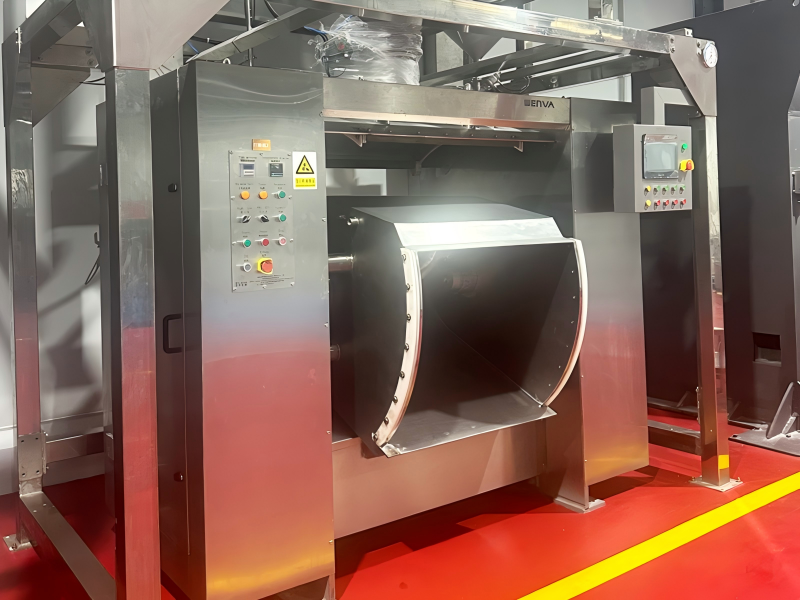
A high-speed horizontal mixer uses horizontally mounted agitators (often Z‑arms, sigma, or helical paddles) to apply intense, rapid mechanical energy to the dough batch. Industrial bakery designs often run two speeds, for example around 35 rpm on slow and 70 rpm on fast, to manage ingredient incorporation and gluten development in stages. [wenvamachine]
In hard biscuit lines, this mixer type is widely used when you need strong, repeatable gluten development and short cycle times to feed high-capacity forming and tunnel oven systems. For products like soda biscuits and Marie-style biscuits, horizontal machines are often the default choice in large plants because they align with high-throughput automation and tight process control. [marketreportanalytics]
A low-speed vertical mixer (also called a vertical spindle mixer) uses one or more vertical mixing arms that rotate through the dough mass at comparatively low speeds. This geometry creates a "folding and stretching" action that can build gluten more gently, with lower frictional heat and a longer mixing window. [ijabe]
Vertical mixers have a long history in hard biscuit and cracker production, especially for formulas that include fermentation or require very precise dough structure. Because the mixing action is less aggressive, vertical machines typically offer a wider margin of error on dough temperature and over‑mixing, which can be valuable when operators or ingredient quality vary. [foodsmachine]
Key technical differences that matter for gluten development in automated biscuit lines:
| Factor | High-Speed Horizontal Mixers | Low-Speed Vertical Mixers |
|---|---|---|
| Primary action | Intensive shear and folding along horizontal axis for fast gluten network formation (wenvamachine) | Gentle stretching and folding with vertical spindle for more progressive gluten development (ijabe) |
| Typical speed profile | Two-speed (slow for wetting, fast for development) at higher rpm, e.g. ~35/70 rpm (es.scribd) | One or two lower speeds, typically significantly below horizontal rpm, with longer mix times (ijabe) |
| Gluten development control | Excellent for strong gluten; higher risk of over-development if time not tightly controlled (wenvamachine) | Wider "safe window"; easier to avoid over-developed dough, good for fermented or sensitive doughs (ijabe) |
| Dough temperature | Higher frictional heat; can require chilled water or shorter cycles (ijabe) | Lower heat build-up; easier to keep dough near target temperature (ijabe) |
| Batch cycle time | Shorter cycles, higher throughput per mixer, good for large industrial lines (wenvamachine) | Longer cycles; may require parallel mixers for high capacity (ijabe) |
| Product focus | High-volume hard biscuits, crackers, soda biscuits with strong gluten requirement (wenvamachine) | Hard biscuits and crackers needing precise structure, sometimes with fermentation step (ijabe) |
| Automation fit | Highly compatible with fully automated lines and continuous feeding to formers (wenvamachine) | Often used in semi-automatic or hybrid lines; can be integrated into automated systems with planning (ijabe) |
From my experience working with high-capacity biscuit plants, horizontal mixers often win when the main goal is maximum throughput per square meter, while vertical mixers remain attractive when quality tolerance is tight and labor skills are limited. In practice, many mature plants combine both, using vertical mixers for critical or fermented doughs and horizontal mixers for standard hard biscuit bases. [marketresearch]
Across global projects, Wenva Machine frequently gets called in when biscuit lines suffer from chronic gluten‑related quality issues. The mixer choice—and how it is operated—is almost always at the center of the problem. [wenva]
Common symptoms include:
- Tough, shrink-prone dough that pulls back during sheeting, often due to over-developed gluten from excessive high-speed mixing. [foodsmachine]
- Blistered or warped biscuits caused by uneven gluten networks and trapped gas, sometimes linked to poor hydration in under‑mixed horizontal batches. [foodplantengineering]
- Weak "snap" and crumbly texture when gluten is under‑developed, more common in under‑loaded vertical mixers or where mixing time was cut too aggressively. [foodsmachine]
- Dough temperature drift across the shift, often from frictional heat in high‑speed mixers, leading to inconsistent gluten strength and forming behavior. [es.scribd]
In these situations, switching between high-speed horizontal and low-speed vertical mixers is rarely the only answer; we typically adjust speed profiles, water temperature, and batch size together with the mixer configuration. [wenvamachine]
When gluten is under‑developed or inconsistent, a correctly specified and programmed high‑speed horizontal mixer can be a powerful solution in hard biscuit lines. It applies sufficiently high mechanical energy to align and strengthen gluten strands quickly, which is ideal for strong, crisp textures. [es.scribd]
From a process engineering standpoint, horizontal mixers help by:
1. Shortening the development phase
- Fast-speed phases ensure the dough reaches target gluten strength within a predictable time, improving batch-to-batch uniformity. [foodplantengineering]
2. Supporting high automation
- Their geometry and faster cycles integrate well with automated ingredient dosing and continuous feeding to formers and tunnel ovens. [marketreportanalytics]
3. Enabling cleaner-label recipes
- Strong mechanical gluten development can reduce reliance on chemical dough improvers, helping meet clean-label and cost-reduction goals. [foodsmachine]
However, horizontal mixers can create gluten issues if not tuned correctly. Over-long fast phases or too high fill levels can over-develop gluten, making dough tight and hard to sheet. Our engineers typically counter this with tighter PLC control, dough temperature monitoring, and sometimes chilled water or jacketed bowls to stabilize frictional heat. [ijabe]
For plants facing over‑developed dough, excessive shrinkage, or temperature control challenges, low-speed vertical mixers are often a more forgiving tool. Their gentler mixing action creates a broader "safe window" before gluten becomes too strong, which is especially valuable for fermented or long-dwell doughs. [foodsmachine]
Key advantages for solving gluten problems include:
- Lower frictional heating, making it easier to keep dough within the optimal temperature range for controlled gluten development. [ijabe]
- More gradual gluten buildup, reducing the risk of over-mixing in lines with variable operator skills or raw material quality. [foodsmachine]
- Good compatibility with fermented doughs, where gluten must remain extensible rather than overly elastic. [ijabe]
The main limitation in a high-output factory is capacity: vertical mixers require longer cycle times and may need to be installed in parallel to keep up with downstream sheeters and ovens. In our experience, single-vertical setups work well for regional plants, while export-oriented factories often require mixed or fully horizontal configurations. [wenvamachine]

From the vantage point of a manufacturer with 40+ years of biscuit line engineering, Wenva Machine treats mixers as the heart of the production line—not a standalone component. In large projects across Asia, Africa, and emerging markets, the wrong mixer choice has repeatedly been the hidden root cause behind chronic gluten-related quality complaints and low OEE. [wenvamachine]
Three expert takeaways we regularly see in the field:
- For hard biscuits with tight snap specifications and high export volumes, high-speed horizontal mixers deliver better ROI when paired with robust temperature control and precise PLC programs. [marketresearch]
- For multi-SKU plants with crackers, fermented biscuits, and variable operators, low-speed vertical mixers provide valuable robustness and quality stability, even if throughput per unit is lower. [marketreportanalytics]
- For greenfield factories, the best results often come from designing mixer choice and gluten strategy together with layout, tunnel oven profile, and packaging speeds—not as an isolated decision. [marketreportanalytics]
If your plant is currently struggling with gluten-related hard biscuit issues, you do not necessarily need a complete mixer replacement. Based on typical Wenva optimization projects, a structured approach looks like this: [wenvamachine]
1. Diagnose dough and product behavior
- Measure dough temperature, extensibility, and visual structure at discharge.
- Compare baked biscuits for snap, spread, blistering, and surface uniformity.
2. Map current mixing profile
- Record actual speeds, batch size, and time at each phase (incorporation vs development).
- Check ingredient loading order and water temperature.
3. Adjust speed and time
- In high-speed horizontal mixers, shorten fast phases or reduce batch size to mitigate over-development. [es.scribd]
- In low-speed vertical mixers, extend mixing time slightly to reach target gluten strength without raising temperature too much. [foodplantengineering]
4. Stabilize dough temperature
- Use chilled or tempered process water and, where feasible, jacketed bowls to maintain a stable dough temperature window. [es.scribd]
5. Re‑evaluate mixer fit
- If quality variability persists, evaluate whether a different mixer type—or a dual-mixer strategy—better supports your product portfolio and capacity targets. [marketreportanalytics]
For many clients, the real breakthrough comes when mixer settings and oven conditions are tuned together—rather than trying to fix gluten only at the mixing stage. [foodsmachine]
From a strategic investment perspective, your decision should align with your business model, not just the current recipe. Industry data shows ongoing growth in automated, high-throughput biscuit systems driven by demand for convenient snacks and export markets. This favors solutions that integrate mixers tightly with the rest of the line. [marketreportanalytics]
Simplified decision guide:
- Choose high-speed horizontal mixers if:
- Your target is high-volume hard biscuits and crackers with consistent specifications.
- You need to synchronize mixing with high-speed forming and tunnel ovens.
- You can invest in automation, cooling, and process control to avoid over-development. [marketresearch]
- Choose low-speed vertical mixers if:
- You run complex or fermented hard biscuit recipes with tight quality tolerance.
- Operator skills or ingredient quality are variable and you need a wider "safe window."
- Your capacity is medium-scale, or you can install multiple vertical mixers in parallel. [foodsmachine]
- Consider a hybrid configuration if:
- Your portfolio includes both standard hard biscuits and specialty or fermented crackers.
- You want to future-proof your plant for new SKUs without redesigning the whole line.
- You plan phased investments, starting with one mixer type and adding another later. [marketreportanalytics]
As a specialist in automated biscuit production lines, Wenva Machine integrates mixer selection, gluten strategy, and factory layout into a single engineering package. Instead of simply supplying a mixer, we design end‑to‑end systems that stabilize dough quality from raw materials to final packaging. [wenvamachine]
Our engineering approach typically includes:
- Process audits of existing plants or detailed simulations for greenfield projects.
- Mixer sizing and configuration (horizontal, vertical, or mixed) matched to oven capacity, cooling conveyors, and packaging speeds. [wenva]
- Control logic and recipe libraries in the PLC to standardize mixing profiles and reduce operator dependency.
- On-site commissioning and training focused on gluten management, dough evaluation, and preventive maintenance.
For clients, this translates into fewer gluten-related complaints, higher yield, and a more flexible platform for new hard biscuit SKUs over the next decade. [wenvamachine]
If your hard biscuit batches are showing gluten-related issues—or if you are planning a new automated line—the choice between high-speed horizontal and low-speed vertical mixers will shape your product quality and profitability for years. Wenva Machine can evaluate your current dough behavior, product portfolio, and capacity goals, then design a mixer-centered solution that stabilizes gluten development across your entire line. [wenvamachine]
To discuss a horizontal, vertical, or hybrid mixer strategy tailored to your factory layout, contact our engineering team and request a customized biscuit line mixing study with sample capacity calculations and layout proposals. [wenva]
1. Are high-speed horizontal mixers always better for hard biscuits?
No. Horizontal mixers excel in high-volume environments where strong gluten and short cycles are critical, but they can over-develop gluten if not tightly controlled. Plants with variable raw materials or fermented doughs may benefit more from low-speed vertical mixers. [wenvamachine]
2. Can I switch from a vertical mixer to a horizontal mixer without changing my recipe?
In most cases, you will need to adjust mixing time, water temperature, and sometimes dough absorption, because horizontal mixers apply more mechanical energy. We typically pilot new profiles before full-scale conversion to avoid unexpected gluten behavior. [foodplantengineering]
3. How do I know if my gluten development is correct?
Look at dough extensibility, dough temperature, and baked biscuit attributes (snap, spread, and blister pattern) together. Consistent target values over multiple batches are a better indicator than mixing time alone. [foodsmachine]
4. Is it worth installing both horizontal and vertical mixers?
For multi-SKU plants producing both standard hard biscuits and specialty crackers, a hybrid setup can provide flexibility and resilience. The decision should be based on long-term product strategy and expected capacity growth. [marketreportanalytics]
5. How does automation level affect mixer choice?
Highly automated plants with integrated ingredient handling and data analytics typically favor high-speed horizontal mixers for throughput. Semi-automatic or regional plants may prioritize the robustness and lower temperature rise of low-speed vertical mixers. [marketresearch]
1. Mastering Biscuit Production: The Science of Dough Mixing and Equipment Optimization – Food processing technical article. [Link] [foodsmachine]
2. Types of Dough Mixers and Their Impact on Biscuit Texture: Mixing Time and Speed Explained – Wenva Machine technical content. [Link] [wenvamachine]
3. Performance of Industrial Dough Mixers and Its Effects on Dough Properties – IJABE research paper. [Link] [ijabe]
4. Industrial Bakery Mixer Types – Technical overview of horizontal and vertical mixers. [Link] [es.scribd]
5. The Heart of Your Biscuit Production Line: Choosing the Right Mixer – Biscuit mixing equipment guide. [Link] [foodsmachine]
6. Biscuit and Snacks Production System Trends and Forecasts – Market analysis 2025–2033. [Link] [marketreportanalytics]
7. WENVA: Customized Biscuit Production Line, Dough Mixer, Tunnel Oven – Company overview. [Link] [wenvamachine]
8. About Us – Wenva Machine company profile. [Link] [wenva]
9. Deeply Engaged in Biscuit Production Equipment – Wenva project and market activities. [Link] [wenvamachine]
10. Bakery Processing Equipment Market Size Outlook, 2026 – Sector report on mixers and bakery equipment. [Link] [marketresearch]


