
Views: 222 Author: Wenva Machine Publish Time: 2026-05-22 Origin: Site
Over the past 40 years working with automated biscuit production lines, our engineering team at Wenva Machine has seen a clear pattern: factories that optimize layout and product flow early enjoy lower operating costs, smoother expansions, and more stable product quality. In plants where every square meter matters, the debate usually centers on whether to use standard turning machines or compact 180-degree sweeps at key transfer points in the line. [supertrakconveyance]
From a practical, factory-floor perspective, this is not just a mechanical decision; it is a strategic choice that affects throughput, maintenance, energy use, and even future oven or packaging upgrades. In this article, we will analyze both options from an industrial baker's and equipment designer's point of view, using real-world layout logic from biscuit and cookie production lines. [making]

In a typical full-automatic biscuit or cookie line, standard turning machines are modules that redirect product flow—usually 90 degrees—using belts, guide rails, and sometimes powered rollers. They help you connect major sections such as: [oyschst.edu]
- Dough sheeting and forming
- Tunnel oven infeed and outfeed
- Cooling conveyors
- Stacking and primary packaging
Because they often use longer conveyor sections and gradual curves, standard turning machines are mechanically simple, easy to maintain, and very forgiving in terms of product handling. For high-volume biscuit SKUs with stable shapes and sizes, this solution can run for years with predictable performance as long as the line speed and loading are controlled. [oyschst.edu]
A 180-degree compact sweep is a tightly curved turning unit that reverses the direction of product flow within a minimal footprint, often creating U-shaped or S-shaped layouts. In biscuit and cookie lines, this allows: [supertrakconveyance]
- Oven outfeed to run back parallel to oven infeed
- Cooling conveyors to be stacked in a compact footprint
- Packaging areas to sit close to dough preparation
Engineers use 180-degree sweeps when floor space is constrained by building columns, existing walls, or when they must fit a high-capacity line into a legacy facility. Compared with long standard turns, these sweeps rely on optimized belt tracking, side guides, and carefully controlled speeds to keep biscuits stable while turning sharply at production speeds. [supertrakconveyance]
When you have enough floor area, standard turns offer straightforward engineering and simple expansion paths. Benefits typically include: [supertrakconveyance]
- Gentler product handling thanks to wider radii and longer conveyors
- Easier integration of metal detectors, checkweighers, and inspection systems
- Flexible operator access and easier sanitation around the line
For greenfield projects with generous building envelopes, we often design linear or L-shaped layouts with standard turning machines to keep the process visually simple and easy to supervise. [wenva]
In older or urban plants where rent and construction costs are high, the layout conversation changes completely. Here, 180-degree compact sweeps deliver: [supertrakconveyance]
- Shorter line length per process step, freeing space for additional SKUs or packaging lines
- U-shaped or multi-row layouts that fit around existing structures
- Reduced walking distances for operators and QA teams
Our experience shows that replacing a traditional long turn with a compact 180-degree sweep can reclaim enough floor space to add a secondary packaging cell or palletizing zone without expanding the building. [wenvamachine]
| Factor | Standard Turning Machines | 180-Degree Compact Sweeps |
|---|---|---|
| Required floor space | Larger radius, longer footprint supertrakconveyance | Minimal radius, highly compact supertrakconveyance |
| Product handling stress | Very gentle turns at moderate speeds | Higher stress if poorly designed; needs precise controls |
| Layout flexibility | Best in straight or L-shaped layouts supertrakconveyance | Ideal for U-shaped / multi-row layouts supertrakconveyance |
| Integration complexity | Simple mechanical integration | Requires more detailed engineering and tuning |
| Maintenance access | More open, easier access points | More compact, some components tighter to reach |
| Upgrade potential | Easy to insert extra inspection modules | Space-limited but can stack functions vertically supertrakconveyance |
| Best for | Large plants, greenfield projects, stable SKUs | Space-limited facilities, brownfield upgrades, multi-SKU lines |
From an operations perspective, the turning strategy directly influences Overall Equipment Effectiveness (OEE) and product consistency. [scribd]
Standard turns tolerate moderate speed increases with minimal tuning because product trajectories are predictable and forces on the biscuits are lower. In contrast, 180-degree sweeps can support high speeds, but only when belt tension, guide geometry, and transfer gaps are engineered precisely. [oyschst.edu]
As a rule of thumb drawn from real production projects, we recommend designing compact sweeps with a slight speed increase versus the upstream conveyor to stabilize spacing and reduce product collisions under high throughput. This is especially important for delicate cookies and sandwich biscuits. [scribd]
In biscuit lines, even a 1% difference in breakage at the turning point can significantly affect annual raw material costs and downstream packaging waste. Standard turning machines naturally minimize breakage because biscuits experience smaller lateral forces. [oyschst.edu]
With 180-degree sweeps, our engineers focus on:
- Optimizing belt material and friction
- Minimizing step changes at transfers
- Designing guides that support products without marking the surface
When these points are handled correctly, breakage on compact sweeps can be brought very close to the level of standard turning modules, even at high speeds. [oyschst.edu]
Drawing on decades of Wenva Machine projects in Asia, South America, and Africa, we typically encounter three layout scenarios in cookie production. [wenva]
- Building: New industrial hall with ample length and width
- Strategy: Straight or L-shaped lines with standard turning machines
- Advantage: Simple supervision, easy future extension of oven length
In this case, we prioritize standard turning machines for their simplicity, reliability, and ease of integrating multi-stage cooling and inspection modules. [making]
- Building: Older facility with columns, low ceilings, or irregular shape
- Strategy: U-shaped or multi-row layout using 180-degree compact sweeps at oven outfeed and cooling sections
- Advantage: Maximum capacity in a limited footprint
Here, compact sweeps allow high-capacity cookie production lines to operate where a conventional straight layout would not fit at all. This is where we see the strongest ROI from investing in more sophisticated turning modules. [supertrakconveyance]
- Building: Medium-sized plant focused on private label or seasonal SKUs
- Strategy: Mix of standard turns and one or two compact sweeps
- Advantage: Balanced space efficiency and maintainability
In such projects, our engineering team often combines one 180-degree sweep at a critical bottleneck with standard turns elsewhere, giving the best blend of flexibility, accessibility, and layout efficiency. [wenvamachine]
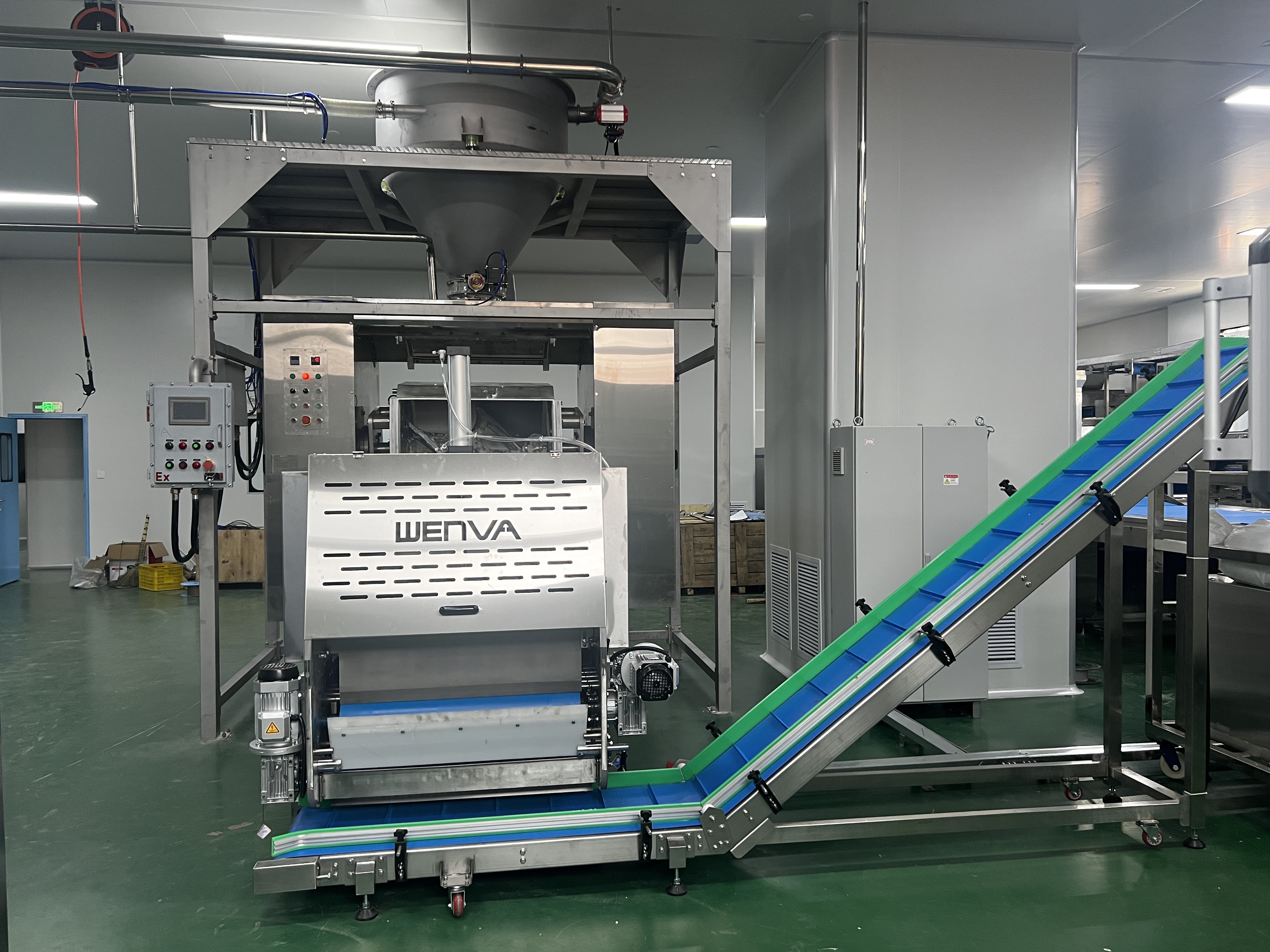
If you are planning or upgrading a biscuit production line in a tight space, here is a practical, expert-level sequence our team typically follows. [making]
1. Map current or planned product flow from dough mixing to palletizing with accurate line lengths and clear bottlenecks.
2. Identify all non-negotiable constraints such as columns, doors, fire exits, and utility corridors.
3. Mark the logical positions where product direction must change (oven in/out, cooling configuration, packaging cells).
4. For each turning point, evaluate whether a standard turn or a compact 180-degree sweep gives you better use of space without compromising quality.
5. Run layout simulations and line balance calculations to confirm that target throughput and buffer times are achievable.
6. Finalize conveyor, guide, and control specifications to ensure biscuits remain stable through each turn.
For many projects, we will simulate both a "standard-only" and a "compact-sweep optimized" layout to show management how much capacity and flexibility each option provides over a 5–10 year horizon. [scribd]
Because Wenva Machine delivers end-to-end automated biscuit production solutions—from mixing and forming to baking, cooling, and packaging—turning strategy is part of a much larger system design. [wenvamachine]
- Upstream: Dough sheet uniformity, forming waste rate, and oven loading patterns
- Midstream: Oven zoning, temperature profiles, and cooling time
- Downstream: Stacking, sandwiching, and packaging automation
Standard turning machines give more physical space to insert inspection systems like camera-based surface checks or advanced metal detection. Compact sweeps, on the other hand, can bring oven and packaging areas physically closer, which shortens response time for operators when anomalies occur. [making]
Compact sweeps sometimes require additional or more precisely controlled drives to maintain stable tension in tight curves. While the difference in total energy usage is usually modest, proper drive selection avoids slippage, unplanned stops, and belt damage. [oyschst.edu]
Standard turns typically share drive systems with adjacent conveyors, making them simpler to manage but slightly less flexible when fine-tuning speed differentials between sections. [oyschst.edu]
From a UX and operator safety standpoint, clear access matters just as much as mechanical performance. [oyschst.edu]
- Standard turns: More open geometry, easier to clean and inspect during scheduled downtime
- 180-degree sweeps: Tighter geometry, so we design with removable guards, access doors, and carefully positioned emergency stops
In our projects, we recommend including walkways, platforms, and service zones in the layout drawing from day one, especially when compact sweeps are used in elevated cooling or multi-level conveyor systems. [wenva]
In one typical mid-size cookie factory case, the customer wanted a higher-capacity line but could not expand the building, which had structural columns very close to the oven exit. The original layout used long standard turning conveyors that consumed most of the central floor area. [supertrakconveyance]
By redesigning the line to use a 180-degree compact sweep at the oven outfeed, we were able to:
- Free enough space to install an additional cooling section and a secondary packaging lane
- Shorten operator walking distances by clustering the packaging and inspection stations
- Maintain product breakage rates within the same range as the previous standard turn layout after fine-tuning belt speed and guides
This kind of project illustrates how compact sweeps can turn a space constraint into a competitive advantage when designed properly. [wenvamachine]
With nearly four decades focused specifically on biscuit and cookie production lines, Wenva Machine combines mechanical engineering, bakery process knowledge, and factory layout experience. We typically support customers in three key ways: [wenva]
- Layout consulting to evaluate standard versus compact sweep options for new or existing buildings
- Customized design of integrated lines, including tunnel ovens, cooling, and packaging
- On-site installation, commissioning, and operator training to ensure stable, efficient operation
Because we operate our own biscuit production base as an experience center, we can demonstrate different layout concepts in practice and share data-driven insights rather than purely theoretical advice. [wenva]
To make the decision easier, consider the following simple rule of thumb based on our project experience. [making]
Choose standard turning machines when:
- Your building has sufficient floor space and future expansion room
- You prioritize ease of maintenance and slower product mix changes
- Your line runs a few high-volume SKUs with very stable shapes
Choose 180-degree compact sweeps when:
- Your facility has strict space limits or challenging geometry
- You need high capacity in a legacy or multi-purpose building
- You want to cluster critical process steps to reduce walking and response times
In many real-world lines, the optimal answer is a hybrid layout, using both technologies in different parts of the system to balance space, accessibility, and performance. [supertrakconveyance]
If you are planning a new cookie production line—or upgrading a space-limited plant—now is the right time to evaluate whether standard turning machines or 180-degree compact sweeps will give you the best long-term ROI. Based on your building drawings, product mix, and capacity targets, Wenva Machine can propose a customized layout that integrates the right turning strategy into a complete automated biscuit production solution. [wenvamachine]
Contact our engineering team with your current floor plan and production requirements, and we will prepare a tailored layout concept that balances space efficiency, product quality, and future expansion options.
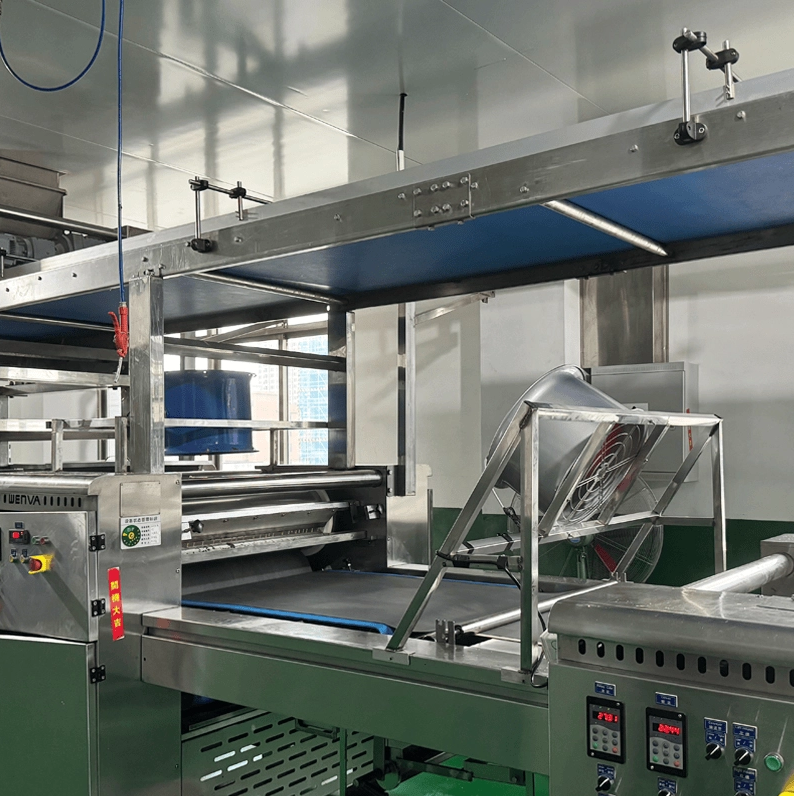
Q1: Will a 180-degree compact sweep increase biscuit breakage?
A1: When designed and tuned correctly—especially regarding belt speed, guides, and transfer gaps—compact sweeps can keep breakage very close to standard turns, even at high speeds. [oyschst.edu]
Q2: Are standard turning machines cheaper than compact sweeps?
A2: The hardware for standard turns is usually simpler, which can reduce initial cost, but the total project cost must also consider the additional floor space they require. [supertrakconveyance]
Q3: Can I retrofit a compact sweep into an existing line?
A3: Yes, many brownfield projects replace long turning sections with 180-degree sweeps to free space; careful engineering is needed to match heights, speeds, and controls. [making]
Q4: How do turning choices affect cleaning and sanitation?
A4: Standard turns offer more open access, while compact sweeps require thoughtful guard design and access points; both can meet hygiene standards when specified correctly. [oyschst.edu]
Q5: Does Wenva Machine provide full-line integration including turning systems?
A5: Yes, Wenva Machine delivers end-to-end biscuit and cookie production lines, including layout design, turning strategy, ovens, conveyors, and packaging integration. [wenva]
1. Wenva Machine – Customized Biscuit Production Line, Company Website. [https://www.wenvamachine.com] [wenvamachine]
2. Yangjiang Ronghua Yuandong Industrial Co., Ltd. (Wenva Machine) – About Us. [http://www.wenva.net/about/] [wenva]
3. SuperTrak Conveyance – Factory Floor Space Optimization. [https://supertrakconveyance.com/factory-floor-space-optimization/] [supertrakconveyance]
4. Making.com – Full-automatic biscuit & cookie production line. [https://making.com/equipment/full-automatic-biscuit-cookie-production-line] [making]
5. Fellows, P.J. – Food Machinery For the Production of Cereal Products (cookie and biscuit machinery fundamentals). [PDF technical resource] [oyschst.edu]
6. "Optimizing Cookie Production Processes" – Case-based teaching material on cookie production efficiency. [scribd]


