
Views: 222 Author: Wenva Machine Publish Time: 2026-06-01 Origin: Site
Content Menu
● Understanding Mixers in Automated Cookie Lines
● What Is a Bottom-Discharge Mixer?
● Changeover Speed: Bottom-Discharge vs. Tilt-Over
>> Why Bottom-Discharge Tends to Be Faster
>> Tilt-Over: Where Time Is Lost
● Product Quality and Dough Consistency
● Integration with Automated Biscuit Lines (Wenva Machine Context)
● Hygiene, Cleaning, and Allergen Control
>> Tilt-Over
● Operator Safety and Ergonomics
● Total Cost of Ownership and ROI
● Decision Framework for Multi-Flavor Cookie Factories
>> Mixer Choice Factors for Cookie Factories
● Expert Insight from a 40-Year Line Manufacturer
● Practical Changeover Playbook (Step-by-Step)
● When a Tilt-Over Mixer Still Makes Sense
● Recommended Path for Cookie Factories
● FAQ
Bottom-discharge mixers generally enable faster, cleaner changeovers than tilt-over mixers in multi-flavor cookie factories, but the best choice still depends on your dough types, batch size, and automation level. For a 40-year automated biscuit line manufacturer like Wenva Machine, bottom-discharge systems align very well with high-throughput, multi-flavor production that demands minimal downtime and strict hygiene. [exactmixing]
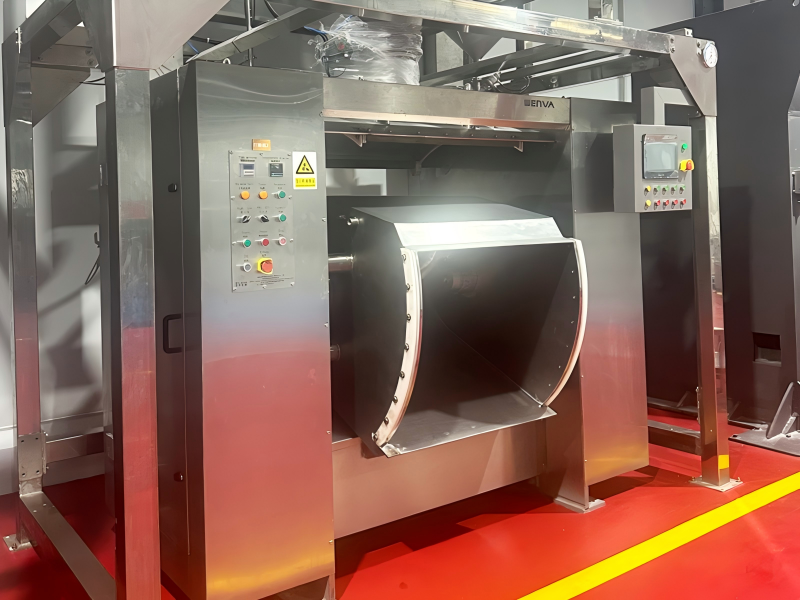
In an automated biscuit or cookie production line, the mixer is the starting point that determines dough consistency, process stability, and final product quality. For multi-flavor cookie factories, the mixer must also support frequent recipe changeovers without compromising productivity. [foodsmachine]
Most industrial cookie and biscuit lines today rely on horizontal dough mixers or continuous mixers engineered for high capacity and integrated with upstream ingredient handling and downstream forming systems. Within this category, you often choose between bottom‑discharge and tilt‑over configurations for batch operations. [jymachinetech]
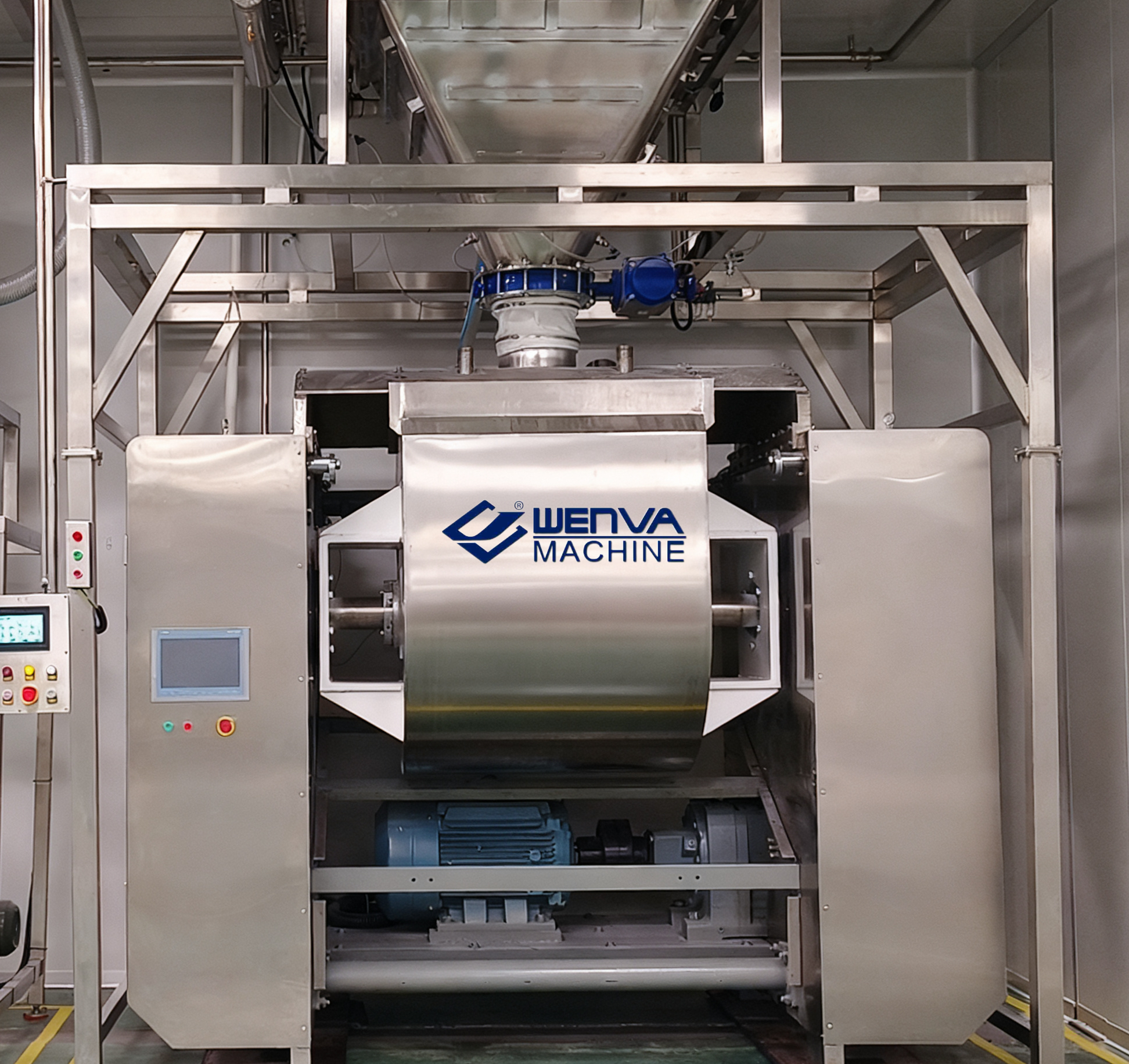
A bottom-discharge mixer uses a discharge gate or valve located at the base of the mixing trough or bowl to release dough directly into a hopper, conveyor, or dough handling system. The mixing shaft and blades remain in place while gravity and controlled discharge mechanisms move the dough out. [exactmixing]
In cookie and biscuit production, bottom-discharge designs are typically paired with horizontal mixers that can be jacketed for temperature control and integrated into fully automated lines. This makes them particularly attractive for high-volume plants and multi-flavor production environments where repeatability and quick transitions matter. [foodsmachine]
A tilt-over mixer (also called a tilting bowl mixer) discharges dough by physically tilting or inverting the bowl so that the contents fall into a trough, cart, or transfer system. The bowl and its dough are rotated via a mechanical tilting mechanism.
Tilt-over systems are common in vertical or planetary mixers used for various bakery applications, particularly when dough needs to be removed as a whole mass and transferred for fermentation or manual handling. In cookie factories, they often appear in lines that still rely on semi-automatic handling or where recipe flexibility and manual inspection are prioritized over maximum line integration. [foodsmachine]
For multi-flavor cookie factories, changeover speed is often the number-one performance metric.
Bottom-discharge mixers typically offer shorter changeover times because:
- Dough exits directly into the line (hopper, sheeter, or wire‑cut feeder) without manual intervention. [jymachinetech]
- Automated purge cycles can be designed to push out most of the residual dough before cleaning.
- Cleaning-in-place (CIP) or semi‑CIP systems are easier to implement due to the fixed bowl and predictable flow path. [exactmixing]
For factories running many SKUs (chocolate chip, oatmeal, sandwich cookies, seasonal flavors), shaving minutes off each changeover accumulates into significant extra production hours per week.
Tilt-over mixers often require:
- More manual scraping and cleaning, especially around rims, joints, and tilt mechanisms.
- Physical movement of bowls or carts, which adds handling time.
- Additional safety checks around moving, tilting parts.
These factors make tilt-over less competitive in plants where changeovers happen multiple times per shift and where operators are already stretched across lines.
In modern biscuit lines, horizontal bottom-discharge mixers with jacketed bowls and controlled mixing profiles deliver:
- Consistent dough temperature, critical for uniform baking color and texture across large runs. [jymachinetech]
- Stable dough structure, especially for high-fat or soft cookie doughs that are sensitive to overmixing. [foodsmachine]
- A steady, predictable dough rheology that works well with high-speed forming equipment like wire‑cutters, rotary moulders, and sheeters. [jymachinetech]
This makes bottom-discharge particularly suitable for soft cookies, sandwich biscuits, and premium high-fat formulations.
Tilt-over mixers can still produce excellent dough quality, especially for:
- Hard or fermented doughs, where vertical mixing with long development time is beneficial. [foodsmachine]
- Specialty products or limited runs where operators inspect dough visually before dumping.
However, because the bowl is moved and tilted, dough handling can be less uniform, and temperature control may be less integrated into the rest of the line compared with fully jacketed, fixed horizontal systems. [exactmixing]
As a manufacturer with 40 years of automated biscuit production line experience, Wenva Machine designs mixing systems to integrate seamlessly with:
- Automated ingredient metering and feeding, including silos, loss‑in‑weight feeders, and minor ingredient dosing. [exactmixing]
- Downstream dough handling systems, such as laminators, sheeters, rotary cutters, and tunnel ovens. [wenvamachine]
- Central PLC / SCADA control, recipe management, and production data monitoring. [4sight]
Within such an integrated architecture, bottom-discharge mixers typically offer:
- Direct discharge to dough hoppers feeding sheeters or wire-cut lines.
- Easier synchronization with continuous or semi-continuous forming (dough delivered at controlled rates). [jymachinetech]
- Reduced reliance on manual transport (no need for rotating or wheeled bowls).
Tilt-over mixers can still be integrated, but they usually require additional transfer equipment and coordination, which can introduce more potential bottlenecks and cleaning points.
Multi-flavor cookie factories often handle nuts, chocolate, dairy, gluten variants, and seasonal inclusions, making hygiene and allergen control critical.
- Fewer open transfers (dough moves inside enclosed equipment rather than open carts).
- Simpler cleaning paths, making it easier to design rapid washdown or CIP cycles. [exactmixing]
- Lower risk of cross-contamination between runs, especially when the mixer is integrated with enclosed conveying to forming.
- Open discharging into troughs or carts increases exposed surfaces to clean.
- More mechanical joints and tilting structures that can trap residues.
- Potentially longer wet-cleaning and dry-cleaning cycles between allergen-sensitive products.
For factories targeting export markets and strict retailer standards, bottom‑discharge systems offer an advantage in demonstrating robust hygienic design.
- Bottom-discharge mixers keep the bowl fixed, which allows safety guards, interlocks, and emergency stops to be integrated in a more predictable way. [4sight]
- Tilting bowls involve moving masses and articulating arms, so the safety system becomes more complex, and operator training must be stricter.
From an ergonomics perspective, bottom-discharge reduces the need for operators to manually push heavy bowls, carts, or dough bins, which aligns with modern occupational safety standards.
From an investment perspective, the right choice is not only about the purchase price but also about lifecycle cost and throughput:
Bottom-discharge mixers typically provide:
- Higher effective uptime because of shorter changeovers and faster cleaning.
- Better alignment with fully automated lines, reducing labor costs across shifts. [jymachinetech]
- More scalable capacity for future expansion (additional lines or more SKUs).
Tilt-over mixers may appeal when:
- Capital budgets are constrained and semi‑automatic handling is acceptable.
- Production volumes are moderate, with fewer daily changeovers.
- The plant values manual inspection per batch more than maximum line integration.
To decide between bottom-discharge and tilt-over, cookie factories can follow a practical framework:
1. Quantify changeovers per day
- If you run many short batches for multiple flavors, a bottom-discharge design usually delivers higher annual throughput.
2. Map allergen and flavor families
- If you regularly switch between allergen-critical recipes (e.g., nuts vs non‑nut), optimized cleaning and enclosed discharge favor bottom-discharge.
3. Assess current and future automation
- If your strategic plan involves integrating automatic dosing, digital recipe control, and high-speed forming, bottom-discharge is typically more compatible. [exactmixing]
4. Evaluate workforce and skill levels
- Plants with limited skilled labor benefit from simpler, more automated discharge and cleaning sequences.
5. Consider dough types and product portfolio
- For soft, high-fat cookies and sandwich biscuits, horizontal bottom-discharge mixers provide highly consistent dough for forming. [foodsmachine]
- For some hard or fermented doughs, a tilt-over or vertical configuration can still be justified.
| Factor | Bottom-Discharge Mixer | Tilt-Over Mixer |
|---|---|---|
| Changeover speed | Very fast, supports frequent SKU changes | Slower, more manual cleaning and handling |
| Line integration | Excellent with automated biscuit lines | Moderate, often needs extra transfer steps |
| Hygiene & allergen control | Strong, enclosed discharge and fewer open transfers | More exposed surfaces and contact points |
| Operator ergonomics & safety | Better, fixed bowl and predictable guarding | More complex safety around moving tilting bowls |
| Ideal production profile | High-volume, multi-flavor, export-oriented factories | Medium volume, flexible, semi-automatic operations |
From Wenva Machine's perspective as an automated biscuit production line specialist, empirical experience shows that:
- Plants that upgraded from traditional batch mixers with manual handling to integrated horizontal mixers with automated discharge see clear gains in throughput and consistency. [jymachinetech]
- When designing new greenfield projects for multi-flavor cookie portfolios, engineers increasingly specify bottom-discharge horizontal mixers as the default due to their compatibility with continuous or semi-continuous dough feeding.
- Tilt-over designs remain relevant in specific niches, but the long-term trend in industrial biscuit manufacturing points toward more automation, fewer open transfers, and less manual intervention, all of which favor bottom-discharge configurations. [foodsmachine]
To maximize the benefit of a bottom-discharge mixer in a multi-flavor cookie factory, an optimized changeover procedure might include:
1. Automated discharge & purge
- Trigger an automatic discharge to empty dough into the receiving hopper.
- Run a brief low-speed "purge" cycle to remove remaining dough.
2. Dry scraping and quick inspection
- Use food-grade tools to scrape minimal residues from blades and bowl.
- Inspect critical points around the discharge gate.
3. Targeted wet-cleaning (if allergen-sensitive)
- Activate a CIP or spray system if available, focusing on blades, bowl walls, and discharge path.
- Follow with air or water removal steps as per your HACCP plan.
4. Recipe parameter change in the PLC
- Load new recipe: mixing time, speed profile, jacket temperature, and discharge setpoints. [4sight]
5. Verification batch
- Run a controlled first batch, check dough temperature, consistency, and forming behavior, then ramp up to full speed.
For tilt-over mixers, similar steps apply, but manual handling and cleaning typically add more time and variability.
Although bottom-discharge is usually the best fit for fast multi-flavor changeovers, tilt-over mixers remain valid when:
- You have legacy processes that rely on fermentation rooms or manual handling of dough tubs. [foodsmachine]
- You run limited SKUs with long production campaigns, so changeovers are infrequent.
- The plant requires a hybrid setup, for example, sharing a mixer with non-cookie applications where tilt-over makes handling easier.
In these cases, Wenva Machine can still help by designing optimized transfer solutions, recipe controls, and cleaning procedures that reduce the time penalties linked to tilt-over discharging.
For most modern multi-flavor cookie factories that aim to:
- Increase line utilization and reduce changeover downtime.
- Strengthen food safety and allergen control.
- Prepare for future automation and data-driven optimization.
a bottom-discharge horizontal mixer integrated into a Wenva automated biscuit production line will generally deliver higher long-term value than a tilt-over mixer.
If you are planning a new multi-flavor cookie factory or upgrading an existing biscuit line, Wenva Machine can help you evaluate, simulate, and select the optimal mixer configuration for your products and layout.
Contact our engineering team to:
- Benchmark your current changeover times.
- Compare bottom-discharge vs tilt-over performance based on your SKUs.
- Design a tailored automated mixing and dough handling solution that supports faster changeovers and consistent cookie quality.

1. Are bottom-discharge mixers always better than tilt-over mixers?
No. Bottom-discharge mixers are generally better for highly automated, high-volume cookie lines with frequent changeovers, while tilt-over mixers can still be suitable for lower-volume or more manual operations.
2. Can I retrofit a tilt-over mixer line to reduce changeover time?
Yes. Improvements in transfer systems, cleaning tools, and recipe management can reduce changeover times on tilt-over lines, though they may still not match the efficiency of a well-integrated bottom-discharge system.
3. Do bottom-discharge mixers work for both hard and soft biscuits?
Modern horizontal bottom-discharge mixers can be configured for a wide range of dough types, including soft cookies, semi-sweet biscuits, and many hard biscuits, especially when combined with proper dough handling and lamination systems. [jymachinetech]
4. How important is dough temperature control in mixer selection?
Very important. Consistent dough temperature helps stabilize baking color, structure, and texture; horizontal mixers with jacketed bowls and integrated controls make this easier to achieve at scale. [exactmixing]
5. What information should I prepare before consulting Wenva about a new mixer?
You should prepare your target product list, daily and hourly capacities, number of planned flavors per shift, allergen matrix, available floor space, and your current changeover and cleaning procedures. This allows engineers to model the right mixing and discharge configuration for your plant.
1. Exact Mixing – "Mixing Systems for Biscuit Production Lines."
<https://www.exactmixing.com/resources/mixing-systems-for-biscuit-production-lines.html> [exactmixing]
2. Foodsmachine – "The Heart of Your Biscuit Production Line: Choosing the Right Mixer."
<https://www.foodsmachine.net/the-heart-of-your-biscuit-production-line-choosing-the-right-mixer.html> [foodsmachine]
3. JY Machine – "Advanced Automatic Biscuit & Cracker Machine | Fully Automated Hard & Soft Biscuit Production."
<https://www.jymachinetech.com/product/advanced-automatic-biscuit-cracker-machine-fully-automated-hard-soft-biscuit-production/> [jymachinetech]
4. Wenva Machine – "Automated Biscuit Production Line: Expert Guide from 40 Years of Manufacturing Excellence."
<https://www.wenvamachine.com/automated-biscuit-production-line-expert-guide-from-40-years-of-manufacturing-excellence.html> [wenvamachine]
5. Wenva Machine – Company and product information (multi-purpose full automatic biscuit production line, mixer and tunnel baking solutions).
<https://wenva668.en.made-in-china.com/product/xKRmWeEYvHVb/China-Wenva-Multi-Purpose-Full-Automatic-Biscuit-Production-Line.html> [wenva668.en.made-in-china]
6. 4Sight – "A market leader in the tyre manufacturing industry upgrades their Control System" (case study referenced for advanced mixer control, temperature and safety concepts).
<https://4sight.cloud/> [4sight]


