
Views: 222 Author: Wenva Machine Publish Time: 2026-06-26 Origin: Site
Content Menu
● What Is an Automated Biscuit Production Line?
● Why Automation Is Now a Strategic Necessity
● Core Components of an Automated Biscuit Line
>> 2. Feeding and sheeting systems
>> 4. Baking: tunnel ovens and heat strategy
>> 5. Post‑baking systems: cooling, stacking, sandwiching, and packaging
● Strategic Factors to Consider Before You Invest
>> 1. Production volume and growth curve
>> 3. Floor space and layout constraints
>> 4. Power, fuel, and sustainability goals
>> 5. Ease of operation, training, and after‑sales support
● How a 40‑Year Manufacturer Designs a Line That Actually Works
>> One‑stop, customized solutions
>> Quality, certification, and continuous innovation
● Real‑World Use Case: From Manual Baking to Data‑Driven Production
● Practical Checklist: How to Choose Your Automated Biscuit Line Partner
● Why Wenva Machine Is Positioned as a Long‑Term Partner
● Call to Action: Plan Your Next‑Generation Biscuit Line
● Frequently Asked Questions (FAQ)
As someone who has spent decades helping biscuit factories upgrade from manual or semi‑automatic processes to fully automated biscuit production lines, I've seen the same patterns repeat: the lines that win combine smart technology, thoughtful layout, and a realistic ROI plan. This guide distills those lessons into practical advice so you can streamline your baking, cut waste, and scale with confidence. [foodsmachine]

An automated biscuit production line is a fully integrated system that handles dough preparation, forming, baking, cooling, and packaging with minimal manual intervention. Instead of separate, disconnected machines, you get a synchronized line designed around your product mix, capacity targets, and factory layout. [wenva668.en.made-in-china]
For manufacturers, this means:
- Stable product quality across shifts and operators. [foodsmachine]
- Higher throughput per square meter of floor space. [wenva668.en.made-in-china]
- Lower dependence on skilled manual labor and easier training. [foodsmachine]
Global biscuit demand has been growing steadily, with the market value projected to rise significantly between 2024 and 2032, driven by urbanization and snacking trends. In this environment, staying manual is not just inefficient—it's uncompetitive. [foodsmachine]
From a plant manager's point of view, "automation" is no longer a buzzword; it directly affects cost per kilo, uptime, and customer retention.
- Reduced production costs: Automated lines can significantly cut labor hours per batch and reduce rework due to more consistent process control. [advetresearch]
- Higher and more predictable output: Synchronizing mixing, forming, baking, and cooling reduces micro‑stops and bottlenecks, improving OEE (Overall Equipment Effectiveness). [gobte]
- Better food safety and traceability: Enclosed conveyors, hygienic design, and automated dosing reduce contamination risks and help with audits. [advetresearch]
- Faster new‑product launches: Modern lines with modular forming tools and programmable recipes make it easier to introduce new biscuit formats. [gobte]
For many factories, the real tipping point is not "Can we afford automation?" but "Can we afford the downtime, waste, and inconsistency of staying where we are?"
When evaluated through a buyer's lens, a biscuit line is not "one machine," but a chain of critical systems. Each must be engineered and sized correctly for your products and throughput.
Dough is where quality is either built in—or lost.
- Industrial mixers with temperature control and programmable speeds keep dough rheology within tight windows. [wenva668.en.made-in-china]
- Both horizontal and vertical dough mixers are used depending on dough type and batch size. [wenva668.en.made-in-china]
- For high‑volume plants, automatic flour feeding and weighing systems stabilize recipes and reduce human error. [wenva668.en.made-in-china]
Expert tip: If your dough temperature fluctuates more than 2–3 °C between batches, expect inconsistent texture and bake color downstream.
After mixing, the dough must be transferred and conditioned without damaging its structure.
- Automated feeding conveyors are designed to maintain dough integrity and temperature while minimizing manual handling. [foodsmachine]
- Dough sheeters reduce dough to target thickness with controlled stress, crucial for laminated or crisp biscuits. [wenva668.en.made-in-china]
Poorly designed feeding sections are a common hidden bottleneck: they cause surging at the moulder, uneven oven loading, and higher breakage.
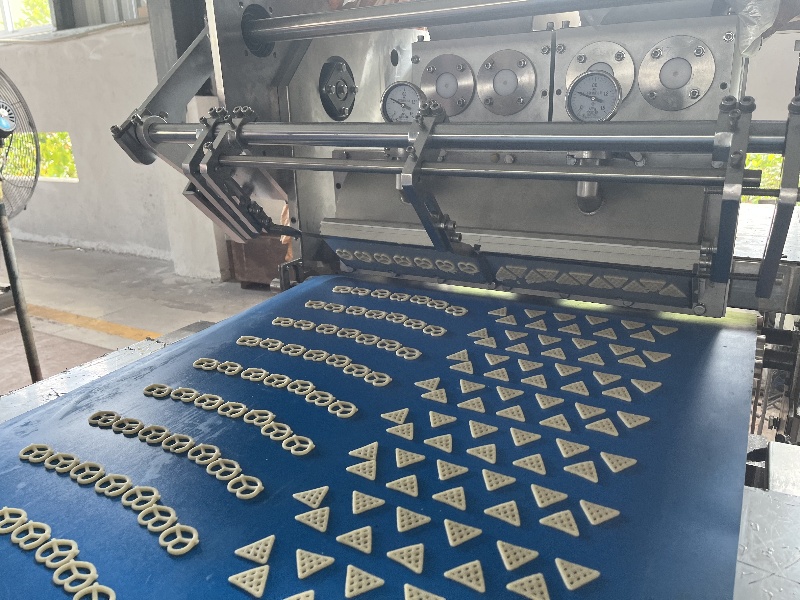
Forming is where brand identity becomes visible—shape, embossing, and thickness all matter.
Typical forming technologies include:
- Rotary moulders and rollers for hard biscuits and crackers.
- Cutting systems for shaped biscuits and cookies.
- Wire‑cut and extrusion machines for soft dough and decorative shapes. [foodsmachine]
Wenva's production lines, for example, support:
- Shortbread and tough biscuits.
- Sandwich biscuits.
- Soda crackers and specialty products, using different molds and tooling sets. [wenva668.en.made-in-china]
If seasonal shapes or frequent changeovers are part of your business, quick‑change or modular mold concepts can dramatically reduce downtime. [wenva668.en.made-in-china]
The oven is the heart of the line—yet often chosen last. That's a mistake.
Modern tunnel ovens are typically:
- Gas‑fired, electric, or hybrid, with multiple zones for fine‑tuned temperature and airflow control. [foodsmachine]
- Designed for specific moisture profiles to achieve shelf life, color, and texture targets. [wenva668.en.made-in-china]
Key decisions include:
- Heat source: direct gas firing vs. indirect heat exchange vs. hybrid—each influences oven spring, surface color, energy cost, and maintenance. [wenva668.en.made-in-china]
- Zoning: multi‑zone ovens enable better control over moisture removal and browning, especially for long shelf‑life crackers. [wenva668.en.made-in-china]
An experienced supplier will not just quote an oven length; they will propose a baking curve matched to your product and throughput.
What happens after the oven is where many lines leak profits.
- Cooling conveyors must ensure controlled moisture equilibrium; too fast, and you risk checking; too slow, and you risk condensation and microbial risk. [foodsmachine]
- Stacker machines and turning/transfer units organize biscuits for downstream operations with minimal breakage. [wenva668.en.made-in-china]
- Sandwiching machines handle filling dosing, registration, and compression force—critical for premium sandwich products. [wenva668.en.made-in-china]
- Automatic packaging stations tie everything together for retail‑ready packs. [foodsmachine]
Designing this section correctly is essential for reducing manual handling and keeping line speed consistent.
Having worked with plants in Asia, Latin America, and Africa, I've seen successful lines share one thing: they made these decisions consciously, not by default.
Start by mapping:
- Current daily/weekly output.
- Realistic 3–5 year growth.
- SKU complexity (how many formats, flavors, and pack sizes). [foodsmachine]
A scalable line is often better than an oversized one that runs under capacity and drives up unit costs.
Different biscuit types have different engineering needs:
- Hard dough vs. soft dough.
- Plain crackers vs. sandwich biscuits.
- High‑fat, short dough vs. lean, fermented dough. [foodsmachine]
Wenva, for instance, configures dedicated lines for crispy biscuits, soft and hard biscuits, double‑layered biscuits, and even specialized products like stackable potato chips and pretzels. [wenva]
Practical approach: Define your "anchor products" that will drive most volume, then design the line around those, with controlled flexibility for the rest.
Real factories are not empty rectangles. There are columns, existing utilities, and safety paths.
- A good supplier will design U‑shaped, L‑shaped, or straight‑through layouts depending on your building. [foodsmachine]
- Transition equipment (e.g., flat‑bending conveyors) can connect levels or avoid obstacles while maintaining product stability. [wenva]
In tight spaces, the right layout can increase effective capacity without expanding your building.
Energy is a major part of your cost structure.
- Choosing between gas and electric ovens is not just about local fuel prices; it also involves maintenance skills, emissions, and future regulations. [foodsmachine]
- Heat‑recovery systems can capture exhaust heat and significantly cut net energy use in continuous baking operations. [wenva668.en.made-in-china]
Forward‑looking factories are already calculating ROI on exhaust heat recovery vs. standard venting in their biscuit lines. [wenva668.en.made-in-china]
Automation only pays off if your team can run it confidently.
Look for:
- Intuitive HMIs, clear alarms, and recipe management rather than complex manual set‑ups. [foodsmachine]
- Structured training, documentation, and bilingual support where needed. [wenva668.en.made-in-china]
- Regional service capability and spare‑parts logistics. [wenva]
For example, Wenva operates a 30,000 m² production base with standardized warehouse management, ensuring high inventory accuracy and the ability to support lines worldwide. [wenva668.en.made-in-china]
As a manufacturer with four decades in biscuit machinery, Wenva has learned that technology is only half the story; the other half is understanding how biscuit businesses really operate. [wenva668.en.made-in-china]
- Over 70% of biscuit enterprises in Fujian and Guangdong provinces have chosen Wenva as their production line partner, creating a strong feedback loop from real‑world operations. [wenva668.en.made-in-china]
- The company has installed nearly 300 professional production lines worldwide, expanding at a rate of about 35 new lines per year. [wenva668.en.made-in-china]
This installed base informs better decisions on line speeds, oven lengths, and the right level of automation for different markets.
Wenva's approach covers:
- Formula adaptation and process tuning for local flours and fats.
- Line layout design tailored to factory constraints.
- Equipment selection across dough mixers, sheeters, forming tools, tunnel ovens, and auxiliary systems. [wenva]
Because the same engineering team oversees all stages, integration issues are caught early—before they become expensive on site.
To support long‑term reliability and compliance:
- Wenva's components are processed using high‑precision laser cutting (±0.05 mm) and CNC bending equipment. [wenva668.en.made-in-china]
- A full quality‑inspection system covers raw materials through finished machines, complemented by a modern WMS‑driven warehouse. [wenva668.en.made-in-china]
- The company holds patents in mechanical design, automation control, and production processes, and has obtained CE and ISO certifications. [wenva668.en.made-in-china]
Rather than treating certification as a one‑time task, continuous R&D updates line technology based on market data and customer feedback.
Imagine a mid‑size biscuit factory in Southeast Asia:
- Current state: multiple deck ovens, manual panning, variable quality, and frequent overtime to meet peak demand.
- Pain points: high labor dependency, inconsistent bake color, and difficulty adding new SKUs without disrupting existing production.
By transitioning to an automated biscuit production line designed around its top three SKUs, and integrating:
- Automatic flour feeding and weighing.
- A soft‑and‑hard biscuit forming section with interchangeable molds.
- A hybrid multi‑zone tunnel oven with exhaust heat recovery.
- Automated cooling, stacking, sandwiching, and packaging. [gobte]
the plant can:
- Improve line OEE through better synchronization and fewer micro‑stops.
- Reduce energy consumption per kilo by recovering waste heat.
- Launch seasonal products (new shapes, fillings) with minimal downtime, using quick‑change forming tools. [gobte]
In practice, plants that implement this kind of upgrade report shorter payback periods than expected, because savings combine labor, energy, and waste reduction. [gobte]
When you compare suppliers, move beyond catalog specs. Use this checklist to assess real capability.
1. Industry experience and references
- How many years in biscuit machinery, not just general food equipment? [wenva668.en.made-in-china]
- Can they show reference lines for similar products and capacity in your climate?
2. Engineering depth and in‑house manufacturing
- Do they handle key operations (cutting, machining, assembly) in‑house? [wenva668.en.made-in-china]
- What quality and inspection systems do they use?
3. Product and process expertise
- Can they support shortbread, hard biscuits, soda crackers, sandwich biscuits, and special products if needed? [wenva]
- Do they offer application testing or a production‑line experience center? [wenva668.en.made-in-china]
4. Customization and layout design
- Will they adapt line length, layout, and oven zoning to your building and SKUs?
- Are auxiliary systems (e.g., sprayers, stackers, turning machines) integrated from the start? [wenva]
5. Service network and life‑cycle support
- Do they provide installation, commissioning, and operator training?
- How do they handle spare parts and upgrades over a 10‑year equipment life? [wenva668.en.made-in-china]
Choosing a supplier with a strong installed base and proven global projects drastically reduces your project risk.
If you are comparing automated biscuit production line suppliers, Wenva brings a specific combination of strengths that goes beyond hardware.
| Evaluation aspect | Wenva Machine highlights |
|---|---|
| Experience | Over 40 years focused on biscuit machinery. (wenva668.en.made-in-china) |
| Market presence | Strong share in Fujian and Guangdong; lines installed in multiple countries across Asia, Africa, and Latin America. (wenva668.en.made-in-china) |
| Product scope | Complete lines plus auxiliary equipment, mixers, ovens, and small biscuit machines. (wenva668.en.made-in-china) |
| Engineering and quality | 30,000 m² factory, high‑precision processing, CE and ISO certifications, multiple patents. (wenva668.en.made-in-china) |
| Customization and support | One‑stop solutions from formula adaptation to layout design and training, supported by a global service mindset. (wenva668.en.made-in-china) |
For biscuit manufacturers who want to "win at the starting line," choosing a partner with this level of specialization can shorten your learning curve and increase confidence in your investment. [wenva668.en.made-in-china]
If you're evaluating an automated biscuit production line—whether for a new plant or an upgrade to existing lines—the next step is a structured technical and business discussion. Prepare your current product list, capacity targets, floor plan, and utility conditions, then engage with a specialist team that can translate those into a complete line concept with realistic ROI assumptions. [foodsmachine]
Wenva Machine's engineering and sales specialists can help you:
- Review your current process and identify hidden bottlenecks.
- Design a tailored production line configuration for your SKUs and layout.
- Estimate energy, labor, and waste savings based on comparable reference lines. [wenva668.en.made-in-china]
A well‑designed line is not just a set of machines—it is an asset that underpins your brand promise for the next decade.
1. What is the typical payback period for an automated biscuit production line?
Payback varies with local labor and energy costs, but many manufacturers see a return in a few years when combining savings from reduced labor, lower waste, and more efficient energy use. A detailed ROI model should be part of any serious proposal. [advetresearch]
2. Can one line handle both soft cookies and hard biscuits?
Yes, if the line is specified correctly with suitable mixers, forming systems, and a multi‑zone tunnel oven, it can handle both categories within defined limits. In practice, the main trade‑off is changeover time and complexity. [wenva]
3. How important is factory layout when choosing a biscuit line?
Layout is critical: poor layout creates bottlenecks, unnecessary conveyors, and safety risks. Good line design always starts from your building constraints and material flows, not from a generic brochure configuration. [wenva]
4. What certifications should biscuit machinery have?
For exports and audits, CE and ISO certifications are common baselines, alongside hygienic design principles and local safety requirements. A supplier with patents and documented quality systems offers additional assurance. [wenva668.en.made-in-china]
5. How do I future‑proof my investment against new product trends?
Prioritize modular forming tools, programmable controls, and flexible oven zoning so you can adjust shapes, thicknesses, and recipes without major hardware changes. Working with a supplier that continuously updates technology based on market trends also helps protect your investment. [gobte]
1. New Era Machines – “The Ultimate Guide to Streamlining Your Baking Processes.” https://www.neweramachines.com/biscuit-making-machines-the-ultimate-guide-to-streamlining-your-baking-processes/
2. Wenva Machine – “Biscuit Machinery Manufacturer & Company Information.” https://www.wenvamachine.com
3. Wenva Machine – “Production Line Series and Auxiliary Equipment.” http://www.wenva.net/pro/Production_line_series/
4. Advet Research – “Biscuit Production Line – Automatic Cookie Manufacturing.” https://www.advetresearch.com
5. GOBTE – “Top 5 Biscuit Line Innovations That Are Changing the Industry.” https://www.gobte.com/top-5-biscuit-line-innovations-that-are-changing-the-industry/
6. Advet / Industry Sources – “Global Biscuits Market Outlook 2024–2032.” https://www.advetresearch.com
7. Cotswold Flour – “Efficiency Meets Deliciousness: Top Tips for Streamlining Batch Baking.” https://cotswoldflour.com/blogs/news/efficiency-meets-deliciousness-top-tips-for-streamlining-batch-baking


