
Views: 222 Author: Wenva Machine Publish Time: 2026-06-10 Origin: Site
Content Menu
● Understanding Turning Machines in L‑Shaped Biscuit Factories
● 90-Degree vs. 180-Degree Turning Machines: Core Differences
● How 90-Degree Turning Machines Work in Biscuit Lines
>> Mechanical Design and Control Principles
>> Where 90-Degree Turning Shines in L‑Shaped Factories
● How 180-Degree Turning Machines Reshape Workflows
>> The Role of 180-Degree Turns in High-Throughput Plants
>> Typical 180-Degree Use Cases in Biscuit Production
● Designing Efficient L‑Shaped Workflows: A Layout Engineer's View
>> Start From Material Flow, Not From Machines
>> Balancing Line Speed and Accumulation
● Safety, Hygiene, and Maintenance Considerations
>> Food Safety and Cleanability
>> Maintenance Windows and Downtime Risk
● Choosing Between 90° and 180° Turns – A Practical Framework
>> Three Key Decision Criteria
>> Example Scenario from an L‑Shaped Factory
● Integrating Turning Machines into a Smart Automated Biscuit Line
>> Digital Monitoring and Line Intelligence
>> Energy and Sustainability Considerations
● Expert Checklist for L‑Shaped Factory Layouts
>> 10-Point Checklist Before Finalizing 90° / 180° Design
● Practical UX Tip: How Operators Experience 90° vs 180° Turns
● Call to Action: Design Your Next L‑Shaped Workflow with Wenva
● FAQ
90-degree and 180-degree turning machines play very different roles in L-shaped biscuit factories, and choosing the right combination can unlock major gains in throughput, hygiene, and layout flexibility. This guide compares both options from an engineer-operator perspective, with insights drawn from Wenva Machine's 40 years of biscuit production line experience.
In an automated biscuit production line, turning machines are used to change product direction while keeping speed, spacing, and product integrity under control. A typical workflow runs from dough mixing and forming to baking, cooling, and packaging, and turning sections connect these stages within the available floor space. [jymachinetech]
In L-shaped factories, production must often turn 90 degrees or loop back 180 degrees due to walls, pillars, or separate hygiene zones. This is where 90-degree turning conveyors and 180-degree turning systems become critical layout elements, not just "optional" accessories. [jymachinetech]

From a practical layout and operations standpoint, 90- and 180-degree turning machines differ in footprint, complexity, and impact on line balancing.
Key comparison of 90° vs 180° turning machines in L-shaped factories
| Factor | 90-Degree Turning Machine | 180-Degree Turning Machine |
|---|---|---|
| Turning angle | Changes direction by 90 degrees to form an L-shaped flow | Changes direction by 180 degrees to reverse or loop back the line |
| Typical use | Corner turns between baking, cooling, or packaging in L layouts | Returning product along a parallel lane or creating U-shaped cells |
| Footprint | Compact; ideal where corner space is limited | Larger footprint; needs more floor length and clearance |
| Line speed impact | Minimal when properly synchronized | More sensitive to speed mismatch and product accumulation |
| Flexibility | Good for incremental line extensions and branching | Ideal for high-capacity loops and multi-line consolidation |
| Investment level | Lower capital cost and simpler installation | Higher investment; more structure and guarding required |
| Maintenance | Easier access to belts, drives, and guides | More components and supports to inspect and lubricate |
(Expert synthesis based on general conveyor engineering practice and Wenva's biscuit line layout guidance.) [jymachinetech]
A 90-degree turning machine typically uses curved belt conveyors or modular plastic belts designed to guide biscuits smoothly around a corner without collisions or product overlap. The curve radius, side guides, and belt surface are engineered to maintain biscuit orientation and spacing, which is especially important for sandwich and cream-filled products. [jymachinetech]
Drive motors and sensors are integrated into the line's PLC so that speed is matched with upstream and downstream conveyors. When designed correctly, operators experience a seamless flow: no backing-up of product at the curve and no gaps that underutilize downstream ovens or packaging machines. [jymachinetech]
In my experience working with food manufacturers, 90-degree turns are the first tool I reach for when:
- The building naturally creates an L-shaped path between process zones.
- A new packaging line needs to branch off from an existing baking line.
- The customer wants to reserve wall space for utilities, walkways, or QC labs.
Because 90-degree modules are compact, they help maximize use of corner space without forcing structural changes to the building. For Wenva's global customers, this often means installing a full-capacity automated line in a legacy plant that was never designed for biscuits. [jymachinetech]
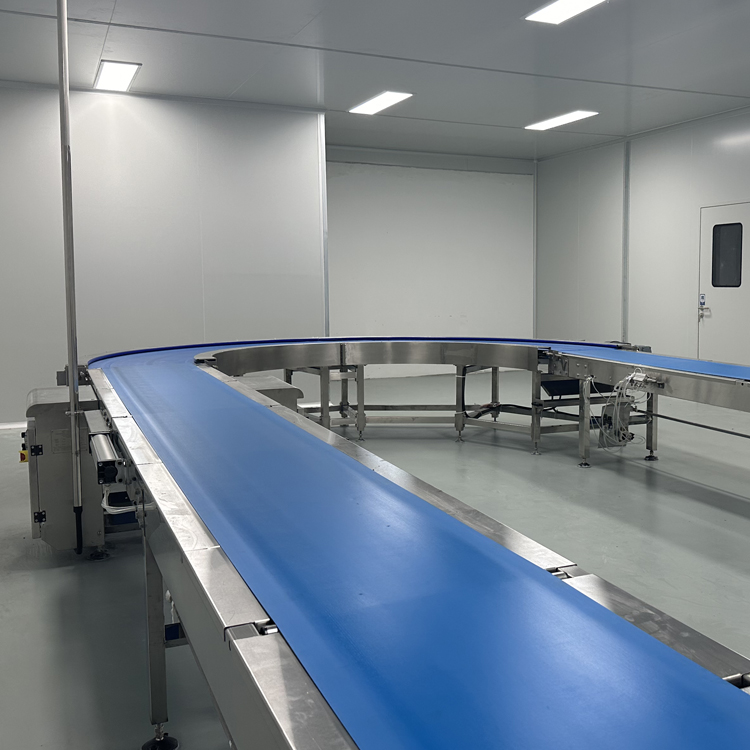
A 180-degree turning machine usually consists of a long-radius curved conveyor or a combination of curves and straight sections that return product in the opposite direction. In biscuit manufacturing, this configuration is especially useful when cooling tunnels or buffer conveyors need to reach a certain length but the factory footprint is limited. [jymachinetech]
By turning the line 180 degrees, engineers can create a U-shaped cell where operators, QC staff, and maintenance teams supervise both "outbound" and "return" flows from a single area. This reduces walking distances, speeds up response to alarms, and can cut labor requirements per ton produced.
From real layout projects, common use cases include:
- Extending cooling time for delicate cookies without building an extension to the factory.
- Looping biscuits back towards centralized packaging in a different hygiene zone.
- Creating parallel lines (Line A outbound, Line B return) that share staff and utilities.
These solutions are especially powerful for export-oriented factories that must handle multiple SKUs and packaging formats within limited space, a scenario Wenva encounters frequently when serving global manufacturers.
When I advise factory owners, the first question is always: What is the ideal product flow from flour silo to pallet? Only then do we decide where to place 90° and 180° turning sections.
A robust biscuit line design usually follows these steps: [foodsmachine]
1. Define oven output (kg/h) and target SKUs.
2. Map required process zones: mixing, forming, baking, cooling, inspection, packaging.
3. Identify physical constraints: columns, walls, loading docks, hygiene separations.
4. Draw the straightest possible flow, then introduce turns only where necessary.
5. Use 90-degree turns for corners and line branching.
6. Use 180-degree turns for loops, returns, and extended cooling or buffering.
This approach keeps line efficiency high and minimizes hidden costs like extra operators, longer product travel, or difficult cleaning routes. [jymachinetech]
Both 90- and 180-degree turning machines can become bottlenecks if their design does not match the oven or packaging speed. Practical rules I share with customers include:
- Keep belt speeds in turning sections slightly higher than upstream conveyors.
- Use accumulation zones before longer 180-degree loops to absorb small disturbances.
- Integrate sensors for jam detection at curves, especially for fragile or iced biscuits.
This kind of fine-tuning is where an experienced line supplier like Wenva adds real value, because the parameters are based on hundreds of previous installations rather than guesswork.

In biscuit factories, food safety and hygiene are non‑negotiable, and turning machines must comply with the same standards as ovens and coolers. Modern automated lines use stainless-steel frames, open profiles, and easy-access belt designs so operators can clean underneath and around curves. [skywinbake]
From a hygiene perspective, 90-degree curves are typically easier to access, while 180-degree loops may require more platforms, walkways, and removable guards. Designing this correctly at the layout stage reduces cleaning time and supports certifications such as HACCP and ISO 22000. [skywinbake]
Turning machines often run continuously for multiple shifts, so maintenance strategy is critical. As a rule of thumb:
- 90-degree units are simpler, with shorter belts and fewer support rollers, making planned maintenance quicker.
- 180-degree systems require inspection of longer belt paths, roller sets, and support structures, and therefore benefit from predictive maintenance strategies integrated into the PLC. [jymachinetech]
Wenva's layouts typically reserve clear side access and overhead clearance around major turning points to make belt replacement and lubrication faster, a detail that strongly influences real-world OEE.
To go beyond generic comparisons, I recommend a simple decision framework that combines factory layout, capacity, and future expansion.
1. Factory footprint and shape
- If your building is truly L-shaped with limited return paths, 90-degree turns will do most of the work.
- If you have long rectangular halls with unused central space, 180-degree loops can unlock efficient U-shaped cells.
2. Capacity and product mix
- For single high-speed SKUs aimed at export markets, 180-degree turns help create long cooling and buffering paths.
- For flexible lines with frequent changeovers, multiple 90-degree branches into different packaging areas may be more efficient.
3. Investment strategy
- When capex is limited, start with essential 90-degree corners and reserve space for future 180-degree loops.
- For greenfield projects with long-term export plans, design 180-degree returns from day one to avoid disruptive future rebuilds. [jymachinetech]
Imagine an L-shaped biscuit factory with 60 m available before a wall and another 40 m after turning the corner. Using only 90-degree turns, you might place the oven in the first leg and cooling plus packaging in the second.
By introducing a 180-degree turn after cooling, you could bring packed product back towards a central palletizing area near the raw material entrance. This reduces forklift traffic, consolidates dispatch operations, and frees space near the back wall for future ovens or specialty lines.
Modern biscuit production lines increasingly use real-time monitoring to manage speed, temperature, and product quality across the entire line. Turning sections are key data points in this digital backbone. [jymachinetech]
By equipping 90- and 180-degree turning machines with encoders, photoelectric sensors, and vibration monitoring, factories can:
- Detect belt tracking issues before they cause stoppages.
- Analyze where minor jams or product overlaps tend to occur.
- Optimize speed profiles across curves to protect fragile biscuits.
Wenva's PLC-based solutions integrate these signals into a unified HMI so operators see the whole line, not just individual machines.
Curved conveyors add drives and motors to a line, so energy efficiency matters. Many modern biscuit lines adopt:
- High-efficiency motors and optimized gear ratios for turning sections.
- Intelligent stop–start control in low-demand periods.
- Layout designs that avoid unnecessary additional curves, reducing total installed power. [skywinbake]
For manufacturers committed to sustainability reporting, these engineering decisions around 90- and 180-degree turning modules directly support lower kWh per ton of biscuits produced.
As a layout and UX-focused content strategist, I find that engineers appreciate clear, actionable checklists. Below is a concise checklist you can use internally when discussing turning machine configurations with your project team or suppliers.
1. Confirm target capacity (kg/h) and SKUs for the next 5–10 years.
2. Map a straight-line flow; add turns only when space or zoning requires it.
3. Identify all corners where 90-degree turns are unavoidable.
4. Evaluate if 180-degree loops can create U-shaped cells or extended cooling.
5. Simulate operator walking paths and maintenance access around each turning module.
6. Check hygienic design: stainless steel, open profiles, easy belt removal. [skywinbake]
7. Verify synchronization with ovens, coolers, and packaging via PLC integration. [jymachinetech]
8. Plan accumulators near 180-degree loops for smoother production.
9. Reserve structural support and floor loading capacity for future expansions.
10. Align final layout with your export, SKU diversification, and sustainability roadmap.
Using a checklist like this strengthens internal decision-making and makes supplier discussions more productive.
Beyond pure engineering, user experience on the shop floor matters. Operators consistently report that:
- 90-degree corners are easier to visually supervise, because the infeed and outfeed are closer together.
- 180-degree loops can feel more complex, but when well-designed, they centralize workstations and reduce walking fatigue.
Designing clear sightlines, logical HMI screens, and safe access platforms around turning points helps operators feel in control rather than "chasing" alarms around the factory.
If your factory is L‑shaped or space-constrained, the right mix of 90-degree and 180-degree turning machines can be the difference between a cramped line and a scalable, export-ready biscuit plant. Wenva Machine brings nearly 40 years of specialized biscuit production line experience, from site survey and layout design to installation and commissioning.
For your next greenfield or retrofit project, you can collaborate with Wenva's engineering team to:
- Audit your existing layout and constraints.
- Simulate different 90° / 180° configurations in CAD.
- Customize turning machines to your hygiene, safety, and capacity requirements.
Visit the official Wenva Machine website's biscuit production line section to explore reference projects and start a technical discussion with the engineering team.
Q1: When should I prioritize 90-degree turning machines in an L-shaped biscuit factory?
You should prioritize 90-degree turning machines when you need compact corner transitions between major process steps, such as from baking to cooling or from cooling to packaging, especially where building walls or columns create natural L-shaped corridors. They are also the most cost-effective choice for incremental line extensions and for adding side-branch packaging or inspection lines. [jymachinetech]
Q2: In what cases does a 180-degree turning machine create the biggest ROI?
A 180-degree turning machine delivers strong ROI when you must extend cooling or buffering length but cannot expand your building, or when creating U-shaped cells that centralize staffing and supervision. For high-capacity, export-focused biscuit plants, 180-degree loops can significantly improve overall operator productivity per ton produced. [jymachinetech]
Q3: Do 180-degree turning systems always consume more energy than 90-degree ones?
Not always, but they typically use longer belts and more mechanical supports, which usually means more drive power. Careful selection of high-efficiency motors, drive sizing, and optimized layouts (avoiding unnecessary extra curves) can keep total energy per ton of product under control. [skywinbake]
Q4: How do turning machines affect product quality for delicate or filled biscuits?
For delicate, filled, or chocolate-coated biscuits, both 90- and 180-degree sections must be engineered with appropriate belt surfaces, side guides, and speed profiles to prevent tipping, smearing, or collisions. Integrating real-time monitoring and fine-tuned belt speeds helps maintain product integrity across curves. [jymachinetech]
Q5: What is the advantage of working with a specialist biscuit line manufacturer instead of generic conveyor suppliers?
Specialist manufacturers like Wenva Machine design turning units as part of a complete biscuit ecosystem—from dough mixing to final packaging—rather than as isolated modules. This ensures better synchronization, hygiene design, maintenance planning, and long-term scalability, all based on decades of biscuit-specific project experience.
1. Wenva Machine – "WENVA: Customized Biscuit Production Line, Dough Mixer …" (Company profile and layout design expertise). [https://www.wenvamachine.com]
2. Wenva Machine – "Automated Biscuit Production Line Solutions: 40 Years of Engineering Cookie Factories for Global Manufacturers" (Site survey, layout and commissioning insights). [https://www.wenvamachine.com/automated-biscuit-production-line-solutions-40-years-of-engineering-cookie-factories-for-global-manufacturers] [wenvamachine]
3. Skywin Bake – "Top 8 Features To Look for in An Automatic Biscuit Production Line" (Key hygienic and energy-efficient design principles). [https://www.skywinbake.net/Top-8-Features-To-Look-for-in-An-Automatic-Biscuit-Production-Line-id46918796.html] [skywinbake]
4. JY Machine Tech – "Essential Guide to the Biscuit Production Line for Efficient Baking" (Process stages and layout considerations). [https://www.jymachinetech.com/essential-guide-to-the-biscuit-production-line-for-efficient-baking/] [jymachinetech]
5. Foodsmachine – "Exploring the Different Types of Biscuit Production Line" (Automated vs conventional line characteristics). [https://www.foodsmachine.net/a-news-exploring-the-different-types-of-biscuit-production-line.html] [foodsmachine]


