
Views: 222 Author: Wenva Machine Publish Time: 2026-06-13 Origin: Site
Content Menu
● Introduction: Why Source Biscuit Maker Machines from China?
● How We Evaluate a Qualified Biscuit Machine Supplier (E‑E‑A‑T Aligned)
● Selection Criteria: How This Top 10 Was Compiled
● Top 10 Biscuit Maker Machine Manufacturers in China (2026)
>> 1. Wenva Machine – Flexible OEM Specialist for Automated Biscuit Lines
>> 2. Shanghai HG Food Machinery Co., Ltd.
>> 3. GELGOOG (Guangzhou) – Multi‑category Snack Equipment Supplier
>> 4. Golden Bake Biscuit Machine (Guangdong)
>> 5. Shanghai Joygoal Food Machinery Co., Ltd.
>> 7. Other Representative Biscuit Machine Manufacturers (Shortlisted)
● Snapshot Comparison: Capacity, MOQ and Certifications
>> Positioning Table of Representative Manufacturers
● Technical Considerations for Biscuit Maker Machines
● Industry Pain Points and How to Avoid Them
>> Common procurement "pits" in biscuit machinery
>> "Inside" avoidance tip rarely shared online
● Buyer's Guide: From Shortlist to Signed Contract
>> 1. Verifying factory and certifications
>> 2. Sampling and FAT (Factory Acceptance Test)
>> 3. Contract and logistics essentials
● Conclusion and Call‑to‑Action
● FAQs from Real Procurement Projects
China is now one of the world's largest biscuit production and bakery equipment bases, supported by mature industrial clusters in Guangdong, Shanghai, Jiangsu and other coastal regions. The domestic biscuit production industry alone is projected to reach about 54.8 billion USD in 2026, driven by demand for higher‑end products and automation. [techsciresearch]
For global buyers, this ecosystem means wide equipment choice (from small lines to 24/7 industrial ovens), experienced OEM suppliers, and competitive total cost of ownership when compared with Europe and Japan. Chinese biscuit maker machine manufacturers have also steadily increased CE, ISO, and food‑contact compliance to better serve markets in Southeast Asia, the Middle East, Africa and Eastern Europe. [wenvamachine]
Before listing the top 10, it is important to clarify the evaluation logic, especially for professional procurement managers who need long‑term partners rather than one‑off purchases.
Key evaluation dimensions (Experience & Trust):
- Factory history and export track record: Years in biscuit machinery, first export date, and share of export revenue. [wenvamachine]
- Compliance and certifications: ISO 9001/14001 for management, CE for safety, and where relevant food‑contact and electrical compliance (e.g., RoHS for some components). [int-enviroguard]
- Quality control (QC) and process traceability: In‑house machining, component traceability, test baking with real formulas, and documented FAT (Factory Acceptance Test) reports. [foodsmachine]
- Delivery reliability: Ability to quote realistic lead times, manage project milestones and provide on‑site commissioning resources.
Technical & expertise dimensions:
- Materials and component grade: Food‑grade stainless steels (typically SUS304 or higher in product‑contact zones), branded motors/inverters, and reliable control systems. [wenva668.en.made-in-china]
- Process capability: Ability to cover dough mixing, forming (rotary moulder / rotary cutter / wire‑cut), baking (electric/gas tunnel ovens), cooling, sandwiching, enrobing and packaging integration. [wenva668.en.made-in-china]
- Engineering and R&D: Independent design capability, ability to replicate recipes, adapt to new biscuit formats, and support continuous line optimization. [wenvamachine]
Authoritativeness & cluster advantage:
- Location in established machinery belts such as Guangdong's baking machinery base or Shanghai/Jiangsu food equipment hubs, which concentrate skilled labor and sub‑suppliers. [ibisworld]
- Participation in international exhibitions (Canton Fair, Bakery China, Dubai, Algeria, etc.), which signals both export seriousness and after‑sales reach. [wenvamachine]
The following list uses these criteria, combined with public information, industry reports and on‑the‑ground sourcing observations, to identify representative manufacturers covering different positioning: high‑flexibility OEM partners, large‑scale turnkey line providers, and specialized niche players. [techsciresearch]
To keep this guide transparent and usable as a sourcing reference, the top 10 list is based on the following structured criteria:
- Core focus on biscuit maker machines or automated biscuit/ cookie production lines, not generic food machinery only. [wenvamachine]
- Minimum 10 years in food or bakery machinery, with verifiable export activities and overseas clients. [wenvamachine]
- Capability to supply at least one complete line (from dough mixing to baking and cooling), not just a single stand‑alone machine. [wenva668.en.made-in-china]
- Availability of key certifications (ISO/CE or equivalent) and proven installation base outside China. [hyperbots]
- Publicly visible participation in exhibitions and/or B2B platforms, supporting due diligence by overseas buyers. [facebook]
This means some smaller or purely domestic‑focused factories are intentionally excluded even if they have low prices, because their after‑sales and documentation systems cannot match the requirements of international procurement teams.
> Note: Information is synthesized from manufacturer sites, industry directories and public rankings; always reconfirm details during RFQ and factory audit. [ensun]
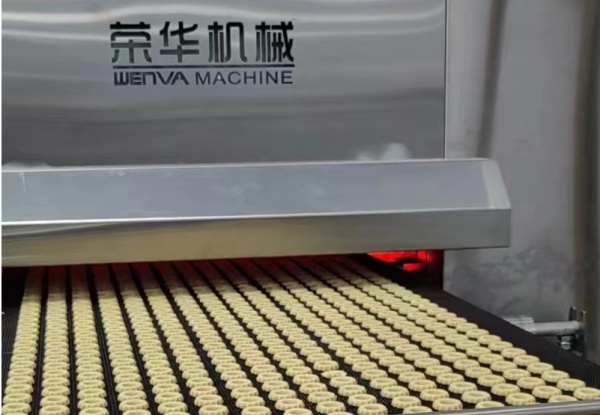
Wenva Machine has specialized in automated biscuit production lines for around 40 years, with roots in biscuit line design dating back to the mid‑1970s. The company independently developed its first biscuit production line in the late 1970s and has been exporting since 1993, with export trade now representing about 40% of its business. [wenvamachine]
From an engineering perspective, Wenva is not just a single‑machine supplier but an integrated line provider, covering dough mixers, forming equipment (rotary moulder, rotary cutter), gas/electric tunnel ovens, sandwiching and auxiliary systems. The factory area is approximately 37,800 m² with around 110 employees, which is large enough to control quality internally while still being agile for mid‑volume OEM orders. [wenva668.en.made-in-china]
For buyers, Wenva's strength sits in its high cost‑performance positioning and willingness to customize for small and medium brands: the company emphasizes full customization based on specific layouts, recipes and capacity targets, supported by an in‑house Biscuit Production Line Experience Center where buyers can test formulas and product shapes before locking specifications. Wenva also deploys technicians for on‑site commissioning and trial production, which is particularly valuable in countries where local biscuit process expertise is limited. [wenvamachine]
- Typical MOQ: Flexible; supports smaller initial lines and phased capacity expansion. [wenvamachine]
- Main markets: Southeast Asia, Middle East, Africa, plus select European and Latin American buyers. [wenvamachine]
- OEM/ODM scope: Custom line layout, oven configuration, forming tools, and recipe‑adapted process parameters; supports private‑label biscuit brands needing distinctive shapes. [wenva668.en.made-in-china]
Shanghai HG is a well‑known food processing machinery group, with biscuit production lines as one of its core segments. Based in Shanghai's machinery cluster, the company benefits from strong access to control components, stainless‑steel processing and automation talent. [wenvamachine]
The firm offers full biscuit lines (hard, soft, soda, sandwich) and can integrate ancillary equipment such as chocolate enrobers and packaging machines. Its positioning tends to suit larger factories and groups that want standardized, high‑throughput lines rather than highly customized small‑scale systems. [ensun]
- Typical MOQ: One full line; more rigid on customization for micro‑factories.
- Main markets: Asia, Middle East, Eastern Europe via engineering companies and agents. [ensun]
- OEM/ODM scope: Strong engineering, but customization generally within pre‑set engineering templates.
GELGOOG is a broader snack and food machinery supplier with a strong presence in biscuit, cookie and wafer equipment. As a Guangzhou‑based enterprise, it leverages the Pearl River Delta's dense manufacturing ecosystem to supply semi‑standard and turnkey lines. [wenvamachine]
Its biscuit maker machine range spans small rotary moulders for entry‑level factories up to automated lines with integrated baking and cooling. For buyers running multi‑snack plants (nuts, wafers, fries), GELGOOG's portfolio breadth can simplify vendor management, though biscuit‑specific process depth may be slightly less customized compared to niche biscuit specialists. [ensun]
- Typical MOQ: One machine or a small line; relatively friendly to new entrants.
- Main markets: Global, with notable penetration in Asia and Africa via traders and local partners. [ensun]
- OEM/ODM scope: Accepts customization but tends to maintain standard modules for faster delivery.
Golden Bake, listed in several biscuit machinery directories, is recognized for complete biscuit and cookie lines with a focus on industrial‑scale configurations. Situated in a major baking machinery cluster, it can provide comprehensive solutions from dough mixing, forming, baking to cooling conveyors. [ensun]
Golden Bake often targets buyers seeking continuous production with higher capacities rather than small entry‑level lines. It is suited to factories that already have some biscuit know‑how and need stable, repeatable engineering rather than extensive process development support.
- Typical MOQ: One complete line with defined capacity; better match for mid‑to‑large plants. [ensun]
- Main markets: Southeast Asia, Middle East, Eastern Europe and Latin America, usually via direct projects.
- OEM/ODM scope: Custom capacities and oven lengths, with limited recipe co‑development.
Shanghai Joygoal manufactures various food processing machines and includes biscuit machines in its portfolio. Their biscuit equipment can handle multiple formats and they emphasize energy‑efficient designs and compact layouts suitable for factories with space constraints. [testigodecine]
For procurement managers, Joygoal is valuable when you need biscuit machines alongside other processing units (e.g., sauce filling, packaging) from the same supplier. The trade‑off is that their biscuit R&D focus is more generalist, so highly specialized biscuit innovation may require internal product development or external consultants. [testigodecine]
- Typical MOQ: Single machines or modular lines, flexible for pilot lines or new product trials.
- Main markets: Asia, Africa, Latin America through a mix of direct export and OEM. [testigodecine]
- OEM/ODM scope: Layout adaptation and some tooling customization; emphasis on integrating with existing plant utilities.
SinoBaker is specialized in bakery and biscuit processing machinery and is often mentioned in professional rankings of cookie and biscuit equipment manufacturers. The company focuses on process control and stable output for high‑volume biscuit plants, offering rotary moulders, tunnel ovens and downstream handling systems. [sftmachinery]
Its strengths include relatively standardized yet reliable lines and well‑documented installations, which appeal to buyers who value proven references over heavy customization. However, MOQ and capacity levels are often higher, making the brand a better fit for factories with existing biscuit sales channels.
- Typical MOQ: One medium‑to‑large line; smaller "test" configurations less common. [sftmachinery]
- Main markets: Domestic China, plus export to Asia, Middle East and Eastern Europe.
- OEM/ODM scope: Parameter tuning, capacity modification and packaging integration.
From 2026 industry directories and B2B platforms, several additional Chinese manufacturers stand out as credible biscuit machine suppliers, though each has more niche focus. Examples include: [ensun]
- Machinery makers with strong tunnel oven expertise that support biscuit as part of broader baking lines. [ensun]
- Regional manufacturers that mainly serve local biscuit brands but have started exporting via trading companies. [ensun]
For these players, due diligence should be stricter because documentation, after‑sales structure and English‑language support can vary significantly. When you use them mainly as component or sub‑system suppliers (e.g., ovens only, or moulds only), they can still be cost‑effective.
> Values are indicative to illustrate positioning; always reconfirm during RFQ and engineering alignment. [sftmachinery]
| Manufacturer | Typical capacity range (t/day) | Typical MOQ (line/machine) | Certifications & focus (indicative) |
|---|---|---|---|
| Wenva Machine | ~0.3–5+ depending on line size (wenvamachine) | Flexible; supports small lines (wenvamachine) | ISO‑style quality system, CE‑oriented export components, focus on full biscuit lines and OEM customization (wenvamachine) |
| Shanghai HG Food Machinery | ~1–8 for industrial lines (wenvamachine) | 1 complete line (wenvamachine) | ISO/CE for export projects, turnkey food lines for larger factories (wenvamachine) |
| GELGOOG (Guangzhou) | ~0.2–3 for biscuit/cookie lines (wenvamachine) | Single machine or small line (wenvamachine) | CE/ISO on key models, broad snack machinery portfolio (wenvamachine) |
| Golden Bake | ~1–10+ for continuous biscuit lines (ensun) | 1 medium/large line (ensun) | Export‑ready documentation, industrial‑scale biscuit equipment (ensun) |
| Shanghai Joygoal | ~0.1–2 for modular lines (testigodecine) | Single machine or modular line (testigodecine) | CE/ISO on main equipment, compact plant layouts, multi‑category food machinery (testigodecine) |
| SinoBaker Machinery | ~1–6+ for cookie/biscuit lines (sftmachinery) | 1 full line (sftmachinery) | Bakery‑focused, process‑control oriented biscuit lines (sftmachinery) |
When evaluating biscuit maker machines, procurement managers should look beyond brochure capacities and focus on engineering fundamentals:
- Material grade and hygiene design: For product‑contact parts, SUS304 stainless steel is standard, with smooth welds and easy‑to‑clean designs to meet export markets' hygiene expectations. Conveyor belts, moulds and hoppers should allow fast disassembly for sanitation. [wenva668.en.made-in-china]
- Process modules: A robust line usually includes dough mixing, aging, forming (rotary moulder/cutter/wire‑cut), tunnel baking (electric or gas), cooling conveyors, stacking and packaging integration. Missing modules will raise integration risk at the buyer's side. [wenva668.en.made-in-china]
- Energy efficiency: With soaring energy costs, gas tunnel ovens with optimized insulation and heat recovery can significantly affect lifetime costs, even if initial CAPEX is similar. [foodsmachine]
- Automation level and control: PLC‑based control, recipe storage, and zone temperature control across the tunnel oven are crucial for repeatable quality and lower operator dependency. [foodmachineryint]
Industry reports show that as Chinese biscuit consumption shifts towards higher‑end and health‑oriented products, more factories are upgrading to automated lines to ensure uniform quality and consistent texture. This trend favors suppliers with strong process know‑how and recipe support rather than only mechanical fabrication. [ibisworld]
- Under‑spec materials and components: Using lower‑grade steel or unbranded motors reduces cost but increases downtime, rust risk and hygiene issues, especially in humid climates. [foodsmachine]
- Over‑promised capacity: Some suppliers quote maximum theoretical output, not realistic steady‑state capacity with your recipe and packaging speed.
- Hidden integration costs: Lines that look cheap on paper can become expensive once you factor in local fabrication, extra conveyors, or electrical rework.
- Weak after‑sales and spares: A machine is only as good as its long‑term support; slow spares and no remote diagnostics can cripple production.
In China's biscuit machinery industry, one internal practice many experienced buyers know but seldom mention publicly is to request the actual FAT recipe sheet and oven parameter log used for a recent export line—not just a video. Suppliers that really understand process will be able to show, under NDA if needed, the real baking curve, zone temperatures, belt speed and dough formula used to validate a similar line. Those who cannot provide this are often more "fabrication‑driven" than "process‑driven," which greatly increases your commissioning risk. [foodsmachine]
This single request often separates engineering‑oriented suppliers (such as Wenva and a few others) from mainly trading‑oriented vendors. It also gives you early insight into how they manage QC and process documentation.
- Check ISO and CE status: Use the certificate number to verify directly with the issuing body or via accreditation databases, ensuring that the certificate is valid, not expired and covers the right scope (e.g., food machinery, not unrelated products). [hyperbots]
- Confirm production site: Use a mix of video calls inside the workshop, third‑party inspections, and, when budget allows, on‑site audits to ensure the company is not purely a trader.
- Review project references: Ask for case studies in your region or climate, particularly for similar capacity and product types.
- Send clear specifications: biscuit types (hard, soft, sandwich), dimensions, desired texture, packaging style, expected daily output and available utilities.
- Request test baking in the supplier's test center where possible; Wenva, for instance, operates a Biscuit Production Line Experience Center that can simulate real‑life production with your formula. [wenvamachine]
- Define FAT criteria jointly: continuous running time, yield, weight variation tolerance, breakage rate, and energy consumption benchmarks.
- Technical annex: Attach detailed P&ID, line layout, utility list, and performance guarantees as contract annexes to avoid misunderstandings.
- Spare parts list: Include critical spare parts and recommended stock for the first 1–2 years, with agreed pricing and lead time.
- Shipping and installation: Plan for packaging, sea freight, customs clearance, and on‑site installation schedules; align on who handles unloading, foundation work and utilities.
Leading Chinese manufacturers regularly ship biscuit lines to over 25 countries and are familiar with export packaging, documentation and on‑site commissioning requirements, which reduces overall project risk when properly coordinated. [ibisworld]
China's biscuit maker machine industry has matured into a globally competitive ecosystem, combining strong process know‑how, integrated supply chains and increasingly robust quality and certification systems. For professional procurement managers, the key is not just "who is the cheapest," but who can provide stable capacity, documented process support and reliable after‑sales service over many years. [techsciresearch]
Wenva Machine stands out in this landscape as a flexible, R&D‑driven partner for small and medium biscuit brands that need high cost‑performance lines, deep OEM customization and efficient communication from design to on‑site commissioning. If you are planning a new biscuit factory or upgrading existing lines, it is worth shortlisting 3–4 suppliers from this guide, requesting detailed layouts and FAT conditions, and then conducting a structured technical and commercial comparison. [wenva668.en.made-in-china]
1. How can I verify if a manufacturer's ISO certificate is valid and not expired?
Ask for a high‑resolution copy of the ISO certificate with the accreditation body's name and certificate number, then verify this number directly via the certification body's online database or by contacting them. Ensure that the scope states food machinery or related manufacturing, and that the expiry date covers your delivery and warranty period. [int-enviroguard]
2. What is a realistic lead time for a complete biscuit production line from China?
For standard‑configuration lines, typical lead times are 60–120 days from deposit to FAT, plus shipping and on‑site installation time; highly customized, large‑capacity lines can exceed 150 days. The overall project schedule should also include time for design approval, civil works in your plant and local utility preparation. [sftmachinery]
3. How do I balance price vs quality when comparing quotations?
Normalize all quotes to include full line scope (including conveyors, electrical cabinets and basic installation supervision) and evaluate lifetime cost: spare parts, energy consumption, downtime risk and technical support responsiveness. Often, mid‑priced but process‑strong suppliers deliver lower total cost of ownership than the cheapest options. [ibisworld]
4. How can I be sure the machine will handle my local flour and recipe?
Insist on test runs using your flour sample and target recipe in the supplier's test facility or during FAT, adjusting process parameters together. Document the confirmed oven curves, belt speeds and dough settings in the technical dossier and make them part of commissioning deliverables. [foodsmachine]
5. What are the most critical spare parts to stock for a new biscuit line?
Common critical items include motors, inverters, temperature sensors, belts, gearboxes, bearings and specialty moulds; having a 6–12‑month stock of high‑wear parts minimizes unplanned downtime. Ask your supplier for a recommended spare parts list based on similar installations in your climate and operating schedule. [foodsmachine]


