
Views: 251 Author: Wenva Machine Publish Time: 2026-07-01 Origin: Site


Content Menu
● Why Automation Matters When You Start a Small Biscuit Factory
● Step 1: Define Your Biscuit Business Model and Product Portfolio
>> Clarify Your Target Market and Positioning
>> Map Products to Automation Requirements
● Step 2: From Kitchen Recipes to Scalable Factory Formulas
>> Standardize Your Core Recipes
>> Pilot Runs on Small Biscuit Machines
● Step 3: Understand Permits, Certifications, and Food Safety Requirements
>> Core Regulatory Steps for a Small Biscuit Factory
>> Certifications that Build Trust
● Step 4: Design Your Factory Layout Around an Automated Biscuit Production Line
>> Key Layout Principles for Small Biscuit Factories
>> Scaling from Small to Medium Capacity
● Step 5: Choosing the Right Automated Biscuit Production Line Equipment
>> Core Equipment Types You Will Need
>> Why Integrated Solutions Reduce Risk
● New Section: Current Automation Trends Shaping Small Biscuit Factories
>> Modular and Quick‑Change Equipment for Short Runs
>> Energy‑Efficient Ovens and Exhaust Heat Recovery
>> Data and Quality Analytics in Biscuit Lines
● Step 6: Branding, Packaging, and Go‑to‑Market Strategy
>> Build a Brand that Reflects Your Production Strength
>> Packaging that Protects and Communicates
● Step 7: Plan Your Investment and ROI Around Equipment Lifecycle
>> Key Cost Drivers in a Biscuit Production Line
>> Why Choosing a 40‑Year Biscuit Machinery Partner Matters
● Practical Example: A Small Soda Biscuit Factory Roadmap
>> Phase 1: Foundation (Year 0–1)
>> Phase 2: Expansion (Year 2–4)
>> Phase 3: Differentiation (Year 5+)
● At‑a‑Glance: Small Biscuit Factory Setup vs Automated Line Benefits
● Final Expert Recommendations for First‑Time Biscuit Manufacturers
● Call to Action: Turn Your Biscuit Vision into a Scalable Automated Factory
● FAQs
Launching a small biscuit factory today is no longer just about good recipes—it is about designing a scalable, automated biscuit production line that can grow from pilot batches to stable industrial output. Drawing on over 40 years of biscuit machinery engineering experience at Wenva Machine, I will walk you through the practical steps, common pitfalls, and smart automation choices that first‑time biscuit manufacturers need to get right from day one. [wenvamachine]
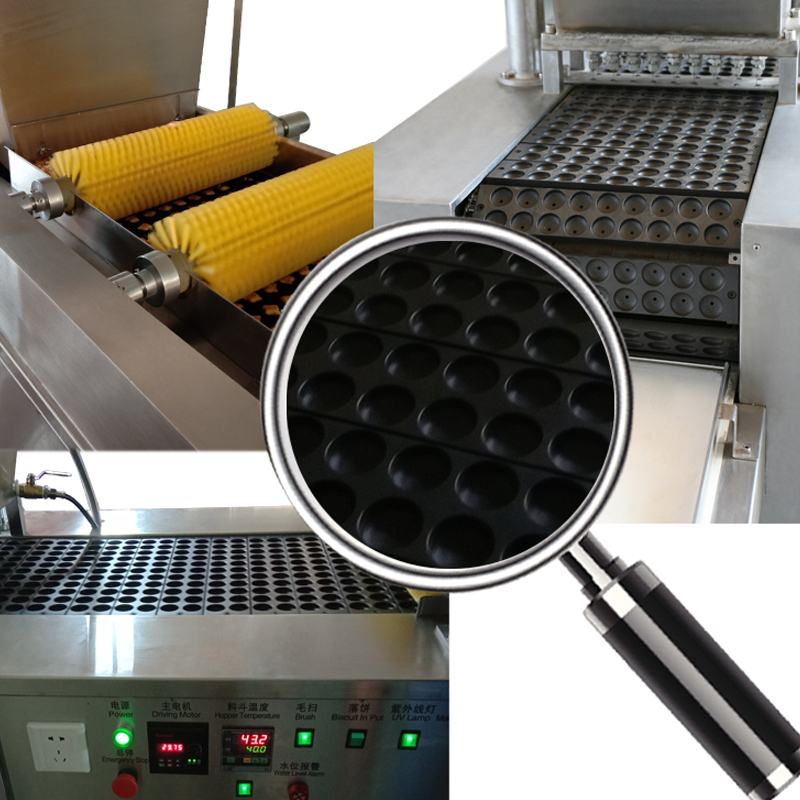
When you set up a small biscuit factory from scratch, every early decision—layout, equipment, recipes, and workforce—will either support or block future automation. Many new biscuit entrepreneurs start with manual or semi‑automatic processes, only to discover later that they must redesign their entire factory to accommodate tunnel ovens, dough sheeters, and automated stacking lines. [wenvamachine]
From a practical industry perspective, building around an automated biscuit production line from the beginning offers four key advantages:
- Consistent product quality and texture across batches
- Lower long‑term labor costs and fewer operator‑dependent risks
- Easier compliance with food safety and audit standards
- Scalable capacity when orders grow or SKUs diversify [wenvamachine]
As a manufacturer that has engineered more than 300 biscuit lines for plants of different sizes, Wenva Machine sees small factories succeed fastest when they treat automation as part of the startup design, not a later add‑on. [wenvamachine]
Before you select any mixer or oven, you must define what kind of biscuit factory you want to build. [wenvamachine]
Ask yourself:
- Are you targeting mass‑market biscuits for supermarkets, or premium cookies for specialty stores?
- Is your focus on shortbread, tough biscuits, sandwich biscuits, or soda crackers?
- Will you need dual‑color swirls, filled center biscuits, or seasonal shapes that require more complex forming technology? [wenvamachine]
These answers drive your line configuration. For example:
- A small plant focused on entry‑level tough biscuits may start with a simpler sheeting and cutting line.
- A brand built around high‑end swirl cookies may need dual‑color extruders and hybrid tunnel ovens from day one. [foodsmachine]
Each biscuit style translates into specific process steps:
- Dough mixing (vertical or horizontal mixers)
- Forming (dough sheeters, rotary moulders, wire‑cut or co‑extrusion machines)
- Baking (electric, gas, or hybrid tunnel ovens)
- Cooling and stacking (cooling conveyors, biscuit stacker machines)
- Decoration / finishing (oil sprayers, egg sprinkle machines, sugar/salt sprinklers)
- Packaging preparation (turning machines, transfer conveyors) [wenvamachine]
Defining your product portfolio early ensures that your automated biscuit production line is engineered for the right dough characteristics, baking curves, and upstream/downstream handling, avoiding expensive retrofits later. [bakingeurope]
Many new biscuit brands begin with a home kitchen recipe and underestimate the work required to industrialize it. [wenvamachine]
You need to translate your prototype biscuits into consistent formulas that behave predictably in automated equipment:
- Set fixed ratios for flour, fat, sugar, leavening, and moisture.
- Define clear mixing times and temperatures for industrial mixers.
- Document target dough characteristics: firmness, extensibility, stickiness, and temperature. [wenvamachine]
In practice, we often work with customers to adapt three to five hero recipes first (e.g., a plain tough biscuit, a shortbread cookie, a sandwich variant), then build the line spec around those. [wenva]
Before committing to a full automated line, it is smart to run pilot tests on small biscuit machines:
- Use compact cookie and sandwich machines to validate dough behavior and forming quality.
- Adjust recipes until dough feeds cleanly into moulds, extruders, or injection machines.
- Validate bake profiles in smaller ovens that simulate your future tunnel oven zones. [wenvamachine]
Wenva Machine operates a Biscuit Production Line Experience Center specifically for this purpose: customers test their recipes on real industrial equipment, collecting data on throughput, texture, and visual appearance before finalizing the line design. [wenva]
From an operator's perspective, regulatory compliance can feel like an obstacle, but in reality, it protects your brand and makes retailer negotiations easier. [wenvamachine]
While exact requirements vary by country, most new factories must:
- Secure permits for food manufacturing, including health and hygiene approvals.
- Demonstrate adequate ventilation, pest control, waste management, and water safety.
- Implement documented Good Manufacturing Practices (GMP) and HACCP‑style hazard controls. [wenvamachine]
Inspections may cover:
- Zoning and building safety
- Employee hygiene facilities and locker rooms
- Separation of raw and finished product flows
- Surface materials and cleanability of walls, floors, and equipment bases [wenvamachine]
Beyond basic permits, certifications help you:
- GMP or equivalent food safety certification for your facility.
- CE, ISO, or similar quality certifications on your equipment. [wenvamachine]
- Optional organic or specialty labels depending on your product strategy. [wenvamachine]
Wenva Machine's automated biscuit production lines, for example, are backed by CE and ISO certifications and multiple patents in mechanical design and automation control, which helps our customers pass audits faster and secure retailer listings. [wenvamachine]
One of the biggest hidden risks for new biscuit factories is poor layout planning. If you treat the production line as individual machines rather than an integrated flow, you will struggle with bottlenecks and hygiene zoning. [wenvamachine]
When planning your first plant, aim for:
- Linear product flow: raw material intake → mixing → forming → baking → cooling → stacking → packaging.
- Minimal cross‑traffic between raw and finished goods.
- Clear allergen and flavor zoning if you handle multiple recipes.
- Accessible maintenance paths around ovens and conveyors. [wenvamachine]
An experienced biscuit machinery manufacturer can provide plant and production line planning drawings that take into account your building dimensions, utility connections, and future expansion zones. [wenva]
Smaller factories often start with:
- One horizontal or vertical dough mixer
- A single dough sheeter or rotary moulder
- One tunnel oven (electric, gas, or hybrid)
- Basic cooling conveyor and manual packing [wenvamachine]
A smart layout leaves room to:
- Add a second forming machine for another biscuit style.
- Extend cooling conveyors and integrate automatic biscuit stackers.
- Upgrade to multi‑zone tunnel ovens when shelf‑life or texture requirements become more demanding. [wenvamachine]
Designing with this modular mindset ensures your initial investment remains usable as you scale.
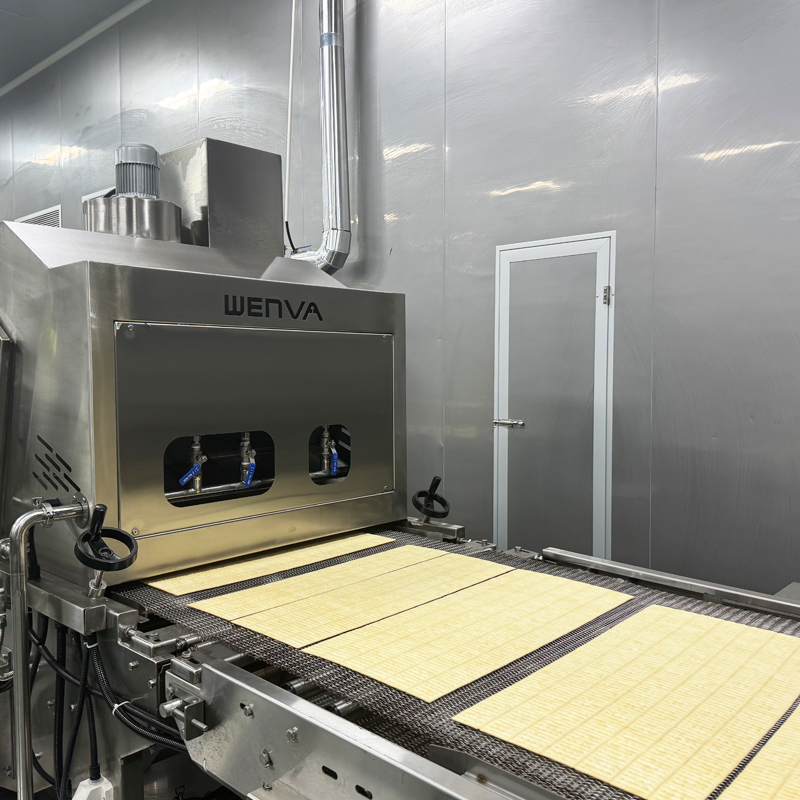
This is where first‑time manufacturers gain—or lose—the most value. It is tempting to buy assorted equipment from different suppliers based on price, but integrated line design is what keeps your factory stable and profitable. [wenvamachine]
A typical automated biscuit production line includes:
- Dough mixer – vertical or horizontal types sized to your batch volume
- Forming equipment – dough sheeter, biscuit shaping machine, wire‑cut or co‑extrusion units
- Tunnel oven – electric, gas, or hybrid, with appropriate zones and control system
- Cooling and conveying – conveyors, turning machines, stackers
- Auxiliary equipment – flour feeding and weighing systems, oil sprayers, egg sprinklers, sugar/salt sprinklers, mould sets. [wenvamachine]
Each choice influences:
- Energy consumption and operating costs
- Maintenance complexity and spare part availability
- The range of biscuit styles you can produce on the same line. [bakingeurope]
In Wenva Machine's experience, factories that select a single integrated supplier benefit from:
- Matched capacities between mixers, formers, ovens, and coolers (no bottleneck machines).
- Consistent PLC and control architecture, simplifying operator training and troubleshooting.
- Shorter installation and commissioning times, because the line is engineered as a whole. [wenva]
With a 30,000㎡ production base and more than 10 precision production lines, our engineering team designs one‑stop customized solutions that align equipment specs with your business model instead of selling random machines. [wenvamachine]
To add strategic value beyond the original article, it is important to understand where biscuit production technology is heading and how small plants can benefit from these trends. [foodsmachine]
Industry‑wide, manufacturers increasingly require:
- Short production runs with frequent recipe or shape changes
- Seasonal SKUs and limited editions
- Multiple textures and fillings on a single line. [gobte]
Technologies such as quick‑change modular molds and interchangeable inserts dramatically reduce downtime when switching biscuit shapes, helping small factories cope with frequent marketing campaigns and retailer demands. [wenvamachine]
Energy cost is a major concern for biscuit plants of all sizes. Modern lines increasingly use:
- Multi‑zone tunnel ovens to fine‑tune moisture removal and texture.
- Exhaust heat recovery systems to reclaim energy from oven flues and reduce gas or electricity consumption. [bakingeurope]
For small producers, choosing the right oven configuration and considering heat recovery from the beginning can significantly improve long‑term ROI, particularly as production hours and capacity expand. [wenvamachine]
Recent innovations include AI‑assisted quality control, using cameras and sensors to monitor biscuit color, shape, and size in real time. Even without full AI, data collection from oven zones, extruders, and stackers helps: [foodsmachine]
- Detect drift in bake quality
- Predict maintenance needs
- Compare performance across shifts and recipes. [bakingeurope]
Small factories that build a data‑aware line from day one find it easier to meet retailer specifications and maintain a stable brand experience.
A technically sound factory still needs a visible brand and effective distribution to succeed. [wenvamachine]
Instead of only emphasizing taste, highlight:
- Consistent quality enabled by automated biscuit production lines.
- Food safety and certifications supported by your chosen equipment.
- Any unique textures, fillings, or shapes made possible by advanced forming technology. [wenvamachine]
Your brand story can legitimately mention that you work with an experienced biscuit machinery manufacturer, giving buyers confidence in stability and scalability.
Effective biscuit packaging should:
- Preserve crispness and texture over the target shelf life.
- Provide clear ingredient and allergen information.
- Reflect your brand's positioning (fun, premium, healthy, traditional).
- Fit retail and logistics constraints, from shelf dimensions to carton stacking. [wenvamachine]
Whether you sell via local retailers, e‑commerce, or international distribution, packaging choices must align with both technical requirements of your biscuits and the capabilities of your production line and upstream handling.
From an expert UX and strategy perspective, one of the most user‑centric things you can do is to plan for the lifetime costs of your equipment, not just the purchase price. [wenvamachine]
Consider:
- Initial equipment and installation costs
- Utilities (electricity, gas, compressed air, water)
- Labor (operators, maintenance technicians, quality staff)
- Spare parts and preventive maintenance
- Downtime during product changeovers or repairs. [bakingeurope]
An experienced supplier can help you model these factors into a 5–10 year ROI calculation, showing how different levels of automation, oven configurations, and modularity affect long‑term profit. [northjersey]
Working with a supplier that has:
- Decades of biscuit line design experience
- A proven global footprint across diverse climates and markets
- An internal technical design team and standardized warehouse for parts and service [wenva]
reduces uncertainty for first‑time investors. Wenva Machine, for instance, supports small factories from the first layout drawing through commissioning and later line upgrades, ensuring that every stage of your growth stays compatible with your initial automation choices. [wenvamachine]
To make these concepts more tangible, here is an example roadmap based on typical projects we see in emerging markets. [wenvamachine]
- Secure permits and basic GMP compliance.
- Develop and standardize 2–3 soda biscuit recipes.
- Install a compact automated biscuit production line: mixer, soda biscuit forming, single‑zone gas tunnel oven, cooling conveyor, manual packing. [wenvamachine]
- Add multi‑zone oven controls to support new textures and extended shelf life.
- Integrate automatic stackers and turning machines to reduce manual handling.
- Introduce seasonal shapes using quick‑change molds or modular inserts. [wenvamachine]
- Expand into filled biscuits, dual‑color cookies, or pretzel‑style snacks using additional forming modules.
- Consider exhaust heat recovery and further energy optimization.
- Integrate basic data logging for oven curves and product quality to support retailer audits and continuous improvement. [foodsmachine]
This staged approach lets small factories start lean while keeping their automation roadmap open.
| Aspect | Small Biscuit Factory Need | Automated Biscuit Production Line Benefit |
|---|---|---|
| Product consistency | Stable texture, color, and shape across batches | Precise, repeatable mixing, forming, and baking control (wenvamachine) |
| Labor and training | Limited skilled staff, risk of human error | Reduced manual handling and standardized operating procedures (wenvamachine) |
| Food safety compliance | Need to pass inspections and retailer audits | Hygienic, certifiable equipment with CE/ISO support (wenvamachine) |
| Scalability | Ability to increase capacity without redesigning the plant | Modular line upgrades (extra formers, zones, stackers) (wenvamachine) |
| Product diversification | New shapes, fillings, and seasonal SKUs | Quick‑change molds, dual‑color extruders, co‑extrusion systems (wenvamachine) |
| Energy efficiency | Pressure to control gas and electricity costs | Multi‑zone ovens, exhaust heat recovery, optimized baking curves (wenvamachine) |
From an industry expert and UX perspective, the most successful small biscuit factories:
- Start with a clear product and market focus, then engineer their line around that focus.
- Treat automation and layout as part of the startup design, not a later upgrade.
- Choose an integrated biscuit machinery partner with deep experience and global references.
- Pilot their key recipes on small biscuit machines and demo lines before finalizing equipment specs.
- Plan for energy, maintenance, and quality data from day one to support long‑term profitability. [wenvamachine]
If you build your small biscuit factory with this mindset, your first automated biscuit production line will not only meet today's orders—it will be ready to support tomorrow's product innovations and market expansions.
If you are planning a small biscuit factory and want to avoid costly detours, consider partnering with a biscuit machinery manufacturer that has 40 years of automated biscuit production line experience and a global track record. With expert support from early recipe trials to plant layout and commissioning, you can launch a factory that is safe, efficient, and ready to grow. [wenva]
Take the next step: define your target biscuit portfolio and contact a specialist team to evaluate the best line configuration, oven type, and automation level for your budget and capacity goals. [wenvamachine]
Q1: Can I start with a semi‑automatic line and upgrade later?
Yes, but it is vital to design your factory layout and utilities with full automation in mind so you can add forming modules, tunnel oven zones, and stackers without re‑building the plant. [wenvamachine]
Q2: How many biscuit types can I produce on a single automated line?
Most modern lines can handle several biscuit styles by combining flexible forming equipment, adjustable oven profiles, and quick‑change molds, as long as recipes are engineered for shared process windows. [bakingeurope]
Q3: What capacity is realistic for a first‑time small biscuit factory?
Typical starter plants focus on one core product family and size their mixers, ovens, and conveyors for a modest daily output, while reserving physical and electrical capacity for future expansion. [wenvamachine]
Q4: How long does installation and commissioning usually take?
For a well‑planned small factory with a single integrated supplier, installation and commissioning often fit within a few months, including equipment setup, operator training, and trial production runs. [wenva]
Q5: Do I need advanced AI quality control from the beginning?
Not necessarily—basic sensors and good process control are enough at startup, but designing your line so that cameras and analytics can be added later will make future quality optimization easier. [foodsmachine]
1. Golden Bake. "Starting from Scratch: The Ultimate Steps to Set Up a Small Biscuit Factory."
2. Wenva Machine. "Biscuit Machinery Manufacturer – About Wenva Machine and Main Products."
[https://www.wenvamachine.com]
3. Ronghua / Wenva Machine. "About Us – Biscuit Production Line History and Global Projects."
4. Golden Bake. "The Latest Innovations in Biscuit Production Line Technology."
5. Baking Europe. "Industrial Biscuit Production Faces Automation Push."
[https://www.bakingeurope.com/news/industrial-biscuit-production-faces-automation-push]
6. Gobte / Industry Blog. "Top 5 Biscuit Line Innovations That Are Changing the Industry."
[https://www.gobte.com/top-5-biscuit-line-innovations-that-are-changing-the-industry/]
7. EINPresswire. "Top Biscuit Production Line Manufacturer Expands Global Footprint with Advanced Automation Technology."


