
Views: 227 Author: Wenva Machine Publish Time: 2026-06-27 Origin: Site
Content Menu
● Understanding Post-Bake Oil Spraying on Hard Biscuits
● Integrated vs. Standalone Oil Sprayers: Key Definitions
● How an Oil Sprayer Works in an Automated Biscuit Line
● Integrated Oil Sprayers: When Tight Line Synchronization Matters
● Standalone Oil Sprayers: Flexibility and Retrofit Advantages
● Integrated vs. Standalone: Practical Comparison for Biscuit Producers
>> Integrated and Standalone Oil Sprayer Comparison
● Real-World Insights from Biscuit Lines
● Design Considerations: What Really Drives Consistency
● Case Scenario: Scaling a Hard Biscuit Line with Integrated Spraying
● Practical Setup Steps for Consistent Finish
● How Wenva Machine Supports Both Approaches
● Choosing Between Integrated and Standalone: A Simple Decision Framework
● Call to Action: Optimize Your Biscuit Finish with Tailored Oil Spraying Solutions
● Frequently Asked Questions (FAQ)
As a biscuit production engineer and long-time automation partner to bakeries, I've seen first-hand how the choice between integrated and standalone oil sprayers can make or break the final appearance and texture of hard biscuits after baking. Getting this decision right means more consistent gloss, better bite, and fewer customer complaints about "dry" or "uneven" products.
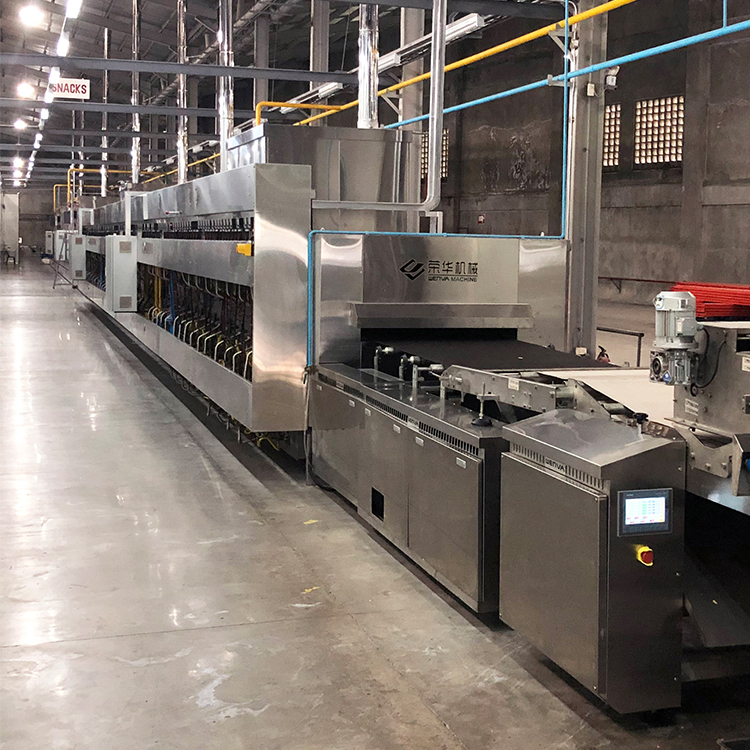
In a modern automated biscuit production line, the oil spraying machine sits directly after the tunnel oven and before the cooling and packaging sections. Its core job is to deliver a thin, uniform oil film to both the top and bottom surfaces of the biscuit, enhancing gloss, mouthfeel, and perceived freshness.
From a process engineer's perspective, oil spraying serves four critical functions for hard biscuits:
- Visual appeal: A light sheen signals quality and freshness on retail shelves.
- Texture and bite: Correct oil film prevents surface dryness and improves crispness.
- Flavor delivery: Oil can carry butter or flavor notes that define a brand's signature profile.
- Process stability: A well-tuned oil sprayer reduces variation between batches and lines.
In practice, the critical variables include droplet size (atomization), spray angle, line speed, biscuit spacing, oil temperature, and spray timing.
Before choosing a solution, it's important to clarify the terminology that OEMs and plant engineers actually use.
- Integrated oil sprayer
This refers to an oil spraying unit mechanically and electronically integrated into the main biscuit production line, often installed as part of the post-oven section and synchronized via the line's central PLC. It is typically designed with matching conveyor geometry, line speed, and control logic.
- Standalone oil sprayer
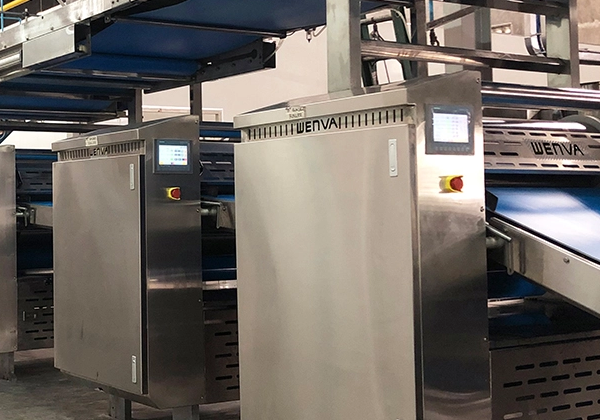
This is a more independent module that can be inserted or removed as needed, and may have its own dedicated control panel, pump, and conveyor section. It can be retrofitted into existing lines or shared across multiple lines with appropriate mechanical interfaces.
In real factories, the distinction is less about the physical box and more about how tightly the oil sprayer is integrated into the oven–cooling–packaging sequence and control system.
Modern biscuit oil sprayers—such as centrifugal disc oil sprayers—combine mechanical and control engineering to deliver consistent performance at industrial speeds.
Core components typically include:
- Oil supply system: Food-grade stainless steel oil tank or external pipeline with an oil pump to ensure stable, continuous oil feed.
- Atomization mechanism: Pressure atomization or air-assisted atomization, often with a centrifugal disc, producing fine, uniform oil mist.
- Nozzles and spray headers: Adjustable nozzles for spray angle and direction, allowing tuning to different biscuit shapes and sizes.
- Automation control: Integrated PLC control synchronizing spray start/stop and volume with belt speed and biscuit position.
- Oil mist collection system: A collection hood and filtration system that captures overspray and reduces workshop pollution.
A typical technical configuration might include:
| Feature | Typical Specification |
|---|---|
| Sprayer type | Centrifugal oil sprayer with dual-side spraying |
| Power | Approx. 3.5–5.5 kW depending on width and capacity |
| Voltage | 220V/380V 50 Hz (customizable per region) |
| Material | Food-grade stainless steel frame and contact parts |
For mid- to large-scale factories, a dual-side sprayer at the oven outlet is now standard, because it ensures stable coating even at high line speeds and reduces the risk of under-coated biscuit bottoms.
In fully automated lines, an integrated oil sprayer is often designed as part of the post-oven module with common control architecture. For hard biscuits and crackers, this integrated approach is particularly attractive when lines run long hours with limited changeovers.
Key advantages from a practitioner's standpoint:
- Perfect synchronization with tunnel oven and conveyor: The sprayer's PLC receives real-time feedback on oven discharge speed and conveyor status, preventing over-spray when the line stops or slows down.
- Better control of spray timing and volume: Fine-tuned recipes for different SKUs can be stored and recalled automatically from the line's main HMI.
- Simplified hygiene and maintenance routines: Integrated machine design often shares CIP-friendly features like stainless steel housings and easy access covers across the post-oven modules.
- Compact footprint: For new plants or redesigned layouts, integrated sprayers minimize additional conveyors and support frames.
From a UX and operator perspective, an integrated sprayer also means:
- Single user interface for oven, oil sprayer, and cooling conveyor.
- Shared alarms and event logs, reducing troubleshooting time.
This is particularly appealing to high-volume bakeries that want "set-and-forget" operation with minimal manual intervention.
Standalone oil sprayers are most valuable in brownfield plants where multiple legacy ovens and conveyors are in use. As a consultant, I've recommended standalone units in cases where factories needed fast upgrades without shutting down the entire line.
Typical strengths of standalone oil sprayers include:
- Retrofit-friendly: They can be inserted between existing oven outlet and cooling conveyor without major redesigns.
- Multi-line sharing: In some configurations, the same sprayer can be moved between lines or used as a trial unit for new products.
- Independent control: With a dedicated control panel, maintenance teams can isolate, test, or upgrade the sprayer without touching the main line PLC.
- Upgrade path: Plants can start with a standalone sprayer and later integrate communication signals with the main line as they modernize.
However, the downside is that operators must pay more attention to line synchronization and manual settings—for example, adjusting pump pressure and nozzle angle when switching from a cream cracker to a butter biscuit on the same oven.
From both engineering and production management perspectives, the choice is not just technical—it's about risk, flexibility, and lifecycle cost.
| Criteria | Integrated Oil Sprayer | Standalone Oil Sprayer |
|---|---|---|
| Line synchronization | Tight integration with oven and conveyor PLC; ideal for high-speed lines | Requires external signals or manual coordination; more operator-dependent |
| Installation scenario | Best for new lines or complete line upgrades | Best for retrofits on existing lines or multi-oven plants |
| Flexibility | Optimized for a specific line layout and capacity | Higher flexibility for repositioning and adjustments between lines |
| Control & UX | Single HMI, shared alarms, central recipe management | Separate control panel; may need duplicated recipes and settings |
| Footprint | Compact, minimal extra conveyors | May require additional frame or conveyor section |
| Investment profile | Higher upfront integration cost, lower long-term handling cost | Lower initial investment for retrofit; potential extra labor for adjustments |
For many mid-sized biscuit factories, a hybrid approach—standalone hardware with logical integration into the main PLC via simple I/O or fieldbus—can combine the best of both worlds.
Based on feedback from biscuit plants that upgraded to centrifugal dual-side oil sprayers, three patterns often emerge:
1. Quality complaints drop: Retail and QA teams report fewer issues related to dull surface, uneven color, or "dry mouthfeel" in hard biscuits.
2. Oil consumption becomes more predictable: Once pump pressure and nozzle parameters are locked in, daily oil usage stabilizes, making cost control easier.
3. Cleaning schedules matter: Plants that implement daily flushing and weekly deep cleaning of the oil circuit see fewer nozzle blockages and more consistent spray patterns.
From an operator's perspective, visual checks at start-up, such as placing a sheet of test paper or biscuit trays to observe spray coverage, remain an indispensable practice even on highly automated lines.
Whether you choose integrated or standalone, certain design and process factors determine the consistency of the finish more than the label on the equipment.
1. Atomization quality
Fine, uniform droplets are critical for avoiding spots and streaks. Centrifugal disc systems and air-assisted nozzles typically deliver superior coverage for high-speed lines compared to simple gravity-fed sprayers.
2. Dual-side spraying
Hard biscuits often benefit from simultaneous top and bottom spraying, especially when the underside tends to be drier or more porous. Dual-side designs also reduce the risk of under-coating when biscuits flip slightly or ride unevenly on the belt.
3. Dynamic control linked to line speed
When conveyor speed changes—during ramp-up, slowdowns, or stoppages—the sprayer should automatically adjust spray volume and timing to prevent over- or under-coating. This is where integrated PLC control provides a clear advantage.
4. Oil quality and temperature
Maintaining a stable oil temperature helps preserve viscosity and atomization performance. Some plants integrate simple heating or circulation loops to prevent thickening at low ambient temperatures.
5. Hygiene and cleaning design
Food-grade stainless steel, smooth surfaces, and easy-access parts reduce buildup and make routine cleaning realistic within tight production schedules. Well-designed oil mist collection systems also protect both operators and nearby equipment.
Consider a mid-sized bakery upgrading its hard biscuit production line to meet export standards. The plant installs a new automated biscuit production line with integrated powder feeding, intelligent dough mixing, continuous forming, tunnel baking, multi-layer cooling, and high-speed packaging.
In this configuration:
- Raw materials like flour and sugar are automatically metered and conveyed via a closed, dust-free system with batching error ≤0.5%.
- The dough mixer adjusts water temperature, rotation speed, and mixing time based on preset recipes, ensuring consistent dough quality.
- The calender forms uniform dough sheets, and molds stamp various shapes before the products enter the tunnel oven.
- Oven temperature, humidity, and belt speed are managed through a central PLC, ensuring stable color and bake level across batches.
- Immediately after the oven, an integrated dual-side oil sprayer applies a controlled oil film, followed by a multi-layer cooling tunnel that brings biscuits to packaging-friendly temperature.
In this scenario, the integrated oil sprayer's biggest value is process stability: operators select a product recipe and the line automatically synchronizes baking and oiling parameters, minimizing changeover time and human error.
From a practical standpoint, here is a step-by-step framework I often use with clients commissioning or optimizing oil sprayers on hard biscuit lines:
1. Define target finish and coverage
- Align QA, marketing, and engineering on the desired gloss level and sensory attributes.
- Prepare reference samples that operators can visually compare during production.
2. Calibrate spray pattern at nominal line speed
- Set line speed to standard production rate.
- Adjust nozzle angle, height, and pressure until coverage is uniform across the width of the belt.
3. Link spray volume to line speed and product type
- Use the PLC to build recipes that tie pump frequency or valve duty cycle to belt speed.
- Create separate profiles for high-fat biscuits vs. low-fat crackers.
4. Validate dual-side balance
- Check the top and bottom of biscuits for consistent appearance, especially after extended runs.
- Adjust bottom spray parameters if underside appears dull or dry compared to the top.
5. Implement routine cleaning and maintenance checks
- Schedule daily flushing with approved cleaning fluids and weekly nozzle inspections.
- Inspect the oil mist collection system and replace filters as needed to maintain airflow and hygiene.
6. Train operators with visual and numeric cues
- Provide simple checklists and HMI guidance, so operators know what spray pressure, temperature, and coverage to expect.
- Encourage logging any deviations in finish to correlate with parameter changes.
These steps apply equally to integrated and standalone systems; the difference is how much of the coordination is automated vs. operator-driven.
As a manufacturer specializing in automated biscuit production lines and auxiliary equipment, Wenva Machine offers oil sprayers designed to integrate seamlessly with full lines or to retrofit into existing setups.
Key capabilities include:
- Centrifugal disc oil sprayers capable of dual-side spraying for biscuits, cookies, and crackers.
- Food-grade stainless steel construction aligned with international hygiene standards.
- PLC-based control systems that can synchronize with tunnel ovens, cooling conveyors, and packaging lines.
- Oil mist collection systems to maintain clean, low-pollution production environments.
Beyond individual machines, Wenva Machine provides full-process automation solutions: automatic powder feeding and weighing, intelligent dough mixing, forming and baking with PLC-controlled tunnel ovens, multi-layer cooling, and integrated packaging systems. This holistic view allows engineers to design oil spraying systems that are matched to the entire line's capacity and layout, whether integrated from day one or added later as a standalone module.
For biscuit producers evaluating options, the decision often comes down to three practical questions:
1. Are you building or fully upgrading a line?
- If yes, an integrated oil sprayer tied into the main PLC and layout is usually the best long-term choice.
2. Are you retrofitting an existing plant with diverse equipment?
- In that case, a standalone unit with retrofit-friendly interfaces offers quicker deployment and lower disruption.
3. How frequently do you change products and line configurations?
- High-mix environments may benefit from standalone flexibility plus partial integration signals (e.g., start/stop, speed reference) to balance agility and control.
For many customers, the most effective strategy is to involve the equipment supplier early, share factory layout, product mix, and growth plans, and co-develop an oil spraying solution that can evolve with the business.
If your hard biscuit products suffer from inconsistent gloss, variable texture, or unstable oil consumption, it may be time to reassess your oil spraying approach. Whether you're planning a new automated production line or upgrading an existing oven, Wenva Machine can help you evaluate integrated vs. standalone oil sprayer options, simulate different layouts, and implement a solution that matches your capacity, product mix, and budget.
Reach out with your current line drawings, capacity targets, and product specifications, and our engineering team can propose a tailored spraying system—including oil sprayer selection, control logic, and mechanical integration—to help you achieve a consistently premium finish on every batch of hard biscuits.
Q1: Do I always need dual-side oil spraying for hard biscuits?
In most high-volume hard biscuit lines, dual-side spraying is recommended because the underside often dries more and contributes significantly to overall mouthfeel. However, for certain products with specific recipes or coatings, a top-only spray may be sufficient if validated through sensory and shelf-life tests.
Q2: How do I control oil consumption with an integrated sprayer?
By linking pump output and spray duration to line speed through the PLC, you can set target oil dosage per kilogram of biscuits and monitor it over time. Regularly comparing line data with actual oil usage helps detect drifts in nozzles or pump performance before they affect product quality.
Q3: Can a standalone oil sprayer be upgraded later to integrate with the line control system?
Yes, many standalone sprayers are designed with spare I/O and communication ports so they can later receive start/stop commands, speed references, or recipe signals from the main line PLC. This allows plants to start with a simple retrofit and gradually move toward higher automation without replacing the hardware.
Q4: What maintenance practices are critical for oil sprayers in biscuit lines?
Key practices include daily flushing of oil circuits, regular inspection and cleaning of nozzles and centrifugal discs, and periodic checks of filters and oil mist collection systems. Proper preventive maintenance reduces unplanned downtime, prevents nozzle clogging, and keeps spray patterns consistent across shifts.
Q5: How do I select the right oil sprayer model for my line?
You should consider line width, capacity, product range, oil type, available power and voltage, and whether the sprayer will be integrated or standalone. Working with an experienced supplier allows you to match these parameters with the appropriate sprayer configuration, from compact units for small lines to high-capacity centrifugal systems for large-scale production.
1. Wenva Machine – Oil Sprayer Machine product page. https://www.wenvamachine.com/oil-sprayer-machine.html
2. Wenva Machine – Automated Biscuit Production Lines overview. https://www.wenvamachine.com/automated-biscuit-production-lines-how-wenva-machine-helps-bakeries-scale-with-confidence.html
3. Wenva Machine – Company and biscuit production line information (Made-in-China listing). https://wenva668.en.made-in-china.com/product/xKRmWeEYvHVb/China-Wenva-Multi-Purpose-Full-Automatic-Biscuit-Production-Line.html
4. Wenva Machine – Main site and product categories (biscuit production line, auxiliary equipment). https://www.wenvamachine.com
5. Wenva Machine – Official website (additional product and process information). https://www.wenva.net


