
Views: 345 Author: WENVA machine Publish Time: 2025-11-25 Origin: Site
Content Menu
● Consumer Upgrading Drives the Rapid Expansion of the Biscuit Industry
>> 1. Young population structure expands long-term snack demand
>> 2. Retail and e-commerce growth accelerates biscuit sales
>> 3. Growing middle class fuels product upgrading
● Market Trends and Opportunities in Indonesia, Vietnam, the Philippines, and Thailand
>> Indonesia: The largest biscuit consumer market in Southeast Asia
>> Vietnam: Rapidly rising middle class with strong interest in healthier bakery products
>> Philippines: Brand renewal and capacity expansion
>> Thailand: A sophisticated food-processing hub
● Rising Local Biscuit Brands Push Equipment Upgrading to a New Stage
● Automation and Healthy Product Transformation in Medium-Sized Factories
>> 1. Medium-sized factories entering a capacity expansion cycle
>> 2. Healthy product categories are surging
>> 3. Automation solves labor challenges
● Key Opportunities for Equipment Manufacturers — Wenva's Strategic Advantages in Southeast Asia
>> 1. Transition from semi-automatic to fully automatic lines
>> 2. Product diversification requires flexible, modular equipment
>> 3. Rapid growth in old-factory renovation
● FAQ
>> 1. Which biscuit production lines are most in demand in Southeast Asia?
>> 2. At what stage do factories usually start upgrading?
>> 3. What advantages does Wenva offer in Southeast Asia?
>> 4. Do customers expect onsite installation and training?
Over the past decade, the snack industry in Southeast Asia has grown at an impressive pace, with biscuits and baked snacks being among the fastest-expanding categories. In Indonesia, Vietnam, the Philippines, and Thailand, consumer demand for biscuits is rising sharply, local brands are growing stronger, and manufacturing facilities are accelerating equipment upgrades.
For manufacturers of automated biscuit production lines, Southeast Asia is shifting from a “potential region” to a “strategic opportunity market.”
This article provides an industry-focused analysis of why this region is poised to become the most attractive investment market for biscuit manufacturers over the next five years, and explains how equipment suppliers—especially Wenva—can play a key role in this wave of industrial upgrading.

The four major countries—Indonesia, Vietnam, the Philippines, and Thailand—have a combined population of over 500 million, with a relatively young demographic. Young consumers show high acceptance of biscuits, crackers, cookies, wafers, and thin-baked snacks, and are more open to trying new flavors and packaging formats.
In Indonesia and the Philippines, biscuits are essential daily snacks for families.
In Vietnam and Thailand, biscuits are evolving from “cheap snacks” toward “light meal substitutes,” especially with the rise of healthy, low-sugar, and grain-based categories.
The rapid expansion of distribution channels such as:
Convenience stores (Indomaret, 7-Eleven, Circle K)
E-commerce platforms (Shopee, Lazada)
Organized wholesale networks
is enabling local biscuit brands to reach consumers more efficiently. This pushes manufacturers to invest in higher-capacity, more stable production lines.
As the middle-income population grows across the region, demand for:
Premium cookies
Soda crackers
Healthy grain biscuits
Filled biscuits
surges quickly.
Product sophistication naturally leads to higher requirements for dough handling, forming precision, baking consistency, and energy-efficient ovens.
With more than 270 million people, Indonesia represents the biggest and most dynamic biscuit market.
Key characteristics:
Numerous local medium-sized biscuit factories
Strong and stable demand for low-priced crackers and cookies
Increasing automation needs to offset labor costs
High seasonal consumption during religious and festive periods
Upgrade needs: automated forming lines, mid-to-wide-width production lines, energy-saving gas tunnel ovens.
Vietnamese consumers show growing preference for healthy, natural, and functional snacks.
Market characteristics:
Imported biscuit brands set high product-quality benchmarks
Local factories seek to improve texture, appearance, and baking stability
Many upgrading from semi-automatic to fully automated lines
Upgrade needs: laminating systems, stable thin-sheet forming, fully automated cookie lines.
The Philippines' snack market is growing quickly, with many factories upgrading their equipment.
Key trends:
High demand for sweet, filled, and long-shelf-life products
Small-to-medium factories with strong investment willingness
E-commerce drives demand for small-pack products
Upgrade needs: multi-functional biscuit lines, fast changeover forming systems, energy-efficient tunnel ovens.
Thailand's food manufacturing industry is advanced and export-oriented.
Market characteristics:
Emphasis on food safety compliance
Strong need for high-quality production lines for export markets
Clear trend toward automation and digitalized production
Upgrade needs: premium cookie lines, wafer and sandwich systems, digitally controlled gas ovens.
As local biscuit brands grow rapidly, they encounter several challenges:
Semi-automatic lines cannot meet increasing order volume
Limited product variety restricts competitiveness
Old ovens consume excessive energy and bake inconsistently
Labor costs are rising, while skilled operators are scarce
This creates structural demand for systematic equipment upgrading.
Key upgrade directions include:
1. Transition from single-function to modular production lines
2. Switching from electric ovens to natural-gas tunnel ovens (30–40% energy savings)
3. Moving from manual processes to continuous automated forming systems
4. Expanding from traditional biscuits to layered, filled, and healthy product lines
5. Implementing digital control and traceability in production
These transitions align well with the capability strengths of Chinese equipment manufacturers, especially Wenva.
Many factories in the region are facing:
Increasing orders
Insufficient capacity
Unstable baking quality
As a result, they are actively expanding from single lines to multi-line setups, and from traditional biscuit categories to innovative products.
Especially in Vietnam and Thailand, rapid growth is seen in:
Low-sugar biscuits
High-fiber grain biscuits
Whole-grain thin crackers
Plant-butter cookies
Multi-layer sandwich biscuits
These products require highly consistent dough processing, precise forming pressure, and stable baking control.
Southeast Asia is increasingly facing labor shortages and rising wages.
Automation has thus shifted from an “optional upgrade” to a necessary investment.
For biscuit production line suppliers, Southeast Asia presents three outstanding opportunities:
Wenva has served many customers in Southeast Asia who upgraded from small-scale workshops to medium-sized automated factories. Common upgrade needs include:
Automatic dough feeding systems
Fully automatic rotary moulder and rotary cutter forming lines
Automatic sugar/salt sprinkling systems
Precision temperature-controlled tunnel ovens
Integrated cooling and packaging connection
These upgrades typically increase capacity from 300–500 kg/h to 1,000–2,000 kg/h.
Local brands across the region are working toward one goal:
expanding their product portfolio.
For example:
Suji biscuits
Butter cookies
Soda crackers
Grain-based thin biscuits
Double-layer sandwich biscuits
Wenva's modular production line design allows factories to expand product types efficiently without repeating major investments.
A large number of factories with 10–20 years of equipment face challenges such as:
Excessive energy consumption
Unstable dough consistency
Uneven baking zones
Forming precision issues
Outdated hygiene and safety compliance
Wenva provides:
Capacity evaluation
Equipment upgrade proposals
Production process optimization
Factory layout design
Local installation, commissioning, and training
These enable factories to upgrade without long production interruptions.
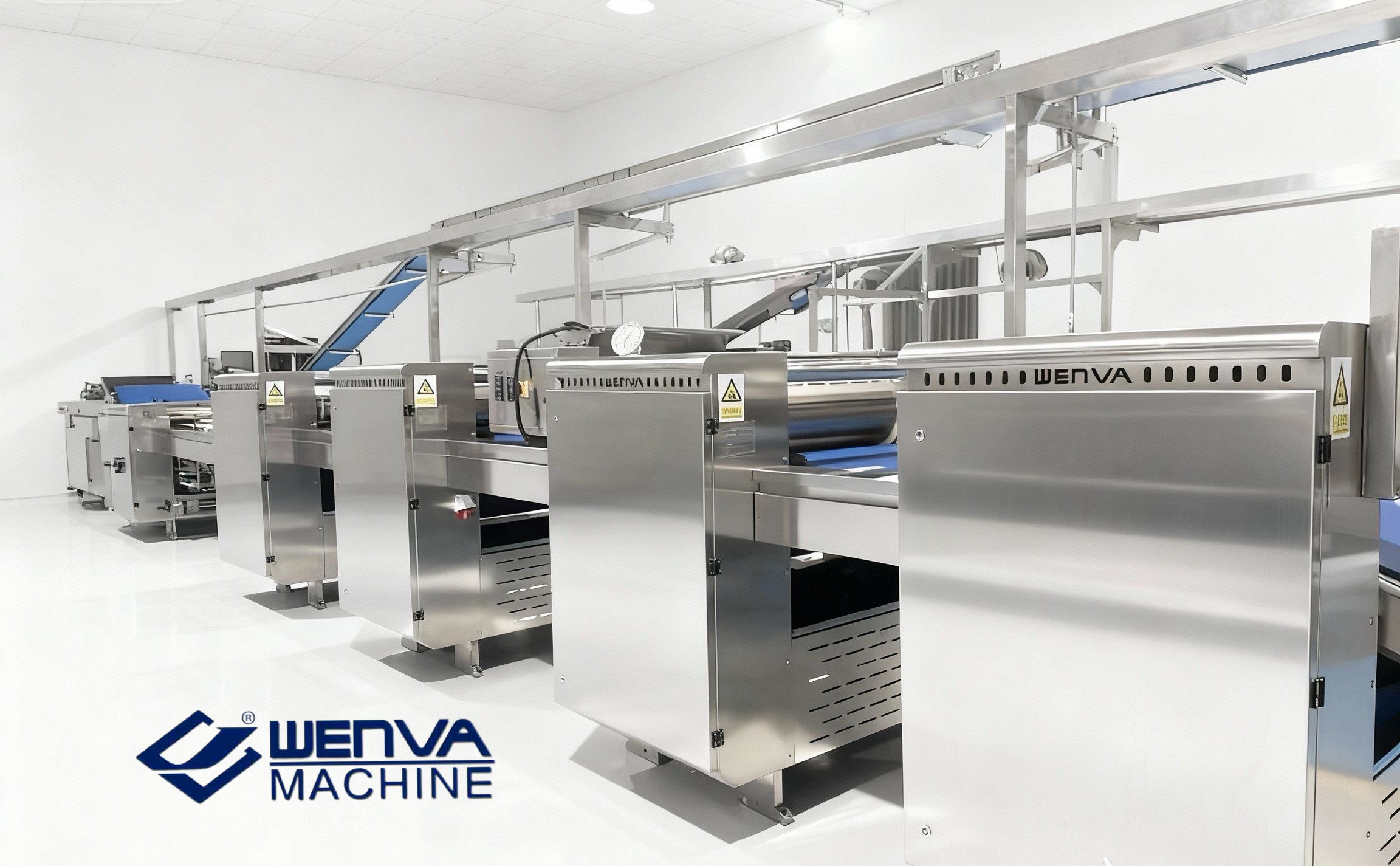
Driven by population growth, consumer upgrading, brand expansion, and accelerating automation needs, Southeast Asia is entering a critical phase of biscuit manufacturing modernization.
For equipment suppliers, this region is no longer a “future opportunity”
it is the opportunity happening right now.
With professional engineering capability, automation expertise, and experience in factory upgrading, Wenva will continue to support biscuit manufacturers in Indonesia, Vietnam, the Philippines, and Thailand in enhancing product quality, increasing output, reducing energy consumption, and achieving greater competitiveness in domestic and export markets.
Soda crackers, cookies, thin baked crackers, double-layer sandwich lines, and healthy grain-based biscuit lines.
Most upgrade from 300–500 kg/h semi-automatic lines to 1,000–1,500 kg/h fully automated lines.
Modular equipment design, energy-efficient tunnel ovens, stable forming/baking technology, factory layout solutions, and long-term service support.
Yes, most factories require onsite installation, commissioning, recipe calibration, and operator training.


