
Views: 268 Author: Wenva Machine Publish Time: 2026-06-29 Origin: Site
Content Menu
● Understanding Modern Industrial Pretzel Production
● What Is an Extruded Pretzel Machine?
>> Strengths of Extruded Pretzel Machines
● What Is a Twisted Pretzel Machine?
>> How Twisted Pretzel Lines Work
>> Strengths of Twisted Pretzel Machines
● Extruded vs. Twisted Pretzel Machines – Key Technical Differences
>> Performance and Product Characteristics Table
● Integrating Pretzel Machines into a Fully Automated Alkaline Biscuit Production Line
>> How Pretzel Equipment Fits into the Biscuit Line
>> Intelligent Control and Remote Monitoring
● Choosing Between Extruded and Twisted Pretzel Technology – A Practical Framework
>> Strategic Questions for Plant Managers and Project Teams
● Latest Trends and Expert Insights in Pretzel Biscuit Production
>> Automation, Data, and Energy Optimization
>> Practical Implementation Steps for New Lines
● Enhancing User Experience and Operator Workflow on Pretzel Lines
>> Operator‑Friendly Design and Safety
>> Designing for Product Development Teams
● Why Work with a Specialist in Automated Pretzel Biscuit Lines
>> Experience, Customization, and Global Support
● Call to Action – Plan Your Next Pretzel Biscuit Line
● FAQ – Extruded vs. Twisted Pretzel Machines
Extruded and twisted pretzel machines each offer clear advantages: extruded pretzel lines deliver higher throughput and lower unit cost, while twisted pretzel machines preserve the traditional artisan look that many brands rely on for premium positioning. For snack manufacturers, the real competitive edge comes from choosing the right technology for your product mix, then integrating it into a fully automated, intelligently controlled biscuit and pretzel production line. [bakersmachinery]
In this guide, I'll draw on more than 40 years of biscuit and pretzel equipment experience and hands‑on project work with fully automated alkaline pretzel biscuit production lines to help you choose between extruded and twisted technologies. The focus is not only on machine selection, but on how each option fits into a complete automated pretzel biscuit line—from dough mixing and alkali dipping to baking, cooling, stacking, and packaging. [readingbakery]

Industrial pretzel production has shifted from semi‑manual operations to fully automated lines that integrate dough preparation, shaping, alkaline dipping, baking, cooling, and packaging under one PLC‑controlled system. Leading manufacturers now design systems that can run 24/7, with remote monitoring and IoT‑enabled analytics to stabilize output and reduce downtime. [directindustry]
A typical alkaline pretzel biscuit line includes:
- Automatic flour feeding and weighing system for dust‑free, closed batching.
- Horizontal and vertical dough mixers for different dough hydration levels. [bakersmachinery]
- Three‑roll sheeter and laminator for controlled sheet thickness and layered texture. [bakersmachinery]
- Gauge rolls and rotary cutting or molding units for consistent product dimensions. [bakersmachinery]
- Dedicated alkaline solution dipping pool and roller system for uniform coating. [bakersmachinery]
- Gas, electric, or diesel tunnel oven with precise temperature and conveyor speed control. [bakersmachinery]
- Cooling conveyors, stacking machines, and integrated packaging equipment. [directindustry]
This context matters because extruded and twisted pretzel machines do not operate in isolation: they sit inside this larger ecosystem and affect line layout, throughput, staffing, and overall ROI. [readingbakery]
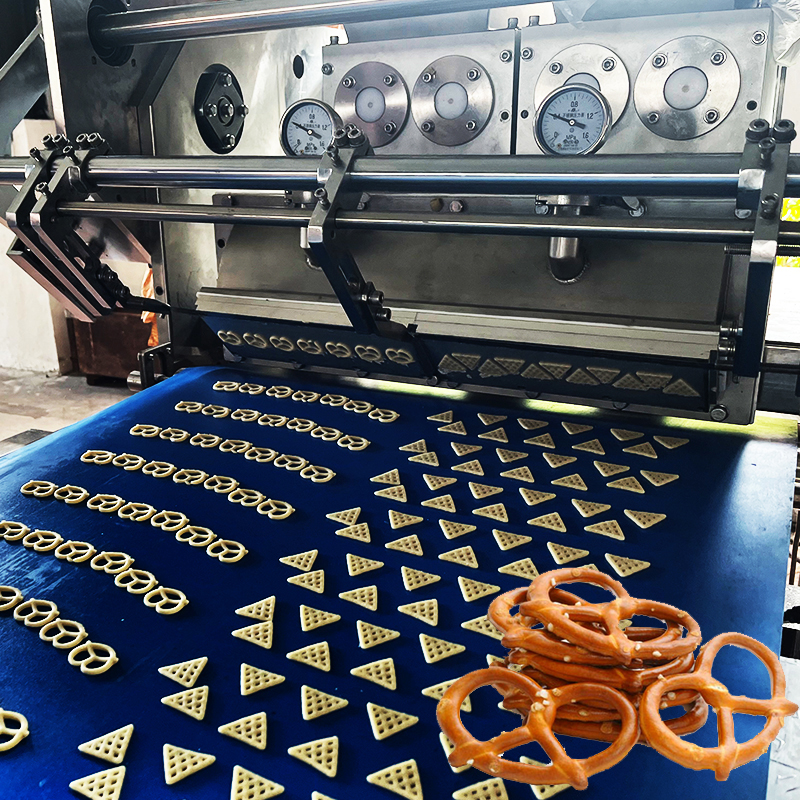
An extruded pretzel machine shapes dough by forcing it through dies or nozzles to produce uniform ropes that are cut, bent, or formed into shapes before alkali dipping and baking. The emphasis is on controlled diameter, repeatable geometry, and continuous product flow, which together support higher output per hour than most twisted systems. [directindustry]
Key characteristics of extruded pretzel technology:
- Continuous dough flow with synchronized cutting and shaping.
- High consistency in weight, length, and cross‑section. [directindustry]
- Easy recipe scaling once process parameters are locked.
- Better integration with high‑speed tunnel ovens and automated cooling/stacking. [readingbakery]
In a fully automatic alkaline biscuit line, the extruder typically receives dough from a calibrated sheeter and gauge roll section, then passes formed pieces directly into the alkaline water treatment zone. [bakersmachinery]
For manufacturers focused on high‑volume output and efficiency, extruded machines offer several practical advantages:
- Higher capacity per meter of line length, ideal for large factories and contract manufacturers. [directindustry]
- Lower labor dependence, as the process is designed for minimal manual intervention. [bakersmachinery]
- Easier maintenance of target weights and dimensions for cost control and packaging efficiency. [directindustry]
- Faster changeover between product shapes using interchangeable dies and adjustable cutting parameters. [directindustry]
From an engineering perspective, extruded systems are easier to model and stabilize because dough rheology and extrusion pressure can be quantified and monitored via sensors and PLC feedback loops. This translates into fewer off‑spec batches and more predictable planning for upstream mixing and downstream packaging. [bakersmachinery]
A twisted pretzel machine forms pretzels by mechanically replicating the classic hand‑twisted motion, often using long moulder units, looping conveyors, and forming tools that create the iconic three‑loop shape. Dough pieces are divided, pre‑proofed, elongated, twisted, and then transferred to the alkali bath before baking. [mopos]
Core elements of twisted pretzel lines:
- Dough dividers tuned for pretzel weight ranges and hydration. [bakersmachinery]
- Long moulders or twisting stations that shape each piece individually.
- Controlled resting or proofing stages to manage dough relaxation and gas development. [bakersmachinery]
- Traditional soda bath or modern alkaline dipping units, followed by tunnel ovens. [readingbakery]
Unlike simple extruded sticks, twisted pretzels must retain visual integrity after proofing, dipping, and baking, so mechanical design focuses on gentle handling and precise timing—not just speed. [bakersmachinery]
Twisted systems are preferred when traditional aesthetics and brand storytelling matter more than absolute maximum capacity. [readingbakery]
Their main strengths include:
- Authentic appearance that closely resembles hand‑twisted artisan pretzels. [bakersmachinery]
- Greater differentiation on shelf for premium, craft‑positioned products.
- Flexibility for regional or specialty shapes that carry local heritage value. [mopos]
- Strong alignment with marketing messages around tradition and craftsmanship. [readingbakery]
For many mid‑size bakeries, twisted machines strike a balance between automation and tradition: they offer repeatable output and integration with modern ovens, but retain enough individuality in each piece to support premium pricing. [readingbakery]
The table below summarizes the most important differences between extruded and twisted pretzel machines from a production and product standpoint. [directindustry]
| Aspect | Extruded Pretzel Machines | Twisted Pretzel Machines |
|---|---|---|
| Core shaping method | Dough extruded through dies, cut and formed in continuous flow. (directindustry) | Dough pieces elongated and mechanically twisted, replicating hand‑made shapes. (bakersmachinery) |
| Typical capacity | Higher throughput per hour on compact footprints, optimized for volume. (directindustry) | Moderate to high capacity, but usually below extrusion at equivalent scale. (bakersmachinery) |
| Product appearance | Very uniform sticks, rods, rings, and simple shapes; clean lines. (directindustry) | Classic pretzel loops with more artisanal look and surface variation. (bakersmachinery) |
| Texture control | Strong control via die geometry and baking profiles; ideal for crisp snacks. (directindustry) | More nuanced texture from proofing and twisting; suited to traditional soft or crunchy pretzels. (bakersmachinery) |
| Recipe flexibility | Excellent for standardized recipes and multi‑SKU dry snacks. (directindustry) | Better for heritage recipes, higher hydration, and regional specialty products. (bakersmachinery) |
| Changeover time | Faster when using modular dies and preset PLC recipes. (directindustry) | Requires mechanical adjustments to twisting units and proofing parameters. (bakersmachinery) |
| Labor requirements | Lower manual handling; lines designed for minimal operator intervention. (bakersmachinery) | Slightly higher monitoring for dough behavior and shape integrity. (bakersmachinery) |
| Brand positioning | High‑volume mainstream snacks and private‑label lines. (directindustry) | Premium, craft, and tradition‑focused brands needing visual storytelling. (readingbakery) |
From a systems engineering view, extruded lines favor volume optimization and cost per kilogram, whereas twisted lines optimize visual identity and perceived value. The right choice depends on whether your business model prioritizes throughput or brand differentiation. [directindustry]
Modern pretzel biscuit production does not rely on standalone machines; instead, extruded and twisted modules sit inside an end‑to‑end automated line. A typical layout for alkaline pretzel biscuits includes: [directindustry]
1. Automatic flour feeding and weighing to achieve batching error ≤0.5% and maintain formula consistency. [bakersmachinery]
2. Horizontal and vertical dough mixers that automatically adjust water temperature, speed, and mixing time. [bakersmachinery]
3. Dough tipping and feeding systems that transfer dough to the sheeting section with minimal manual contact. [bakersmachinery]
4. Three‑roll sheeter, laminator, and gauge rolls to build the required structure and thickness. [bakersmachinery]
5. Extrusion or twisting units to form pretzel biscuit shapes. [directindustry]
6. Alkaline solution dipping pool with rollers and conveyors for uniform coating and color. [bakersmachinery]
7. Gas, electric, or diesel tunnel ovens with PLC‑controlled temperature, humidity, and belt speed. [readingbakery]
8. Multi‑layer cooling conveyors that bring products to packaging temperature in a controlled environment. [bakersmachinery]
9. Stacking and packaging machines (flow wrappers, vertical packers, and optional boxing systems). [bakersmachinery]
In this configuration, both extruded and twisted pretzel machines can be configured to match factory layout and desired capacity using 90° or 180° turning units, modular conveyors, and customizable oven lengths. [directindustry]
Another differentiator in modern lines is intelligent control:
- PLC and touch‑screen interfaces centralize control of mixers, sheeters, forming units, ovens, and coolers. [bakersmachinery]
- IoT‑ready controllers provide remote access via mobile apps or computer terminals. [bakersmachinery]
- Sensors monitor temperature, humidity, pressure, and conveyor speed in real time. [bakersmachinery]
- Automatic adjustments reduce defect rates and stabilize color, texture, and moisture content. [readingbakery]
This level of automation is crucial when running high‑volume extruded lines, but it also protects brand integrity on twisted lines where small variations can affect appearance and mouthfeel. [bakersmachinery]

Based on long‑term experience implementing pretzel biscuit lines for different markets, I recommend starting with a structured decision framework rather than looking only at machine specs. [exactmixing]
Ask yourself:
- What is our primary value driver: cost per kilogram or brand differentiation?
- Are we targeting mainstream snack channels or premium/heritage segments?
- How important is the classic looped pretzel appearance to our customers?
- What capacity do we need per hour, and how do we expect it to grow?
- How flexible must our line be for shape and recipe changes over the next 5–10 years?
As a practical rule:
- If you aim for high‑volume private label or multi‑regional snack distribution, an extruded system integrated into a fully automatic alkaline biscuit line will usually deliver better ROI. [exactmixing]
- If your brand story leans on tradition, region, or craftsmanship, a twisted pretzel machine may be the better choice, even if capacity per hour is lower. [readingbakery]
Consider a manufacturer launching both:
- A mass‑market salted pretzel stick line for supermarket channels, and
- A branded, premium twisted pretzel biscuit for specialty stores.
A common expert recommendation is:
- Implement an extruded pretzel line for the stick products, using modular dies and high‑speed tunnel ovens to hit target volumes and minimize unit cost. [exactmixing]
- Add a twisted pretzel module—either as a separate line or as a parallel forming section—to create the visual identity required for the premium product. [readingbakery]
Both lines can share upstream flour feeding, mixing, and sheeting systems, as well as downstream cooling, stacking, and packaging, maximizing asset utilization. [directindustry]
Current projects in pretzel and alkaline biscuit production increasingly focus on data‑driven optimization and energy flexibility. [utf-group]
Key trends include:
- Wider adoption of multi‑fuel tunnel ovens (gas, electric, hybrid) to match local energy prices. [readingbakery]
- Integration of line‑level data with MES or ERP systems for real‑time OEE tracking and predictive maintenance. [exactmixing]
- Upgraded alkaline dipping designs that improve coating uniformity while reducing solution waste. [bakersmachinery]
- Intelligent scrap collection and return systems that protect margins by minimizing raw material loss. [bakersmachinery]
From an expert standpoint, the deciding factor is no longer just "extruded vs twisted"—it is how well your chosen machine type fits into a smart, integrated line that can adapt to market demands over time. [exactmixing]
For manufacturers planning a new pretzel biscuit line, a phased approach usually delivers better outcomes:
1. Define product portfolio – Clarify which SKUs require extruded shapes and which rely on twisted aesthetics.
2. Map capacity needs – Determine hourly throughput and seasonal peaks.
3. Design layout – Use turning machines, modular conveyors, and customizable oven lengths to fit your plant space. [directindustry]
4. Select control architecture – Choose PLC, HMI, and IoT options that support remote monitoring and future upgrades. [bakersmachinery]
5. Plan training and after‑sales support – Ensure access to installation engineers, spare parts, and recipe fine‑tuning. [readingbakery]
Experienced equipment partners with strong OEM/ODM capabilities can help tailor extruded and twisted modules to your factory layout and product roadmap, reducing commissioning time and ramp‑up risk. [exactmixing]
In high‑volume biscuit and pretzel production, user experience is just as important for operators and maintenance teams as it is for end consumers. The best lines incorporate: [utf-group]
- Clear, multi‑language touch‑screen interfaces with recipe libraries and guided workflows. [bakersmachinery]
- Accessible components for cleaning and maintenance, especially in alkaline dipping and baking zones. [utf-group]
- Hygienic, food‑grade stainless‑steel construction that meets CE and ISO requirements. [bakersmachinery]
- Intuitive alarms and maintenance prompts to minimize unplanned stoppages. [bakersmachinery]
Pretzel machines that are easy to operate and clean reduce training time and improve safety, which is critical in plants running 24/7 schedules with rotating crews. [utf-group]
R&D and product managers also benefit from lines designed with customization and prototyping in mind:
- Modular forming sections allow quick trials of new shapes or sizes. [directindustry]
- Adjustable dipping times and oven profiles help fine‑tune color, surface shine, and crunch. [readingbakery]
- Optional sandwiching machines, cream mixers, and sprinklers support value‑added pretzel biscuits. [bakersmachinery]
This flexibility lets you test new extruded snack concepts and twisted heritage shapes on the same base infrastructure, shortening time‑to‑market for new products. [exactmixing]
Manufacturers with decades of specialization in biscuit and pretzel lines bring more than hardware—they bring proven line concepts, optimized layouts, and project know‑how. Typical benefits include: [readingbakery]
- End‑to‑end project support from design and factory layout to installation and commissioning. [bakersmachinery]
- Custom line widths and capacities that align with your plant constraints and growth plans. [directindustry]
- Global after‑sales service for training, spare parts, and long‑term technical support. [readingbakery]
- OEM and ODM services for private‑label pretzel biscuits and alkaline cookies. [bakersmachinery]
When evaluating suppliers, look for documented quality systems, international‑grade components, and a track record in both extruded and twisted pretzel technologies.
If you are planning to upgrade from semi‑manual operations or launch new pretzel biscuit products, now is the time to evaluate which pretzel machine type—extruded or twisted—best fits your strategy, and how it will integrate into a fully automatic alkaline biscuit line. Define your product portfolio, capacity targets, and brand positioning, then engage a specialist equipment partner to translate these requirements into a concrete line design with the right pretzel forming technology, oven configuration, and automation level. [exactmixing]
Q1: Which is better for high‑volume industrial production, extruded or twisted pretzel machines?
A1: For pure throughput and cost efficiency, extruded pretzel machines generally outperform twisted systems, especially when integrated into fully automatic lines with high‑speed tunnel ovens. [directindustry]
Q2: Do twisted pretzel machines still make sense in modern automated plants?
A2: Yes. Twisted machines are valuable for brands that rely on traditional aesthetics and regional heritage, and they can still be fully integrated with automated proofing, dipping, baking, and packaging equipment. [mopos]
Q3: Can one production line handle both extruded and twisted pretzel biscuits?
A3: In many projects, manufacturers share upstream mixing and sheeting, then route dough to separate extruded and twisted forming sections, while using common ovens, cooling, and packaging where process parameters allow. [directindustry]
Q4: How does the alkaline dipping process affect pretzel quality?
A4: A well‑designed alkali dipping pool with controlled dwell time and solution recycling gives pretzels their characteristic golden color, shiny surface, and signature taste, while minimizing chemical waste and cost. [readingbakery]
Q5: What certifications and materials should I look for in pretzel biscuit equipment?
A5: Look for food‑grade stainless‑steel construction, CE and ISO compliance, and international‑grade components in mixers, forming units, ovens, and control systems to ensure safety, durability, and regulatory acceptance. [utf-group]
1. Reading Bakery Systems – Industrial Pretzel Production Line Equipment. Available at: [https://www.readingbakery.com/resources/industrial-pretzel-production-line-equipment.html] [readingbakery]
2. Bakers Machinery – Pretzel Production Line (WP/Fritsch/Koma). Available at: [https://bakersmachinery.com/pretzel-line-wp-fritsch-koma/] [bakersmachinery]
3. J4 – Pretzel Bread Production Line. Available at: [https://www.directindustry.com/prod/j4/product-222288-2265395.html] [directindustry]
4. Iteca Automatic Lines S.p.A – Pretzel Bread Production Line. Available at: [https://www.directindustry.com/prod/iteca-automatic-lines-spa/product-4567818-2650151.html] [directindustry]
5. UTF GROUP – Equipment for the Production of Pretzels and Other Snacks. Available at: [https://utf-group.com/en/pretzel-mashines/] [utf-group]
6. Exact Mixing – Suppliers of Pretzel Production Line Mixing Equipment. Available at: [https://www.exactmixing.com/resources/suppliers-of-pretzel-production-line-mixing-equipment.html] [exactmixing]
7. Wenva Machine – Pretzel Biscuit Production Line Equipment and Alkaline Pretzel Biscuit Machine. Available at: [https://www.wenvamachine.com/pretzel.html] [bakersmachinery]
8. Mopos – Pretzel Make‑Up Line. Available at: [https://www.mopos.com/pretzels_line] [mopos]


