Views: 222 Author: Sara Publish Time: 2025-03-10 Origin: Site
Content Menu
● Understanding Commercial Cookie Machine Fundamentals
● Step 1: Assessing Production Requirements
>> 1.1 Volume and Output Capacity
>> 1.2 Dough Compatibility Analysis
>> 1.3 Facility Space Planning
● Step 2: Comparing Machine Types and Technologies
>> 2.1 Wire-Cut Cookie Machines
● Step 3: Evaluating Critical Features
>> 3.1 Automation and Smart Controls
>> 3.2 Energy Efficiency Metrics
● Step 4: Production Line Integration
>> 4.1 Dough Preparation Stage
● Future-Proofing Your Investment
● FAQ
>> 1. What's the lifespan of a commercial cookie machine?
>> 2. Can I retrofit older machines with smart features?
>> 3. How much staffing is required?
>> 4. What's the lead time for custom-configured systems?
>> 5. Are financing options available?
Selecting the ideal commercial cookie machine requires balancing production needs, dough characteristics, and operational efficiency. As a manufacturer of cookie production line machinery, we've crafted this guide to help bakeries navigate critical considerations while highlighting advanced solutions that align with global industry standards.
Commercial cookie machines automate dough forming, shaping, and deposition, reducing labor costs by up to 60% compared to manual methods. Modern systems integrate IoT sensors for real-time monitoring and achieve precision tolerances of ±0.5mm in cookie weights.

- Small bakeries (500–1,500 cookies/hour): Opt for semi-automatic machines like the POLIN Multidrop Compact ($18,000–$25,000).
- Mid-sized facilities (1,500–4,000 cookies/hour): The Third Rotary Cookie Depositor ($45,000–$65,000) handles up to 250 cookies/minute.
- Industrial plants (6,000+ cookies/hour): High-speed rotary systems like the Deighton Traymatic ($120,000+) with dual-lane output.
| Dough Type | Ideal Machine | Example Models |
|---|---|---|
| High-fat, dense doughs (shortbread) | Wire-cut machines | Thomas L. Green Wirecut Machine |
| Soft, sticky batters (chocolate chip) | Depositors | POLIN Multidrop Classic |
| Embossed/3D designs | Rotary molders | Janssen F-Series |
| Multi-textured doughs | Hybrid systems | Deighton Formatic |
Machines like the Suprema MAXX feature adjustable extrusion pressures (5–25 bar) to handle doughs with 15–35% moisture content.
- Compact layouts: The Multidrop Twiny (2.5m x 1.2m) fits into 30m² areas.
- Vertical integration: Stackable cooling towers save 40% floor space.
- Modular designs: SK Machinery's cookie production line allows phased expansion.
Wire-cut machine diagram
- How it works: Dough is extruded through nozzles and sliced by reciprocating wires.
- Best for: Crumbly doughs requiring clean edges.
- Top model: Suprema MAXX achieves 40 cycles/minute with bidirectional tray loading.
- Key feature: Engraved rollers imprint designs at 30–60 RPM.
- Customization: The SK Machinery Rotary Moulder offers 100+ interchangeable dies.
- Output: Up to 3,000 embossed cookies/hour.
- Simultaneous deposition: The POLIN Multidrop Twiny layers two doughs or adds fillings.
- Precision: Servo-controlled pumps ensure ±1% weight accuracy.
- Cleaning: CIP (Clean-in-Place) systems reduce sanitation time by 70%.
- Deighton Formatic: Combines rotary molding and wire-cutting for products like filled sandwich cookies.
- Output flexibility: Switch between 5 cookie types in under 15 minutes.
- AI-powered adjustment: The Third Rotary Cookie Depositor auto-compensates for dough viscosity changes.
- Recipe memory: Store 200+ presets on HMI touchscreens.
- Remote monitoring: OPC-UA connectivity for real-time production analytics.
- Ovens: Recirculating systems like the PRISM OVEN cut energy use by 25%.
- Motors: IE4-class motors reduce power consumption by 18–22%.
- Heat recovery: Capture waste heat for facility warming (ROI: 2–3 years).
Certifications: NSF/3-A sanitary standards for food contact surfaces.
Safety features:
- Laser guards on cutting zones
- Emergency stops within 0.5m of all workstations
- Automated allergen purge systems
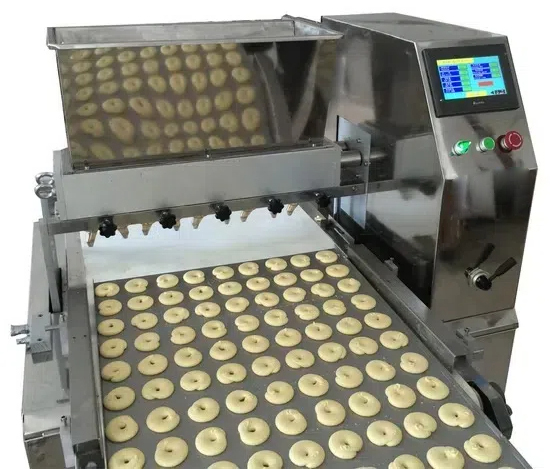
A complete commercial cookie machine setup includes:
- Mixers: High-shear vertical mixers (300–1,000L capacities) with jacketed bowls for temperature control.
- Chillers: Rotary screw chillers maintain dough at 18–22°C for optimal extrusion.
- Forming: Match machine speed to oven capacity (e.g., 150 cookies/minute former → 15m tunnel oven).
- Baking: Multi-zone ovens (gas/electric) with ±2°C temperature control.
- Cooling conveyors: 20–30m spiral chillers reduce cookie temperature to 30°C in 8 minutes.
- Quality control: X-ray scanners detect foreign objects with 0.3mm resolution.
| Machine Type | Initial Cost | Output | Payback Period |
|---|---|---|---|
| Basic depositor | $22,000 | 1,200/hr | 14 months |
| High-speed rotary | $85,000 | 6,000/hr | 11 months |
| Full production line | $350,000 | 15,000/hr | 18 months |
Upgradability: Choose machines with modular designs like the SK Machinery platform.
Trend adaptation:
- Vegan dough compatibility
- Gluten-free batter handling
- Recyclable packaging interfaces
Selecting a commercial cookie machine demands thorough analysis of production targets, dough properties, and operational constraints. By prioritizing flexible, energy-efficient systems with smart controls, bakeries can achieve 20–35% higher margins while maintaining consistent quality. Partner with manufacturers offering comprehensive training and localized spare parts support for maximum uptime.

Properly maintained machines last 12–15 years. Critical components like extrusion nozzles may need replacement every 2–3 years.
Yes. Many manufacturers offer IoT retrofit kits ($3,000–$8,000) adding predictive maintenance alerts and production tracking.
Automated lines need 1 operator per 2 machines vs. 3–4 workers for manual production.
Standard machines ship in 6–8 weeks. Fully customized lines require 14–22 weeks for design and testing.
Most suppliers offer 3–5-year leasing plans with monthly payments starting at $900 for mid-range depositors.
[1] https://yidacateringequipment.com/guide-choose-perfect-cookie-depositor-machine/
[2] https://www.foodsmachine.net/a-news-choosing-the-best-cookie-maker-machine-for-your-factory.html
[3] https://www.bkoversea.com/Selecting-the-Perfect-Cookie-Depositor-A-Comprehensive-Guide-to-Top-Models-and-Their-Benefits-id44968566.html
[4] http://www.biscuitmakingline.com/cookie-production-line.html
[5] https://erikarecord.com/cookie-machines/wire-release/
[6] https://www.youtube.com/watch?v=8XzYmupdpR8
[7] https://www.youtube.com/watch?v=Emu93ey-Ixw
[8] https://www.neweramachines.com/blog/how-to-choose-the-best-cookie-manufacturing-machinery-for-large-scale-baking-operations/
[9] https://www.readingbakery.com/resources/commercial-cookie-production-equipment.html
[10] https://empirebake.com/suprema-cookie-depositors.html
[11] https://www.youtube.com/watch?v=mohakuogSas
[12] https://www.youtube.com/watch?v=qFxy2cREv8k
[13] https://probake.com/equipment/cookie-machines/multidrop-depositors/
[14] https://www.youtube.com/watch?v=WHklSkikT5o
[15] http://www.westmerebakingequipment.com/cookie-depositor-buying-guide
[16] https://en.bralyx.com/blog-bralyx/bralyxpedia/commercial-cookie-depositor/
[17] https://www.readingbakery.com/resources/cookie-manufacturing-production-line-equipment.html
[18] https://www.readingbakery.com/resources/cookie-manufacturing-machines.html
[19] https://www.readingbakery.com/resources/cookie-production-line.html
[20] https://www.youtube.com/watch?v=S1uInHa5c0E
[21] https://www.shutterstock.com/search/cookie-machine
[22] https://www.westmerebakingequipment.com/cookie-depositors
[23] https://www.foodsmachine.net/a-news-the-ultimate-cookie-machine-buying-guide.html
[24] https://www.bakeryequipment.eu/choosing-the-ideal-cookie-depositor
[25] https://sh-mooha.en.made-in-china.com/product/uNcEqXyTgmhQ/China-Commercial-Cookie-Making-Machine-Cookie-Depositor-Machine.html
[26] https://www.gobte.com/5-features-every-top-cookie-production-line-should-have/
[27] http://biscuitmakingline.com/3-3-cookies.html
[28] https://www.papafoodmachine.com/hot-selling/automatic-cookie-machine.html
Abstract In modern biscuit production, the double-layered sheet biscuit production line, with its innovative structure and efficient production process, has become a key piece of equipment for improving production efficiency and product quality. Compared to traditional single-layered biscuits, double-layered sheet biscuits offer a richer and more multi-layered texture, giving consumers new choices in biscuit types. Based on the ideas and concepts of double-layered sheet biscuits, Wenva Machinery, in collaboration with our clients, has incorporated new technologies and ideas into its traditional shortbread and chewy biscuit production line, developing a double-layered sheet biscuit production line. This article aims to introduce in detail the working principle, technical advantages, and significant benefits of the double-layered sheet biscuit production line in terms of product taste, appearance, and packaging efficiency. The article also discusses the equipment's automation control, en
This article discusses common tunnel oven problems encountered in biscuit production, including inconsistent baking, underbaked products, and equipment malfunctions. It provides insights into the causes of these issues and offers practical solutions to avoid them. Best practices for tunnel oven operation, such as regular training and maintenance, are also highlighted to ensure efficient and high-quality biscuit production.
In industrial baking production, the tunnel oven length and its temperature zone structure are key technical factors that determine baking quality. A properly designed oven length directly affects the product’s residence time inside the oven, while multi-zone temperature control ensures stable heat distribution and proper product structure formation. Based on tunnel oven operating principles, this article systematically analyzes the relationship between oven length and baking time, the mechanisms of multi-zone temperature control, and the suitability of different tunnel oven structures for various baked products, providing technical guidance for food factories seeking to optimize baking quality.
This article explores custom tunnel oven solutions for biscuit and snack manufacturers, highlighting their efficiency, quality consistency, and flexibility. It discusses the functionality, benefits, and key features of tunnel ovens, as well as their applications in various snack production. The article concludes with guidance on selecting the right oven and answers to common questions.
Choosing the right tunnel oven for biscuit production is a strategic decision that affects capacity utilization, factory layout efficiency, and long-term return on investment. This article explains how to select an industrial baking oven by analyzing the relationship between capacity and oven length, factory layout considerations, and the balance between initial investment and long-term ROI.
The heating system is a critical component of an industrial tunnel oven, directly affecting baking performance, energy efficiency, and operating costs. This article explains how gas and electric tunnel oven heating systems work, compares their energy consumption and maintenance requirements, and analyzes their suitability in different countries and regions, helping manufacturers choose the right tunnel oven solution.
A tunnel oven plays a critical role in modern biscuit production by enabling continuous and stable baking. This article explains how a biscuit tunnel oven works, focusing on its continuous baking principle, temperature zone design, heat transfer methods, and process advantages. It also introduces Wenva Machine’s tunnel oven solutions for industrial biscuit production lines.
This article explores global pretzel biscuit market trends, consumer demand drivers, OEM and private label opportunities, and key considerations for building pretzel biscuit production lines, helping snack manufacturers evaluate market entry and long-term growth strategies.
This article compares automatic pretzel biscuit machines and semi-automatic biscuit machines in terms of labor cost, efficiency, and ROI. It helps startup and established factories choose the right equipment based on production scale, budget, and long-term profitability.
This article explains gas, electric, and diesel tunnel ovens for pretzel biscuits, comparing energy consumption, maintenance, and suitable markets. It highlights why customizable oven length is essential for stable baking, consistent color, and efficient pretzel biscuit production.
This article explains how to choose the right pretzel biscuit production line by analyzing capacity, factory layout, equipment configuration, and ROI. It helps manufacturers select a pretzel biscuit making machine that delivers stable production and long-term profitability.
This article explains how a pretzel biscuit machine works by detailing the complete pretzel biscuit production process, including mixing, forming, alkaline dipping, baking, and cooling. It helps manufacturers understand equipment functions and achieve stable, industrial-scale pretzel biscuit production.
This article explains how to choose the right pretzel biscuit production line by analyzing equipment configuration, automation level, and ROI. It helps manufacturers match production capacity, reduce labor costs, and achieve stable, long-term profitability in pretzel biscuit manufacturing.
Uniform coloring in pretzel biscuits is not achieved by adjusting a single parameter. It is the result of a **well-coordinated system** that includes the alkaline solution tank, press rollers, idler rollers, conveyor belts, and baking oven.By investing in a properly engineered alkaline dipping system, manufacturers can eliminate color inconsistency, stabilize product quality, and enhance the market competitiveness of their pretzel biscuits.
Producing Danish butter cookies at scale is a system challenge rather than a recipe issue. This article analyzes three critical production stages—mixing stability, forming precision, and baking control—using a problem-to-solution approach. It explains why high-butter cookies demand specialized equipment and coordinated process design to achieve consistent appearance, texture, and long-term production stability.
This article provides a comprehensive analysis of industrial double-layer biscuit production lines, covering process flow, key equipment functions, and selection principles. It also compares integrated and modular solution approaches and offers guidance for manufacturers at different development stages, supporting stable and efficient production planning.
Building a successful biscuit factory in Africa requires more than identifying market demand or installing modern equipment. Long-term success depends on the ability of the factory to operate continuously, reliably, and efficiently under local conditions. From a biscuit production line manufacturer’s perspective, sustainable operation is the cornerstone of profitability, product consistency, and competitive strength.This article outlines key considerations for achieving sustainable biscuit production in African markets. It begins by emphasizing the importance of understanding local operating environments, including climate conditions, energy structures, and production rhythms. These factors directly influence production line design and long-term stability.The article highlights the strategic importance of the first production line, noting that a stable and well-planned starting point allows manufacturers to establish reliable operations and quality control systems.
Soda biscuit forming is not the result of trial and error, but a repeatable and controllable scientific process.When temperature, moisture, and rolling control operate as a closed loop, forming stability becomes a built-in capability of the production line.Choosing an industrial biscuit production equipment manufacturer with a deep understanding of processing science ensures not only reliable machinery, but also long-term consistency, efficiency, and product quality.
This article explains common quality defects in butter cookie production and the mechanisms behind them. It provides practical guidance on dough preparation, depositing control, and baking conditions, along with equipment and process adjustments that improve uniformity and stability.
In industrial butter cookie production, achieving the signature “buttery, crisp, melt-in-mouth” texture depends not only on the recipe but on two critical technical pillars: **precise temperature control** and **proper fat management**. High-fat dough is extremely sensitive to temperature changes; e